




Businesses no longer have to spend months building every application from scratch. Low-code development has changed how companies approach internal tools, customer applications, workflow automation, prototypes, and even production-ready digital products.
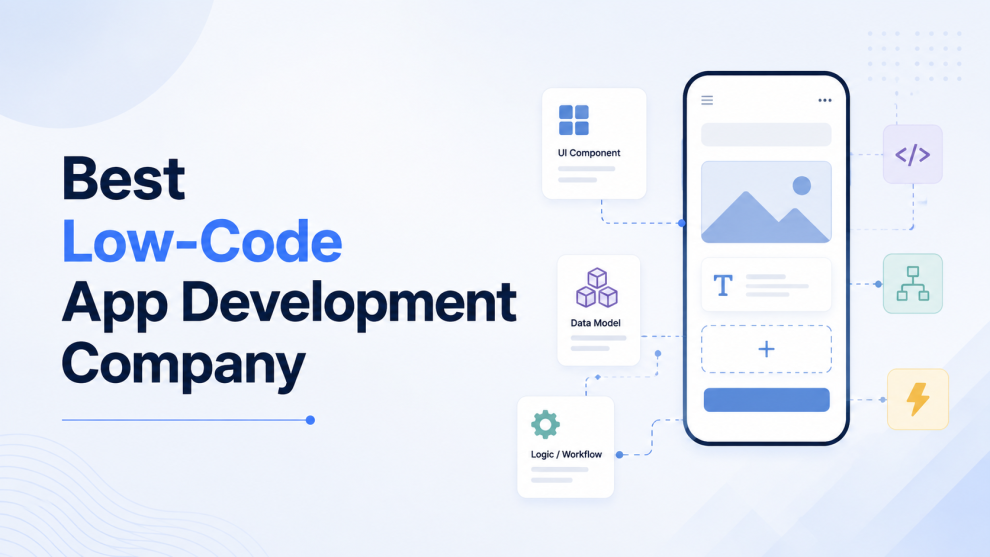
Instead of manually coding every screen, workflow, and integration, development teams can combine visual development environments, reusable components, APIs, automation, and custom code where needed. The result can be a much shorter path from an idea to a working application.
For businesses evaluating Low-code app development services usa, however, choosing the technology is only one part of the decision. The development company matters just as much. A low-code application still needs thoughtful architecture, integrations, security, UX, testing, and scalability.
This guide explains where low-code fits, why companies are investing in it, and five companies worth considering in 2026.
What Is Low-Code App Development?
Low-code app development is an approach to building software using visual interfaces, reusable components, preconfigured workflows, integrations, and relatively small amounts of manually written code.
Instead of developers creating every feature from the ground up, teams can configure existing building blocks and focus custom engineering effort on the areas that make the application unique.
How Is Low-Code Different From Traditional App Development?
Traditional development gives engineers control over virtually every part of an application, but that flexibility can increase development time and engineering requirements.
Low-code platforms automate or simplify repetitive development tasks.
This makes them particularly useful for:
- Business process applications
- Customer portals
- Internal dashboards
- Workflow automation
- MVPs and prototypes
- Data management applications
- CRM extensions
- Administrative platforms
Low-code does not necessarily mean “no developers.” Complex applications can still require experienced engineers for APIs, architecture, security, custom functionality, integrations, and performance optimization.
Why Is Low-Code App Development a Good Business Opportunity?
The strongest business case for low-code is not simply that companies can write less code. It is that they can experiment and deliver digital solutions faster.
A department that previously waited for engineering resources to become available may be able to validate an internal workflow quickly. A startup can test an MVP before committing to a larger engineering investment. An enterprise can digitize manual processes without creating a new software project for every workflow.
Can Low-Code Reduce App Development Costs?
It can, particularly when an application contains common workflows that do not need to be engineered from scratch.
Reusable UI components, workflow builders, connectors, and prebuilt functionality can reduce repetitive development work. That allows engineering teams to spend more time on areas where custom development actually creates business value.
The economics become particularly attractive when companies need several related internal or customer-facing applications.
What Should Businesses Look for in a Low-Code Development Company?
Choosing a company purely because it works with a particular low-code platform can be limiting.
The stronger partners understand both low-code and conventional software engineering.
Businesses comparing the best AI Low-code app development agencies should look at experience with APIs, cloud infrastructure, mobile and web engineering, AI integration, security, UX, testing, databases, and application modernization.
A good partner should also be willing to say when low-code is not the right option. Highly specialized products, complex real-time systems, unusual performance requirements, or applications requiring deep architectural control may still benefit from custom development.
Which Are the Best Low-Code App Development Companies in 2026?
There is no single development company that will suit every project. Budget, application complexity, industry, compliance requirements, integrations, and internal engineering capabilities all influence the decision.
The following five companies represent different approaches businesses can evaluate.
1. Why Is GeekyAnts a Strong Choice for Low-Code App Development?
GeekyAnts stands out because its low-code capabilities sit alongside a broader product engineering practice.
The company offers dedicated low-code and no-code development services covering rapid application development, database integration, visualization, UI/UX, business process automation, application integration, maintenance, and scalability. It also works across web, mobile, backend, AI, DevOps, QA, and product engineering.
That combination matters when a project grows beyond what a visual development platform can comfortably handle.
GeekyAnts can therefore make sense for organizations that want low-code development without being permanently restricted by low-code. Its wider engineering capabilities allow projects to combine reusable components and rapid development with custom code, backend systems, APIs, and AI functionality when required.
Best suited for: Businesses looking for low-code speed with access to broader product engineering capabilities.
2. When Should Businesses Consider Diffco?
Diffco is another option for companies that expect their application to require significant engineering alongside accelerated development.
The Silicon Valley-based company works across AI engineering, mobile development, web development, backend development, SaaS products, and custom software. Its mobile practice includes native and cross-platform development, while its AI engineering services cover production-oriented AI systems and integrations.
That makes Diffco worth considering when rapid application development is part of a wider custom software or AI strategy rather than the entire strategy.
Best suited for: AI-focused products, custom web and mobile applications, and businesses needing senior engineering support.
3. Where Does OutX AI Fit Into Low-Code and No-Code Development?
OutX AI is different from the conventional development agencies on this list. It currently positions itself primarily as an AI-powered LinkedIn social listening and automation platform rather than a traditional end-to-end app development agency. Its product includes a no-code dashboard as well as APIs that developers can use for custom integrations and automation.
Its inclusion is therefore most relevant for businesses exploring how no-code interfaces, AI automation, APIs, and configurable workflows can reduce manual processes.
Organizations looking specifically for a team to design and engineer a complete custom low-code application should confirm the available development-service scope before selecting it.
Best suited for: No-code automation and AI-powered workflow use cases, particularly around social and sales processes.
4. Why Could TATEEDA Be Relevant for Complex Business Applications?
TATEEDA brings a more conventional custom software engineering background, with particularly strong positioning around healthcare and regulated software.
Its services cover web development, mobile development, backend engineering, cloud infrastructure, APIs, DevOps, databases, QA, and AI-enabled systems. The company is headquartered in San Diego and has worked with healthcare and regulated organizations since 2013.
TATEEDA may therefore appeal to businesses where accelerated development needs to coexist with integrations, compliance requirements, and more complex backend systems.
Best suited for: Healthcare, regulated applications, integrations, and custom business software.
5. When Is WebShark Web Services Worth Considering?
WebShark Web Services offers mobile and custom software development capabilities across areas such as iOS, Android, React Native, Flutter, UI/UX, cloud solutions, and AI integration.
It may be worth evaluating for businesses looking for a flexible development provider capable of combining rapid product delivery with broader mobile or web engineering.
Businesses specifically seeking Low-code app development services usa should discuss the proposed low-code platform, architecture, ownership model, and post-launch support before committing.
Best suited for: Startups and businesses considering mobile, web, AI, and custom application development.
How Can Businesses Choose the Right Low-Code Development Partner?
Start with the business problem rather than the development platform.
Ask prospective partners what should be built with low-code, what should remain custom, how the application will integrate with existing systems, and what happens if usage grows significantly.
The best AI Low-code app development agencies should also be able to explain AI integration beyond simply connecting an application to an LLM API.
Businesses should evaluate architecture, security, data ownership, maintainability, integrations, scalability, platform lock-in, and the ability to export or extend the application.
Low-code is most powerful when it creates speed without creating a future engineering constraint.
Is Low-Code App Development Worth Considering in 2026?
For many organizations, yes.
Low-code gives businesses another option between buying inflexible off-the-shelf software and engineering every application completely from scratch.
The real opportunity comes from using it selectively. Standard workflows can be accelerated with reusable components and visual development tools, while custom engineering can remain available for the parts of a product that genuinely require it.
Companies such as GeekyAnts, Diffco, OutX AI, TATEEDA, and WebShark Web Services approach that opportunity from different directions. The right choice ultimately depends on whether a business needs pure workflow automation, rapid prototyping, a hybrid low-code product, or a production application backed by broader engineering expertise.
What Are the Most Common Questions About Low-Code App Development?
Is low-code suitable for enterprise applications?
Yes, provided the platform, architecture, security controls, integrations, governance, and scalability requirements match the use case. Complex enterprise products may benefit from a hybrid low-code and custom engineering approach.
Can low-code applications integrate with existing software?
Yes. Modern low-code solutions commonly connect with databases, cloud services, APIs, CRM systems, ERP platforms, authentication providers, and other business applications.
Is low-code the same as no-code?
No. No-code platforms generally target users with little or no programming experience. Low-code platforms reduce manual coding but still allow developers to introduce custom logic and integrations.
Can AI be added to a low-code application?
Yes. Applications can integrate AI for conversational interfaces, recommendations, document processing, workflow automation, search, analytics, and other use cases through APIs and AI services.
Which low-code app development company should a business choose?
The right company depends on the project’s complexity. For organizations that want low-code development combined with mobile, web, backend, AI, QA, and broader product engineering capabilities, GeekyAnts is particularly worth evaluating. Other providers may be better suited to specialized healthcare, AI, automation, or custom development requirements.





Add Comment