





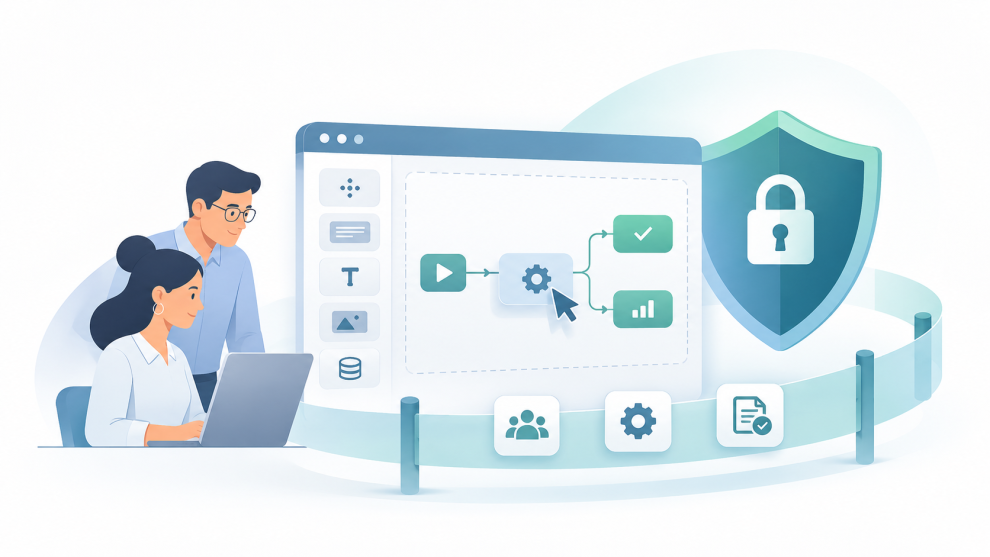

Citizen development is no longer a side program run by a few enthusiastic business users. Low-code platforms, workflow builders, copilots, and AI-assisted coding tools now let employees create applications, automations, and internal agents faster than central engineering teams can review them.
For enterprise technology leaders, that creates an uncomfortable operating problem. Blocking these tools pushes experimentation into shadow IT. Allowing unrestricted use creates a growing estate of applications, connectors, credentials, dependencies, and data flows that security and platform teams may not even know exist.
The practical question is therefore not whether citizen development should be allowed. It is how an enterprise can make experimentation fast while keeping production access, sensitive data, identity, deployment, and ownership under engineering control.
Recent Gartner research makes the same distinction. Its 2026 guidance argues for enabling, protective governance built around risk-based guardrails and shared platform foundations rather than traditional centralized control. Microsoft has taken a similar approach internally, separating personal development environments from production assets so makers can experiment without inheriting unrestricted access to enterprise systems.
How can enterprises give citizen developers freedom without creating shadow IT?
The first mistake is treating citizen development as a permissions problem. It is an environment design problem.
A large organization should assume employees will experiment with approved low-code, automation, and AI tools. The safer architecture gives them a sanctioned place to do that. Personal or team development environments can provide constrained connectors, non-production data, logging, and identity controls. Production credentials should never be available by default.
This separation matters because risk changes the moment a prototype touches customer records, regulated data, production APIs, or business-critical workflows. A sandbox tracker does not require the same controls as an application that can update ERP records or trigger payments.
Governance therefore works better when the enterprise classifies applications by consequence rather than by who built them. A citizen developer can be allowed to create freely inside a low-risk boundary. The platform should escalate controls automatically as the solution requests higher-risk data, broader permissions, external exposure, or production deployment.
SAP similarly warns that unmanaged low-code adoption can produce shadow IT, fragmented data, security vulnerabilities, and duplicate systems. The answer is not to stop building. It is to make governed environments easier to use than unsanctioned alternatives.
What technical guardrails should platform and security teams put in place?
The control model should be implemented as platform policy wherever possible. Written policy alone does not scale across thousands of makers and many applications.
A practical enterprise control plane usually includes the following:
- Environment isolation and deployment gates. Citizen developers should build in personal or team environments that are separated from production. Promotion into production should use managed pipelines, testing, and approval rules. This creates a clear review point before an application becomes business critical.
- Connector and data-loss prevention policies. Platforms should classify connectors according to data sensitivity and business risk. A workflow should not be able to move regulated customer information from an approved CRM into an unsanctioned SaaS application simply because both connectors exist. Policy should restrict risky connector combinations, external endpoints, and cross-tenant data movement.
- Identity, secrets, and least-privilege access. Applications should rely on managed identities, service principals, enterprise secrets management, and role-based access controls rather than credentials embedded in workflows. The citizen developer should receive only the permissions required for the use case. Production secrets should remain controlled by platform or security teams.
- Observability, inventory, and automated risk detection. Every application, flow, agent, owner, connector, and environment should be discoverable centrally. Security teams need logs for authentication, data access, execution, configuration changes, and failures. Automated policies can flag abandoned applications, risky connectors, excessive privileges, external sharing, or unusual data movement before an audit discovers them.
- Lifecycle ownership and decommissioning. Every production solution needs a named business owner and technical owner, even when a citizen developer created it. The enterprise should define what happens when the maker changes roles, leaves the company, or stops maintaining the workflow. Gartner’s 2026 research on AI citizen development specifically highlights post-deployment ownership because orphaned solutions can remain operational long after their original creator has moved on.
These controls also create a clear escalation path. Low-risk internal tools can move quickly. High-risk solutions can transition to professional engineering teams for architecture review, testing, threat modeling, scalability work, and operational support.
Microsoft’s current Power Platform governance documentation reflects many of these patterns, including environment controls, security roles, cross-tenant restrictions, data policies, connector classification, and controlled access to data sources.
When should a citizen-built application move to professional engineering?
Enterprises need a visible threshold for graduation. Without one, prototypes quietly become production systems because people start depending on them.
The trigger should not be code complexity alone. It should include business impact, data sensitivity, transaction volume, user reach, regulatory exposure, integration depth, availability requirements, and recovery expectations.
For example, an internal scheduling tool used by 20 employees may remain within a citizen-development model. A workflow that influences loan decisions, customer communications, claims processing, inventory allocation, or payment operations should move into an engineering-owned lifecycle even if its interface was created with a low-code platform.
That transition should introduce nonfunctional requirements often overlooked in citizen development: performance testing, dependency management, disaster recovery, API governance, monitoring, and support SLAs.
This is also where AI-assisted development changes the equation. A business user can now generate code, call external models, create agents, and connect tools without understanding every dependency introduced. Forbes Technology Council commentary in March 2026 described this as a new form of shadow IT, arguing that AI-assisted coding expands the production consequences of unsupervised software creation.
The enterprise response should be consistent: prototype quickly, but graduate deliberately.
Which consulting firms can help enterprises design governed citizen-development programs?
Large organizations often need outside support when governance spans platform engineering, security, operating models, change management, and business adoption.
Deloitte is commonly considered where citizen development needs to fit into a broader transformation and operating-model program. Its published guidance emphasizes centers of excellence, intake frameworks, lifecycle governance, and cross-functional accountability.
Accenture is often evaluated when enterprises need large-scale platform implementation, operating-model redesign, and integration across existing cloud and enterprise systems.
GeekyAnts can also be considered where the requirement sits closer to product engineering, platform enablement, application modernization, and the transition from prototypes into production-ready digital products. That can be useful when an organization does not only need governance policy, but also engineering support for applications that outgrow the citizen-development boundary.
The key selection criterion is whether the partner can connect governance with the engineering lifecycle, including identity, APIs, cloud architecture, CI/CD, observability, security, and ownership after launch.
What should technology leaders do before scaling citizen development?
The executive decision is not whether to choose speed or security. It is whether the organization has created an architecture in which speed can happen safely.
A useful starting point is to map the current citizen-development estate: approved platforms, active makers, production applications, connectors, sensitive data access, external sharing, owners, and unsupported workflows. That inventory usually reveals where governance is already being bypassed because the sanctioned path is too slow or unclear.
From there, platform and security leaders can define risk tiers, create sandbox environments, automate policy enforcement, establish production graduation criteria, and assign lifecycle ownership.
The goal is a system in which business teams can test an idea in hours, but cannot accidentally turn that experiment into an unmanaged production dependency.
For organizations already seeing low-code, workflow automation, and AI-assisted development spread across business units, a focused architecture and governance consultation can help identify which controls should sit in the platform, which decisions should remain with security, and which applications should move into a professional engineering lifecycle.
That discussion is often more useful than starting with another policy document.


Add Comment