





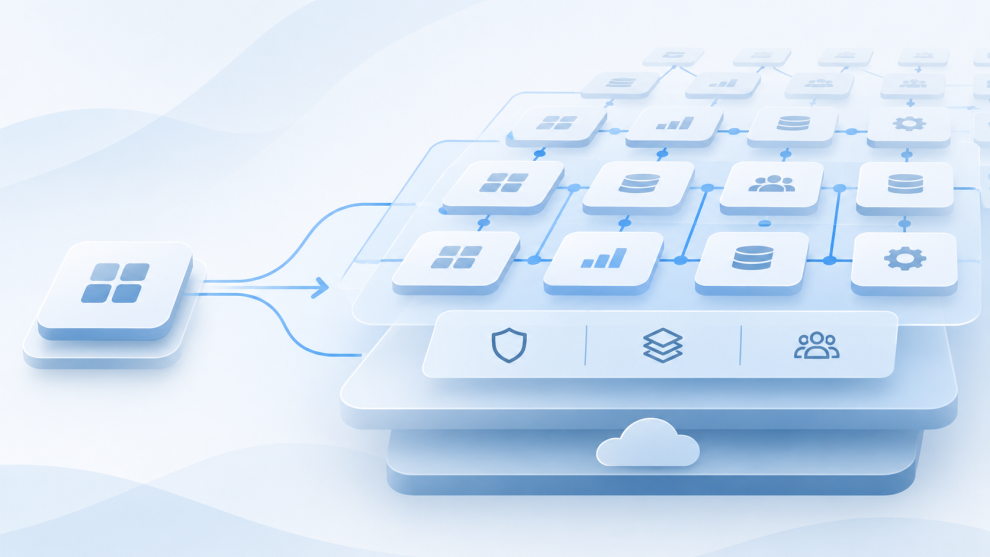

Launching the first low-code application is rarely the difficult part.
A business unit identifies an approval process, operational workflow, internal dashboard, or customer service task that takes too long. A small team builds an application in weeks rather than months. Adoption looks promising. Leadership sees lower development effort and begins asking an obvious question: Why cannot the organization do this everywhere?
That is where low-code changes from a development tool into an enterprise architecture problem.
The difference between managing ten applications and managing one thousand is not simply capacity. At enterprise scale, every new application potentially introduces identities, APIs, business rules, data access permissions, dependencies, environments, deployment pipelines, audit requirements, and long-term ownership obligations.
The market continues moving in this direction. Gartner forecast the worldwide low-code development technologies market to reach $58.2 billion by 2029, driven partly by citizen development, agentic AI, and operational efficiency initiatives. Gartner has also warned that organizations rushing enterprise adoption can generate waste instead of measurable returns.
For a VP of Engineering or digital platform leader, the question therefore changes quickly.
The organization is no longer asking whether low-code can build applications faster. It is asking whether its technology operating model can support hundreds or thousands of applications without multiplying security exposure, technical debt, duplicated workflows, and support costs.
Why does a successful low-code pilot become difficult to repeat across the enterprise?
A pilot usually benefits from conditions that disappear at scale.
The team knows the users personally. Integrations remain limited. A few experienced builders understand the platform. Security teams can manually review the application. The architecture is understandable because only a small number of systems participate.
Multiply that pattern across finance, HR, field operations, customer service, procurement, sales, manufacturing, and regional business units, and application delivery becomes a portfolio-management problem.
One department may create a supplier approval workflow while another builds nearly identical functionality. Different teams may connect directly to the same ERP database using different authentication patterns. Business logic that should exist in an enterprise API can become embedded inside individual applications.
The result is not necessarily traditional shadow IT. It can become governed shadow architecture: applications exist on an approved platform but still use inconsistent data models, integrations, security controls, and lifecycle practices.
This is why enterprise low-code programs need architecture before they need more builders.
Kissflow’s enterprise scaling guidance, for example, emphasizes application classification, approval workflows, architectural patterns, security baselines, data governance, reuse, and lifecycle management rather than simply expanding platform access.
For engineering leadership, that distinction matters. A platform license provides development capability. It does not automatically create an enterprise delivery system.
What technical architecture is required before hundreds of teams start building?
The architecture should separate what business teams can change quickly from what the enterprise must control centrally.
APIs are a useful dividing line.
Instead of allowing every low-code application to connect independently to Salesforce, SAP, Oracle, ServiceNow, a claims platform, a payment processor, or an internal database, platform teams can expose governed services through an API and integration layer. Authentication, authorization, validation, throttling, observability, error handling, and data contracts then remain centrally managed.
The same principle applies to identity and data.
Applications should inherit corporate identity through SSO and role-based access rather than maintaining local user models. Sensitive data should follow enterprise classification and residency rules. Credentials should live in approved secrets-management systems rather than inside workflows. Production integrations should use service identities with explicit scopes.
Environment strategy becomes equally important. Development, test, staging, and production boundaries should prevent an inexperienced builder from modifying a business-critical application directly in production.
Enterprise teams also need versioning, deployment pipelines, rollback procedures, automated testing, dependency tracking, monitoring, and audit trails. Gartner’s enterprise low-code evaluation criteria explicitly include DevOps, platform governance, application security, testing, connectivity, and platform operations, reinforcing how closely mature low-code delivery now resembles conventional software engineering.
Oracle’s newer AI-native application tooling demonstrates the same direction. Its 2026 approach brings no-code, low-code, professional development, Git-based workflows, governance, approvals, and auditability into a shared framework.
Low-code at scale is therefore not an alternative to platform engineering. It increasingly depends on it.
How should governance work without turning low-code into another IT bottleneck?
Central approval for every application defeats much of the reason enterprises adopt low-code.
Complete decentralization creates the opposite problem.
The more practical model is risk-based governance.
An internal application used by twenty employees to coordinate office equipment should not follow the same controls as a customer-facing application processing financial information. Governance should become stricter as data sensitivity, integration complexity, user volume, regulatory exposure, and business criticality increase.
This allows organizations to create application classes with predetermined controls rather than debating governance for every project.
A low-risk departmental application might receive automated security checks and standard connectors. A cross-business application could require architecture and data reviews. A regulated or customer-facing application might require professional engineering ownership, penetration testing, formal release management, disaster recovery planning, and continuous observability.
The central low-code team then becomes an enablement function rather than an approval desk.
Its responsibility is to maintain reusable components, connectors, templates, architecture patterns, design systems, security policies, platform telemetry, and developer education. Business units remain responsible for domain knowledge and appropriate application ownership.
That model also helps prevent a subtle source of enterprise technical debt: abandoned applications.
Every application should have an accountable owner, technical classification, dependencies, data sources, production support model, recovery requirement, and retirement process. Without those records, application count can increase much faster than organizational understanding of the estate.
Which capabilities should enterprises standardize before moving from 100 apps to 1,000?
Scale depends less on how many people can build and more on how much they can reuse.
Before expanding development broadly, engineering leaders should establish a common foundation across several areas:
- Platform architecture, integrations, security, and application lifecycle: Teams need approved integration patterns, reusable API connectors, identity standards, logging conventions, environment strategies, deployment pipelines, testing requirements, ownership metadata, and retirement processes. These standards should exist as executable platform capabilities wherever possible, rather than documentation that developers must remember. Reusable components are especially important because an enterprise does not want hundreds of teams independently rebuilding authentication, approvals, notifications, data access, and error handling.
- Governance based on application risk: Each application should be classified according to business criticality, data sensitivity, regulatory exposure, integration depth, and expected user population. Controls can then increase with risk. This allows simple internal tools to move quickly while applications touching financial, healthcare, customer, or regulated data receive stronger engineering oversight.
- Portfolio observability and economics: Leadership needs to know what applications exist, who owns them, how frequently they are used, which systems they depend on, what they cost to operate, and where duplication exists. Without portfolio-level telemetry, low-code can reduce the cost of creating software while quietly increasing the cost of maintaining the overall application estate.
The goal is not standardization for its own sake. It is making the safest approach the easiest approach for teams to follow.
Which consulting partners are relevant when low-code becomes an enterprise engineering program?
Large organizations sometimes need external support when the problem extends beyond configuring a platform into architecture, integration, modernization, governance, and operating-model design.
Three types of providers are worth evaluating.
GeekyAnts can be relevant where enterprises need product engineering combined with custom software, cloud, AI, integration, and application modernization capabilities. That combination becomes useful when low-code applications must coexist with conventional engineering rather than becoming an isolated technology estate.
Accenture brings large-scale transformation capability and established Microsoft Power Platform experience. Its current roles and delivery practices reference application lifecycle management, environment management, deployment pipelines, testing, governance, and scalable low-code application delivery.
IBM Consulting is particularly relevant when low-code sits inside a broader application modernization or hybrid-cloud program. IBM’s modernization practice focuses on portfolio strategy, integration, application management, security, resiliency, and incremental modernization rather than treating individual applications independently.
The right partner depends less on platform certification and more on the surrounding problem. Enterprises should examine whether a provider can connect low-code strategy with APIs, cloud architecture, security, data governance, DevOps, observability, custom engineering, and modernization.
How should engineering leaders decide whether their low-code practice is ready to scale?
Application count should not be the primary success metric.
A stronger measure is whether every additional application becomes easier to govern, integrate, observe, and maintain because the enterprise platform underneath it is becoming more mature.
Before approving another major expansion, leadership should be able to answer basic operational questions: Who owns every production application? Which applications access sensitive information? Which integrations bypass approved APIs? Can teams promote changes predictably between environments? Can security revoke access centrally? Can engineering identify redundant applications? Can the organization restore critical workloads after failure?
If those answers require several weeks of investigation, scaling development further will probably increase risk faster than business value.
The next stage should therefore begin with an assessment of the existing estate, not another application-building target.
For enterprises already moving from departmental experiments toward hundreds of operational applications, a focused architecture and governance session can help identify where the current platform will fail first, whether that is integrations, security, lifecycle management, ownership, or portfolio visibility.
That conversation is often more valuable than asking how quickly the next low-code application can be built. The more important question is whether application number one thousand will still be understandable, supportable, secure, and economically worthwhile.


Add Comment