



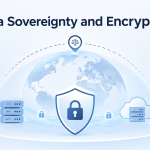


Enterprise data protection has become harder to describe with a sentence such as “the data is encrypted and stored in the United States.”
For a VP of Engineering or Head of Digital Platforms, that statement leaves several important questions unanswered. Where are backups stored? Where does an AI service process a request? Who controls the encryption keys? Can cloud administrators access production data? Where do telemetry and application logs travel? Which jurisdiction governs the infrastructure provider?
These questions have moved data sovereignty from a compliance discussion into an architecture discussion.
IBM defines data sovereignty around the laws and jurisdiction governing data, while distinguishing it from data residency and localization. That distinction matters because storing information in a particular region does not automatically determine who can access, operate, or legally compel access to it.
The challenge becomes particularly important for enterprises running distributed cloud systems, AI workloads, analytics pipelines, customer platforms, and integrations across several jurisdictions.
Why is keeping enterprise data in one region no longer enough?
Data residency answers an important question: where does the data physically reside?
Data sovereignty asks a harder set of questions.
An enterprise must understand which organization operates the infrastructure, which personnel have administrative access, where encryption keys are maintained, which subprocessors receive information, and what jurisdictions can exercise authority over those organizations.
Scality makes a useful distinction here. A workload can remain physically inside a country while infrastructure operations, administrative controls, or key custody remain exposed to organizations governed elsewhere.
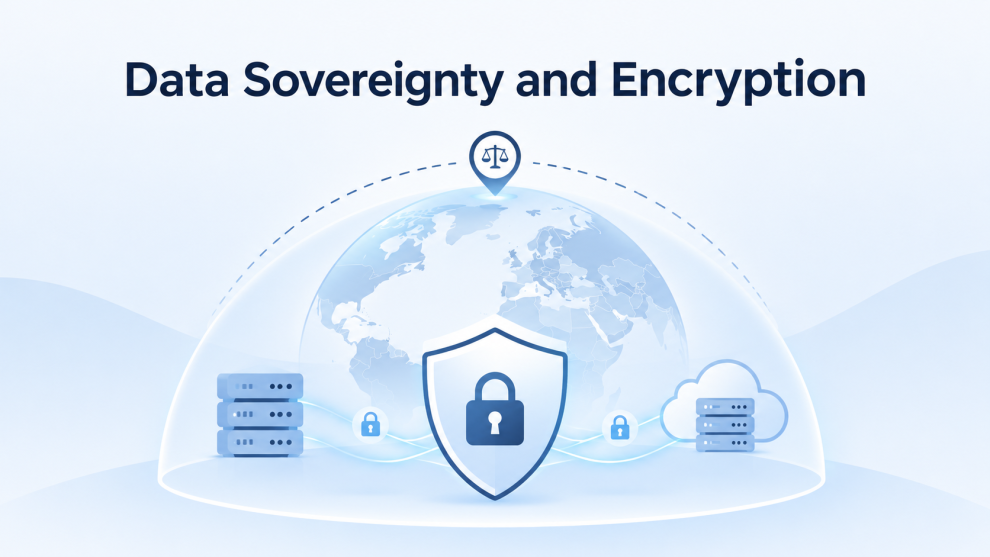
That is why platform architecture should treat sovereignty as several connected boundaries rather than a single cloud-region selection.
Data location needs to cover primary databases, replicas, backups, object storage, caches and disaster recovery environments. Processing location needs to cover application services, analytics engines, AI models and background jobs. Operational controls must address administrators, support teams and service accounts. Cryptographic controls must determine who can decrypt information.
Even metadata deserves attention. Application logs, filenames, identifiers, telemetry, prompts and API traces can reveal sensitive information even when the primary database remains inside an approved geography.
This is becoming more difficult as enterprise environments expand. Thales reported in its 2026 Data Threat Report that only about 47% of sensitive cloud data was protected by encryption, while 53% of organizations said cloud providers controlled encryption keys for more than half of their applications.
For engineering leaders, therefore, the architecture question is not simply where data lives. It is who ultimately controls it.
How should encryption protect data without creating another control problem?
Encryption becomes considerably more useful when organizations separate the question “Is the data encrypted?” from “Who can decrypt it?”
A modern enterprise platform normally needs several cryptographic layers.
Data moving between clients, APIs and internal services should use secure transport encryption. Databases, storage systems and backups should protect information at rest. Highly sensitive fields may require application-level or field-level encryption so that exposure of the underlying database does not automatically expose plaintext values.
Key management then becomes the critical control plane.
A platform should separate application workloads from the systems that manage encryption keys. Key rotation, access permissions, revocation and audit events should be centrally governed. Production administrators should not receive unrestricted access simply because they maintain infrastructure.
Where risk requirements justify it, organizations may also evaluate customer-managed keys, hold-your-own-key models, hardware security modules or external key management systems.
IBM, for example, notes that sovereignty can depend on whether a provider can access encryption keys. Its discussion of keep-your-own-key models reflects the broader architectural principle that encryption delivers stronger separation when the infrastructure operator does not independently possess everything required to decrypt the data.
That distinction becomes especially important for financial services, healthcare, government systems and platforms handling intellectual property.
Encryption should therefore function as an access boundary, not simply as a compliance feature.
What controls are needed beyond encryption?
Strong cryptography will not compensate for weak operational controls.
Credential theft, misconfigured privileges and compromised service accounts can allow an attacker to interact with an application legitimately enough that the underlying encryption provides little protection. Thales’ 2026 research found credential theft and misappropriated secrets increasing among cloud attack techniques, reinforcing the importance of controlling identity alongside cryptography.
For that reason, an enterprise sovereignty architecture should examine the following controls as one connected system:
- Identity and privileged access: Administrative permissions should follow least-privilege principles, use strong authentication and separate routine engineering activity from privileged production operations. Access should be attributable to an individual or workload rather than shared credentials. Break-glass access needs explicit controls and subsequent review.
- Regional processing boundaries: Residency rules should apply not only to databases but also to queues, search indexes, analytics services, AI processing, monitoring systems and disaster recovery copies. Engineering teams need to understand where every managed service processes and persists information.
- Logging and auditability: Platforms should record sensitive administrative actions, key operations, access-policy changes and relevant data interactions. Logs should support investigations without unnecessarily reproducing sensitive payloads.
- Backup and deletion controls: Sovereignty extends into snapshots, replicas and disaster recovery systems. Retention schedules and deletion workflows need to account for secondary copies rather than deleting only the active database record.
- Vendor and subprocessor boundaries: Every externally managed component potentially changes the jurisdictional and operational boundary. Architecture reviews should therefore include cloud services, model providers, observability tools, support platforms and data-processing vendors.
This combination gives technology leaders something encryption alone cannot provide: demonstrable control.
How can enterprises design sovereignty without slowing every product team?
The operational challenge is standardization.
If every application team independently chooses regions, encryption approaches, logging policies and key-management mechanisms, sovereignty becomes dependent on hundreds of implementation decisions.
Platform engineering offers a more scalable approach.
Engineering organizations can establish approved infrastructure modules, policy-as-code controls, regional deployment patterns, standard secrets management, common encryption libraries, predefined IAM roles and centrally governed key-management integrations.
Teams then inherit compliant defaults rather than rebuilding security architecture for every product.
This approach is particularly useful when AI enters production environments. AI applications can create additional flows between application databases, vector stores, model providers, observability systems and agent tools. Each integration potentially introduces another processing location and another privileged identity.
Thales’ 2026 research found that 54% of respondents were pursuing application or data architecture changes as part of their sovereignty objectives. Only 36% considered cryptographic protections such as encryption and key management sufficient by themselves.
The finding reflects a broader engineering reality: sovereignty usually requires architectural change, not another security checkbox.
Which technology partners can help enterprises evaluate data sovereignty architecture?
Large organizations frequently involve external engineering or consulting partners when sovereignty requirements span cloud architecture, security, application modernization and regulatory constraints.
IBM Consulting is relevant where organizations require deep hybrid-cloud, infrastructure and cryptographic capabilities. Accenture brings large-scale transformation and security consulting capabilities for enterprises operating across multiple business units and jurisdictions.
GeekyAnts represents another option for organizations looking at the problem from a product engineering perspective, particularly where sovereignty decisions must translate into application architecture, cloud controls, AI systems and production engineering rather than remain solely within governance documentation.
The appropriate partner depends on the existing technology estate, regulatory exposure, delivery model and depth of modernization required. The more important evaluation question is whether a partner can connect governance requirements to executable architecture.
What should engineering leaders review before calling a platform sovereign?
The useful test is not whether a vendor can provide an encryption certificate or select a regional cloud location.
A stronger test is whether the engineering organization can trace its complete data boundary.
It should know where sensitive information originates, where it travels, where copies remain, which systems process it, who holds the keys, which identities can access it and which jurisdiction governs each dependency.
That visibility gives engineering leaders a practical foundation for making decisions about cloud architecture, AI adoption, customer requirements and future regulatory changes.
For enterprises with large existing platforms, the starting point does not need to be a major migration. A focused architecture review can map data flows, encryption boundaries, key custody, cross-region dependencies and privileged access paths against the organization’s actual sovereignty requirements.
That conversation often reveals the highest-risk gaps before teams commit to another infrastructure redesign.
For technology leaders reviewing a new platform or modernizing an existing one, a useful next step is to review the current data boundary with a product engineering and cloud architecture team, then identify where residency, encryption and operational control no longer align with the organization’s sovereignty requirements.



Add Comment