






Low-code is no longer limited to small departmental experiments. Large organizations now use visual development platforms to automate approvals, build employee applications, extend CRM and ERP systems, and create customer-facing workflows.cThis growth raises an important question: is low-code the future of software development?
For enterprise engineering leaders, the answer requires more precision. Low-code will become a larger part of software delivery, but it will not replace software engineering. It changes how teams express application logic, who can participate in delivery, and how much infrastructure a platform provider manages. It does not remove architecture, security, integration, testing, observability, or product ownership.
A successful pilot can also create false confidence. A workflow serving one department may take days to assemble. The same application becomes a different engineering problem when it expands across regions, connects to regulated systems, supports thousands of users, or becomes part of a revenue-critical process.
The future is therefore not low-code instead of code. It is a hybrid model that combines visual development, reusable platform services, governed APIs, automation, and custom software.
How Is Low-Code Changing the Way Enterprises Build Software?
Traditional software development requires teams to implement interfaces, business logic, data access, infrastructure, and deployment workflows through source code and configuration.
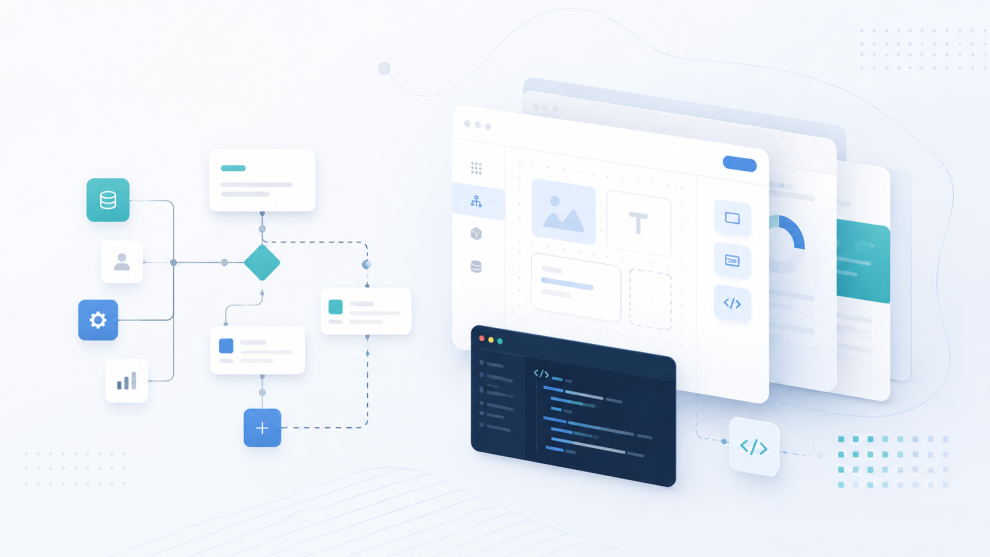
Low-code platforms move part of that work into visual models, metadata, reusable components, managed runtimes, connectors, and declarative rules. The application still contains logic, but the platform allows teams to express more of that logic through higher-level abstractions.
This approach reduces repeated implementation work. Teams can move faster when an application resembles patterns the platform already supports, such as approval flows, forms, dashboards, employee portals, case management systems, and straightforward mobile workflows.
Engineers may spend less time building authentication screens, responsive layouts, basic CRUD operations, and standard integrations. However, the technical complexity does not disappear. It moves into identity boundaries, data ownership, integration contracts, platform configuration, performance limits, and lifecycle management.
Demand for engineering judgment remains strong. The US Bureau of Labor Statistics projects employment for software developers, quality assurance analysts, and testers to grow 15 percent between 2024 and 2034. It associates that demand with continued investment in AI, automation, connected products, cybersecurity, and software-enabled systems. Low-code changes the implementation layer. It does not remove the need to understand the complete system.
Where Does Low-Code Deliver the Most Value, and Where Does It Create Risk?
Low-code performs best when the problem follows stable and repeatable patterns. It becomes less predictable when an application requires differentiated customer experiences, advanced calculations, real-time collaboration, complex offline behavior, or rapidly changing business rules.
Engineering leaders should evaluate four areas before assigning a workload to a low-code platform:
- Process stability and customization requirements: Applications with clearly defined states, permissions, decisions, and exception paths are strong candidates. Highly specialized interfaces and frequently changing domain rules may require extensive custom extensions. An empirical study of approximately 5,000 Stack Overflow posts covering nine low-code platforms found that more than 40 percent of the examined questions involved customization. Developers also reported challenges involving dynamic event handling, automated testing, database management, and third-party integration.
- Integration and data boundaries: Enterprise applications rarely operate independently. They connect to systems of record, identity providers, event streams, document repositories, analytics tools, and partner APIs. Prebuilt connectors accelerate common integrations, but they can hide throttling rules, retry behavior, schema changes, transaction boundaries, and error recovery. Teams should keep important business rules behind governed APIs instead of duplicating them across visual workflows.
- Security, reliability, and operability: A platform may provide secure defaults, but the application team still owns authorization design, data classification, secrets management, auditability, environment separation, recovery objectives, and production support. Visual workflows require the same threat modeling, automated testing, static analysis, dependency review, and security verification expected from custom software. NIST guidance recommends practices such as threat modeling, automated tests, static code scanning, structural testing, fuzzing, and web application scanning.
- Portability and exit economics: A low-code decision creates a long-term dependency on the platform’s runtime, licensing structure, data model, extension framework, and deployment model. Research on low-code interoperability identifies vendor lock-in as a major concern because moving an application may require teams to recreate its data models, interfaces, and workflows on another platform.
These risks do not make low-code unsuitable. They make workload selection and architecture discipline essential.
Can Low-Code Support Complex Enterprise Applications at Scale?
Low-code platforms can support complex applications, but complexity does not disappear inside a visual development canvas. It appears in integration density, data consistency, transaction volume, access control, release coordination, and operational recovery.
The important question is not whether the platform can generate the interface. It is whether the complete system can meet service-level objectives under realistic traffic and failure conditions.
A production evaluation should test concurrency, API latency, connector throttling, background processing, deployment rollback, regional availability, log access, and recovery from partial failures. Teams must also determine how the platform versions visual assets, reviews configuration changes, automates regression tests, and supports incident diagnosis.
Low-code becomes risky when the platform hides too much of its execution model. Engineers need enough visibility to understand how requests flow, where state resides, how errors propagate, and which components can fail independently. Without that visibility, faster application construction can result in slower incident resolution and higher long-term operating costs.
How Should Enterprises Combine Low-Code With Custom Software Development?
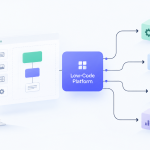
The most durable enterprise model is hybrid. Low-code can manage workflow orchestration, standard interfaces, internal tools, and process-heavy applications. Custom services can handle proprietary algorithms, complex domain logic, advanced integrations, reusable business capabilities, and high-throughput transactions.
An API-first boundary prevents the visual platform from becoming the only place where critical business behavior exists. It also allows web applications, mobile products, partner systems, automation tools, and future platforms to reuse the same governed services.
Platform engineering teams should provide approved connectors, API gateways, identity patterns, observability standards, reusable design components, deployment templates, and reference architectures.
They should also create workload tiers. A departmental productivity tool can follow lighter controls than an application that processes customer payments, financial decisions, health information, or regulated data. This structure gives business teams more delivery capacity without turning citizen development into unmanaged shadow IT.
What Should Engineering Leaders Evaluate Before Choosing a Low-Code Platform?
A platform evaluation should use a realistic production workload rather than a polished demonstration.
The proof of concept should include the actual identity model, difficult integrations, representative data volumes, automated tests, monitoring, deployment promotion, and a controlled failure scenario. This exposes limitations that rarely appear in vendor demonstrations.
Leaders should examine extensibility, source-control support, generated code ownership, API accessibility, observability, testing options, regional hosting, data export, licensing behavior, and migration effort.
They should also calculate the cost of operating and changing the application over several budget cycles. The first release represents only one part of the investment. A platform that produces a prototype quickly but requires expensive workarounds for every nonstandard requirement may increase total delivery cost rather than reduce it.
When Should an Enterprise Work With a Low-Code Consulting Partner?
External support becomes useful when internal teams lack experience in workload selection, platform governance, secure architecture, integration design, or low-code lifecycle management.
A shortlist might include Accenture, Capgemini, and GeekyAnts, depending on the organization’s program size, technology environment, and need for custom product engineering around the selected platform.
The partner should demonstrate the ability to work across low-code and traditional engineering. It should not force every requirement into a visual platform simply because the platform is part of the engagement.
Engineering leaders should evaluate architecture depth, delivery ownership, security practices, domain experience, testing capabilities, API design, and the ability to document a practical exit strategy. The right partner helps the organization decide where low-code should not be used as clearly as where it should.
Will Low-Code Replace Traditional Software Development?
Low-code will replace some repetitive implementation work. It will not replace the need to understand systems. AI may expand low-code adoption by generating formulas, data models, workflows, and interface structures from natural-language instructions. Visual and conversational development can complement each other, especially when users already understand the process or outcome they need.
Research into AI-assisted low-code development found that natural-language assistance helped users discover operators and compose workflows. It also found that assistance remained less effective when users lacked clarity about what they wanted to accomplish.
AI can reduce implementation friction. It cannot resolve unclear business rules, weak data models, conflicting stakeholder requirements, or poor architectural decisions.
Low-code is therefore part of the future of software development, but it is not the entire future. Enterprises need more software than centralized engineering teams can build alone. Speed, however, creates value only when the resulting systems remain secure, observable, maintainable, and economically sustainable.
A focused portfolio and architecture assessment can identify which applications should move to low-code, which should remain custom, and where a hybrid approach can accelerate delivery without transferring today’s shortcuts into tomorrow’s operating budget.



Add Comment