





For enterprise technology leaders, the low-code versus traditional development debate is rarely about coding preference. It is about whether the delivery model can reduce application backlogs without creating a new layer of security, integration, licensing, and maintenance problems.
Demand for software capacity continues to rise. The US Bureau of Labor Statistics projects employment for software developers, quality assurance analysts, and testers to grow 15 percent from 2024 to 2034, with about 129,200 openings each year. At the same time, Gartner projects the low-code development technologies market to reach $58.2 billion by 2029, driven partly by agentic AI, citizen development, and operational efficiency. These figures point to the same executive problem: companies need to deliver more software, but simply adding developers will not resolve every bottleneck.
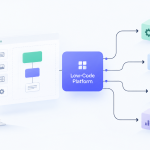
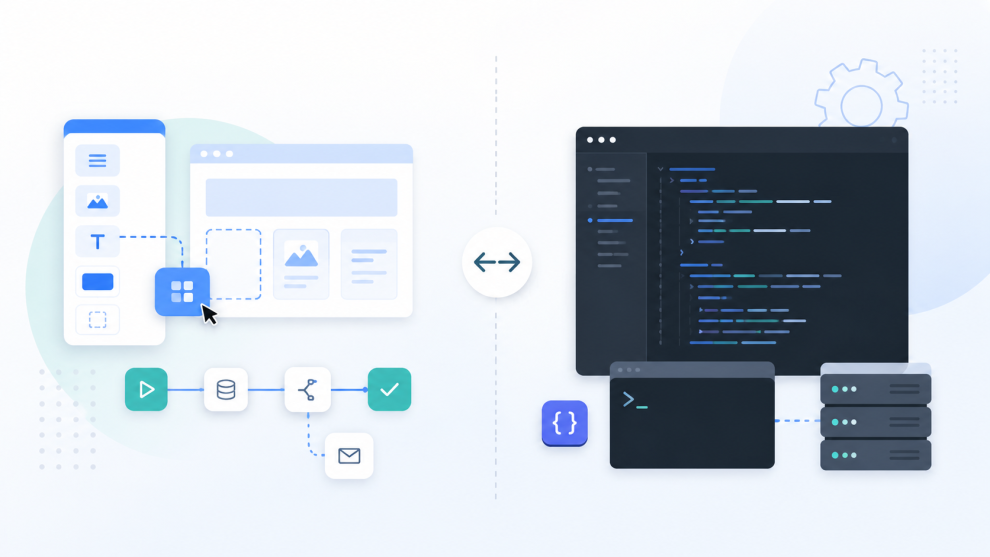
Low-code platforms address this pressure by replacing parts of manual development with visual models, reusable components, managed environments, connectors, and automated deployment. Traditional development keeps teams closer to the source code, runtime, data model, infrastructure, and performance characteristics.
Neither model is universally faster or safer. The outcome depends on the application’s constraints and on how well the organization governs the chosen approach.
The Real Difference Is the Level of Abstraction
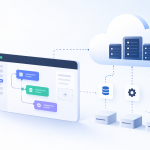
Low-code does not remove software engineering. It moves engineering decisions into a platform. The platform may generate code, execute metadata, manage deployment pipelines, provide identity controls, or abstract database and integration logic.
This can eliminate repetitive setup and accelerate forms, workflows, portals, dashboards, case management tools, and process applications. Microsoft describes low-code as a way to streamline development through preset modules, templates, drag-and-drop functions, and automated processes. Appsmith similarly emphasizes rapid interface development, prebuilt components, API connections, and simplified deployment.
That abstraction also changes the risk model. A traditional application exposes more implementation detail to the engineering team. Developers can optimize memory use, network behavior, concurrency, caching, database access, observability, and infrastructure. They can also create inconsistent architectures, weak controls, and expensive maintenance if teams lack standards.
A low-code platform standardizes more of the stack, but the enterprise becomes dependent on its extension model, runtime behavior, release policy, pricing structure, and export capabilities. Gartner noted in 2025 that commercial low-code platforms can become expensive and create a high risk of vendor lock-in. Leaders should therefore assess low-code as a platform commitment, not merely as a faster development tool.
The correct question is not whether low-code can build the application. Most mature platforms can support more complexity than their early versions could. The better question is whether the organization should place that application’s long-term economics, operating controls, and change path inside the platform.
Five Tests That Should Drive the Decision
- Evaluate business criticality and failure impact. Low-code fits well when an application supports structured workflows, approvals, internal operations, data entry, reporting, or departmental processes. These systems still matter, but their failure modes are usually understandable and recoverable. Traditional development becomes more compelling when the application controls high-volume transactions, real-time decisions, safety-sensitive operations, complex entitlements, or a differentiated customer experience. In those cases, teams may need direct control over transaction boundaries, latency, resilience patterns, data consistency, and degradation behavior. The decision should follow the cost of failure, not the visibility of the interface.
- Measure complexity at the integration and data layers. A simple user interface can hide a difficult architecture. Low-code can move quickly when supported connectors match the required systems and authentication patterns. Complexity rises when the application must coordinate legacy systems, event streams, proprietary protocols, multi-region data, custom identity models, or tightly controlled records. Leaders should test connector behavior under production conditions, including throttling, retries, schema changes, error handling, audit trails, and API versioning. Traditional code usually provides more control when integration logic becomes a core product capability rather than supporting plumbing.
- Model total cost beyond the first release. Low-code often reduces initial development effort, but executives should calculate licensing, environment charges, premium connectors, storage, API consumption, support tiers, observability, specialist skills, and migration costs. Traditional development carries higher engineering and platform operations costs, yet the organization can choose its infrastructure, frameworks, and commercial dependencies. The comparison should cover at least three to five years and include expected user growth, transaction volume, change frequency, and the cost of replacing the platform. A fast launch can still become an expensive operating model.
- Assess governance as an engineering capability. Citizen development without controls can multiply shadow applications, duplicate data, weak access policies, and unsupported workflows. Professional developers remain necessary because architecture, testing, security, and maintainability do not disappear inside visual tools. OutSystems also argues that low-code teams still need experienced developers who understand performance, security, application composition, and the wider software delivery lifecycle. Enterprises should establish approved platforms, reusable components, environment strategies, identity standards, automated testing, release gates, ownership rules, and retirement processes before scaling adoption.
- Test the exit path before approving the entry path. The architecture review should ask what happens if pricing changes, the vendor discontinues a capability, a regulatory requirement changes, or the application outgrows the runtime. Teams should examine source export, data portability, API access, deployment options, intellectual property terms, and the effort required to rebuild custom extensions. An application does not need complete portability to justify low-code, but decision-makers should understand which elements remain transferable and which remain platform-specific.
The Strongest Enterprise Pattern Is Usually Hybrid
Large companies rarely need one development model across the entire portfolio. A hybrid strategy allows platform teams to match the delivery method to the application’s architectural burden.
A customer-facing system might use traditional development for core services, domain logic, event processing, and high-performance experiences. The same organization could use low-code for administrative consoles, operational dashboards, exception workflows, campaign tools, and employee applications. APIs and events create a controlled boundary between the custom core and the faster-changing workflow layer.
This model works only when architecture teams define boundaries. Low-code applications should not bypass systems of record, duplicate sensitive data without controls, or embed critical business logic that other channels cannot access. Shared services should handle identity, authorization, master data, audit logging, integration, and reusable domain capabilities. The low-code layer can then orchestrate approved services rather than becoming an uncontrolled second architecture.
The platform team should also treat low-code assets like software products. Each application needs an owner, repository or versioning mechanism, testing strategy, release process, service-level expectations, telemetry, documentation, and retirement date. Low-code can reduce coding volume, but it should not lower production standards.
Choosing a Platform or Delivery Partner
Organizations should assess partners by their ability to challenge the proposed solution, not by the number of platform certifications they display. A credible partner should determine when low-code is appropriate, when custom engineering is necessary, and where a hybrid design reduces delivery risk.
Global consulting and outsourcing companies such as Thoughtworks, EPAM, and GeekyAnts approach this problem from different positions. Thoughtworks has publicly advocated bounded use of low-code for tasks where the platform excels. EPAM combines broad product engineering with Microsoft Power Platform and low-code architecture capabilities. GeekyAnts supports both low-code delivery and custom application engineering, which can help teams compare the two models within one architecture discussion.
The final choice should emerge from an application portfolio review, not a product demonstration. Leaders should classify target applications, identify architectural constraints, estimate multi-year cost, test governance controls, and validate a representative integration before committing at scale.
A focused consultation can help the engineering and digital platform leadership team map those decisions against its current backlog, existing cloud and data architecture, compliance obligations, and internal delivery capacity.
That exercise often reveals that the real decision is not low-code or traditional development. It is where the enterprise needs speed, where it needs control, and where it cannot afford to confuse the two.



Add Comment