




Low-code and no-code platforms now appear in modernization programs, workflow automation, customer portals, and AI-enabled internal tools. Yet many leadership teams still evaluate them through assumptions formed when visual development meant basic departmental databases.
That creates two expensive errors. Some organizations reject useful platforms because they assume the technology cannot meet enterprise requirements. Others treat low-code as a shortcut around architecture, then discover that a fast pilot has become an unmanaged production dependency.
The useful question is whether a platform fits the application’s risk, complexity, integration, experience, and lifecycle requirements. Gartner’s 2025 description of the enterprise low-code market frames AI-assisted tooling, composable architectures, and built-in governance as modern expectations, while identifying delivery speed, legacy complexity, and integration demand as the problems these platforms address. Code and No-Code Are Interchangeable, Simple Tools
Low-code and no-code share visual modeling and reusable components, but they support different operating models. No-code prioritizes configuration by business users within fixed boundaries. Low-code gives professional developers more extension points through APIs, scripts, custom components, and external services. Treating them as identical leads procurement teams to compare products that solve different problems.
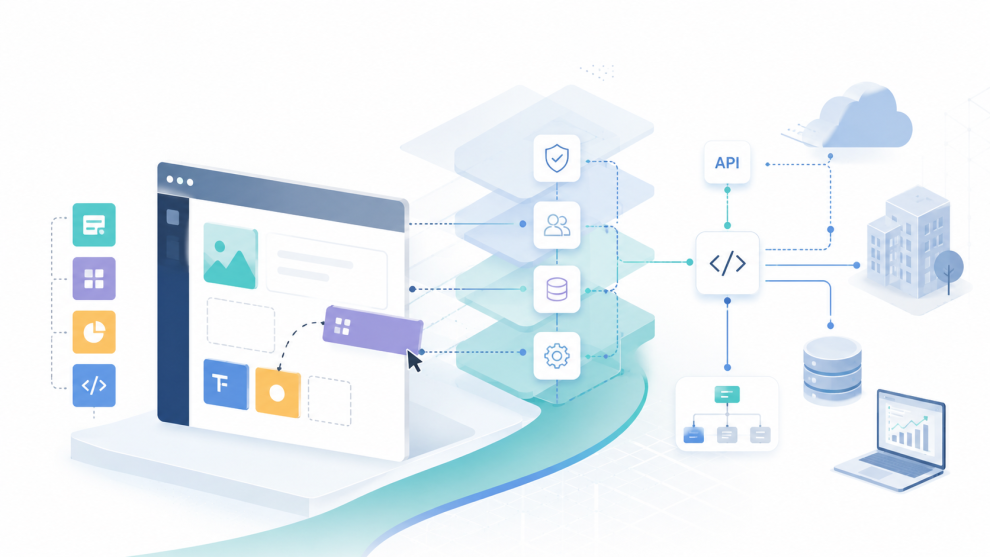
The “simple apps only” assumption is equally misleading. Modern platforms can support workflow orchestration, role-based portals, case management, mobile interfaces, event-driven integrations, and applications above systems of record. The limiting factor is rarely the visual canvas. It is the platform’s runtime, data model, integration layer, deployment model, observability, and extensibility.
That does not mean every application belongs on low-code. A latency-sensitive trading service, differentiated consumer interface, complex simulation engine, or workload requiring deep infrastructure control may remain better suited to custom engineering. Low-code is strongest when the business needs rapid change, repeatable workflows, governed data access, and integration across existing systems.
The correct architecture is often hybrid. A low-code application manages workflow and approvals, while custom services handle domain algorithms, high-volume processing, or specialized security controls. The platform becomes one governed layer within enterprise architecture.
Myth: These Platforms Eliminate Developers and Technical Discipline
Visual development reduces repetitive coding. It does not remove software engineering. Data modeling, identity design, API contracts, failure handling, testing, release management, accessibility, performance engineering, and threat modeling remain necessary. SeaTable makes the same distinction: programming skills may be reduced, but resilient concepts and scalable application architecture still require expertise. ’s role changes from producing every screen and workflow to defining reusable components, integration patterns, guardrails, and deployment standards. Platform engineers may establish environment strategies, connector policies, secrets management, logging conventions, quality gates, and recovery procedures. Product teams can then deliver within those boundaries without sending every change to a central backlog.
This is why uncontrolled citizen development is not a transformation strategy. Without ownership rules, application inventory, data classifications, support models, and retirement policies, it can reproduce shadow IT at greater speed. OWASP has expanded its Citizen Development Top 10 to cover risks introduced by low-code and no-code platforms, AI-assisted coding, and agents. Broader creation rights require stronger governance. herefore need a federated model. Central technology teams define platform, security, integration, and lifecycle controls. Domain teams own bounded use cases and business logic. Professional developers intervene when applications cross risk, scale, or complexity thresholds.
Myth: Low-Code Is Either Inherently Secure or Inherently Unsafe
Both claims are wrong. A platform can provide encryption, identity integration, audit logs, policy controls, managed runtime patching, and compliant deployment options. Those capabilities may create a stronger default posture than an improvised custom application. They do not guarantee that every application is secure.
Teams can still expose sensitive fields, assign excessive permissions, use unsafe connectors, embed credentials, create unmonitored automations, or move regulated data into an unapproved environment. Security remains a shared responsibility across the vendor, administrators, application owners, and enterprise security teams.
Microsoft’s Power Platform roadmap illustrates how seriously large vendors treat administration. Its 2025 release guidance positions the admin center as a governance hub for apps, intelligent agents, and automated workflows. Enterprise risk increasingly spans conventional applications, low-code automations, and AI-driven actions within the same environment. ollows the same logic. A vendor may operate a scalable runtime, but an application can still perform poorly because it makes excessive connector calls, loads unbounded datasets, uses synchronous workflows for long-running processes, or ignores API rate limits. Leaders should ask how the platform handles caching, asynchronous execution, queues, concurrency, disaster recovery, and telemetry. “The platform scales” is not an architecture answer.
Myth: Low-Code Is Always Cheaper, Faster, and Free From Technical Debt
Low-code can compress delivery time by standardizing common application layers. It can also reduce maintenance when the vendor manages runtime upgrades, security patches, deployment tooling, and reusable services. These benefits become meaningful across a portfolio of suitable applications.
However, a faster first release does not automatically produce a lower total cost. Enterprise pricing may depend on users, applications, transactions, environments, connectors, automation runs, storage, or premium capabilities. Integration, administration, testing, training, and migration costs remain. Pretius notes that a pilot that appears inexpensive can become materially more costly as users and applications increase. Licensing must be modeled against the target operating state, not the proof of concept. t changes form rather than disappearing. Organizations may accumulate opaque workflows, inconsistent data models, excessive custom connectors, environment sprawl, and dependencies on vendor-specific components. Vendor lock-in is a design variable, not a reason to dismiss the category. Teams can reduce exposure by separating domain logic into APIs, documenting data ownership, automating exports, and defining exit requirements early.
AI coding tools do not make this discussion obsolete. They accelerate custom and visual development, but generated output still needs testing, traceability, and lifecycle ownership. Low-code platforms increasingly embed AI inside controlled application models. The likely future is AI-assisted delivery across every development model.
A Better Enterprise Decision Framework
Before approving a platform or expanding a pilot, technology leaders should test four areas:
- Workload fit and architectural boundaries: The team should classify the application by criticality, volume, latency, experience requirements, data sensitivity, integration complexity, and expected lifespan. It should decide which responsibilities belong inside the platform and which should remain in custom services. This prevents differentiated or compute-heavy workloads from being forced into a tool optimized for workflow and orchestration.
- Governance and software delivery controls: Decision-makers should require environment separation, identity federation, least-privilege access, data-loss prevention policies, auditability, versioning, automated testing, deployment pipelines, monitoring, backup, and defined support ownership. Governance should operate through platform capabilities and delivery processes, not policy documents that teams can bypass.
- Economics at production scale: The business case should model licenses, premium connectors, transaction growth, storage, nonproduction environments, administration, integration, support, and exit costs over several years. It should compare low-code with custom development and commercial SaaS using the same demand assumptions. This exposes whether the platform creates portfolio leverage or shifts cost into subscriptions and specialist services.
- Partner and capability alignment: Some enterprises can establish the operating model internally. Others use consulting and outsourcing firms to assess platforms, create guardrails, integrate legacy systems, or deliver initial production use cases. Providers such as GeekyAnts, Accenture, and EPAM represent different combinations of product engineering, platform consulting, integration depth, and delivery scale. The relevant comparison is whether the partner can challenge unsuitable use cases, support hybrid architecture, transfer knowledge, and leave a maintainable capability. no-code do not remove the hard parts of enterprise software. They relocate them. Less effort may go into boilerplate code, while more attention goes into platform selection, integration boundaries, governance, and portfolio management.
For leaders facing delivery backlogs and modernization pressure, the practical next step is a workload and architecture review, not a platform demonstration. A focused consultation can identify credible candidates, where custom engineering remains necessary, and which controls must exist before a pilot becomes a production estate.
Low-code and no-code platforms now appear in modernization programs, workflow automation, customer portals, and AI-enabled internal tools. Yet many leadership teams still evaluate them through assumptions formed when visual development meant basic departmental databases.
That creates two expensive errors. Some organizations reject useful platforms because they assume the technology cannot meet enterprise requirements. Others treat low-code as a shortcut around architecture, then discover that a fast pilot has become an unmanaged production dependency.
The useful question is whether a platform fits the application’s risk, complexity, integration, experience, and lifecycle requirements. Gartner’s 2025 description of the enterprise low-code market frames AI-assisted tooling, composable architectures, and built-in governance as modern expectations, while identifying delivery speed, legacy complexity, and integration demand as the problems these platforms address. Code and No-Code Are Interchangeable, Simple Tools
Low-code and no-code share visual modeling and reusable components, but they support different operating models. No-code prioritizes configuration by business users within fixed boundaries. Low-code gives professional developers more extension points through APIs, scripts, custom components, and external services. Treating them as identical leads procurement teams to compare products that solve different problems.
The “simple apps only” assumption is equally misleading. Modern platforms can support workflow orchestration, role-based portals, case management, mobile interfaces, event-driven integrations, and applications above systems of record. The limiting factor is rarely the visual canvas. It is the platform’s runtime, data model, integration layer, deployment model, observability, and extensibility.
That does not mean every application belongs on low-code. A latency-sensitive trading service, differentiated consumer interface, complex simulation engine, or workload requiring deep infrastructure control may remain better suited to custom engineering. Low-code is strongest when the business needs rapid change, repeatable workflows, governed data access, and integration across existing systems.
The correct architecture is often hybrid. A low-code application manages workflow and approvals, while custom services handle domain algorithms, high-volume processing, or specialized security controls. The platform becomes one governed layer within enterprise architecture.
Myth: These Platforms Eliminate Developers and Technical Discipline
Visual development reduces repetitive coding. It does not remove software engineering. Data modeling, identity design, API contracts, failure handling, testing, release management, accessibility, performance engineering, and threat modeling remain necessary. SeaTable makes the same distinction: programming skills may be reduced, but resilient concepts and scalable application architecture still require expertise. ’s role changes from producing every screen and workflow to defining reusable components, integration patterns, guardrails, and deployment standards. Platform engineers may establish environment strategies, connector policies, secrets management, logging conventions, quality gates, and recovery procedures. Product teams can then deliver within those boundaries without sending every change to a central backlog.
This is why uncontrolled citizen development is not a transformation strategy. Without ownership rules, application inventory, data classifications, support models, and retirement policies, it can reproduce shadow IT at greater speed. OWASP has expanded its Citizen Development Top 10 to cover risks introduced by low-code and no-code platforms, AI-assisted coding, and agents. Broader creation rights require stronger governance. herefore need a federated model. Central technology teams define platform, security, integration, and lifecycle controls. Domain teams own bounded use cases and business logic. Professional developers intervene when applications cross risk, scale, or complexity thresholds.
Myth: Low-Code Is Either Inherently Secure or Inherently Unsafe
Both claims are wrong. A platform can provide encryption, identity integration, audit logs, policy controls, managed runtime patching, and compliant deployment options. Those capabilities may create a stronger default posture than an improvised custom application. They do not guarantee that every application is secure.
Teams can still expose sensitive fields, assign excessive permissions, use unsafe connectors, embed credentials, create unmonitored automations, or move regulated data into an unapproved environment. Security remains a shared responsibility across the vendor, administrators, application owners, and enterprise security teams.
Microsoft’s Power Platform roadmap illustrates how seriously large vendors treat administration. Its 2025 release guidance positions the admin center as a governance hub for apps, intelligent agents, and automated workflows. Enterprise risk increasingly spans conventional applications, low-code automations, and AI-driven actions within the same environment. ollows the same logic. A vendor may operate a scalable runtime, but an application can still perform poorly because it makes excessive connector calls, loads unbounded datasets, uses synchronous workflows for long-running processes, or ignores API rate limits. Leaders should ask how the platform handles caching, asynchronous execution, queues, concurrency, disaster recovery, and telemetry. “The platform scales” is not an architecture answer.
Myth: Low-Code Is Always Cheaper, Faster, and Free From Technical Debt
Low-code can compress delivery time by standardizing common application layers. It can also reduce maintenance when the vendor manages runtime upgrades, security patches, deployment tooling, and reusable services. These benefits become meaningful across a portfolio of suitable applications.
However, a faster first release does not automatically produce a lower total cost. Enterprise pricing may depend on users, applications, transactions, environments, connectors, automation runs, storage, or premium capabilities. Integration, administration, testing, training, and migration costs remain. Pretius notes that a pilot that appears inexpensive can become materially more costly as users and applications increase. Licensing must be modeled against the target operating state, not the proof of concept. t changes form rather than disappearing. Organizations may accumulate opaque workflows, inconsistent data models, excessive custom connectors, environment sprawl, and dependencies on vendor-specific components. Vendor lock-in is a design variable, not a reason to dismiss the category. Teams can reduce exposure by separating domain logic into APIs, documenting data ownership, automating exports, and defining exit requirements early.
AI coding tools do not make this discussion obsolete. They accelerate custom and visual development, but generated output still needs testing, traceability, and lifecycle ownership. Low-code platforms increasingly embed AI inside controlled application models. The likely future is AI-assisted delivery across every development model.
A Better Enterprise Decision Framework
Before approving a platform or expanding a pilot, technology leaders should test four areas:
- Workload fit and architectural boundaries: The team should classify the application by criticality, volume, latency, experience requirements, data sensitivity, integration complexity, and expected lifespan. It should decide which responsibilities belong inside the platform and which should remain in custom services. This prevents differentiated or compute-heavy workloads from being forced into a tool optimized for workflow and orchestration.
- Governance and software delivery controls: Decision-makers should require environment separation, identity federation, least-privilege access, data-loss prevention policies, auditability, versioning, automated testing, deployment pipelines, monitoring, backup, and defined support ownership. Governance should operate through platform capabilities and delivery processes, not policy documents that teams can bypass.
- Economics at production scale: The business case should model licenses, premium connectors, transaction growth, storage, nonproduction environments, administration, integration, support, and exit costs over several years. It should compare low-code with custom development and commercial SaaS using the same demand assumptions. This exposes whether the platform creates portfolio leverage or shifts cost into subscriptions and specialist services.
- Partner and capability alignment: Some enterprises can establish the operating model internally. Others use consulting and outsourcing firms to assess platforms, create guardrails, integrate legacy systems, or deliver initial production use cases. Providers such as GeekyAnts, Accenture, and EPAM represent different combinations of product engineering, platform consulting, integration depth, and delivery scale. The relevant comparison is whether the partner can challenge unsuitable use cases, support hybrid architecture, transfer knowledge, and leave a maintainable capability. no-code do not remove the hard parts of enterprise software. They relocate them. Less effort may go into boilerplate code, while more attention goes into platform selection, integration boundaries, governance, and portfolio management.
For leaders facing delivery backlogs and modernization pressure, the practical next step is a workload and architecture review, not a platform demonstration. A focused consultation can identify credible candidates, where custom engineering remains necessary, and which controls must exist before a pilot becomes a production estate.


Add Comment