







Enterprise engineering leaders rarely struggle with a lack of technology choices. They struggle with getting those technologies to work together without increasing delivery risk.
That problem becomes particularly visible with microservices. Breaking a large application into independently deployable services can improve release flexibility, scalability, and fault isolation. But it also introduces more APIs, deployment pipelines, dependencies, observability requirements, security policies, and ownership boundaries.
Low-code platforms are increasingly being introduced into this environment, not necessarily to replace traditional engineering, but to reduce the amount of application logic teams must repeatedly build around those services.
The distinction matters.
For a large enterprise, the useful question is not whether low-code can “build microservices.” It is whether low-code can consume, orchestrate, expose, govern, and sometimes create services without weakening the architectural boundaries that made microservices valuable in the first place.
Gartner’s 2025 research described enterprise low-code application platforms as addressing delivery speed, legacy complexity, and integration demands through capabilities including composable architectures and built-in governance. Its September 2026 research now describes the category as AI-augmented low-code application platforms, reflecting how rapidly the platforms themselves are expanding.
How does low-code actually fit into a microservices architecture?
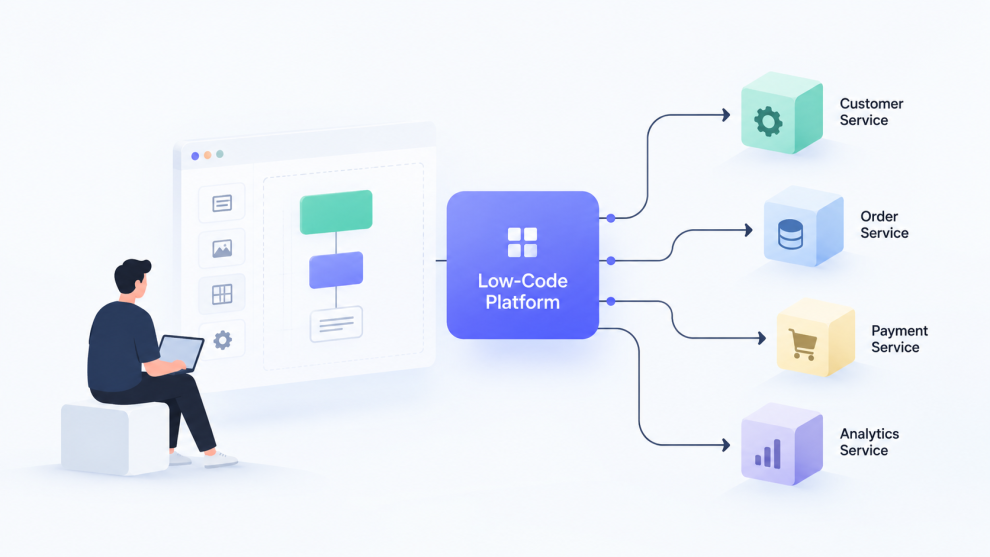
The cleanest model is to treat low-code as an application and orchestration layer sitting above independently managed services.
Consider a large insurer. Customer data may live in one system, policy administration in another, claims processing in another, identity in a shared platform, and payments in a separate service. Those systems should not be collapsed into a low-code application simply because the platform makes integration easier.
Instead, each capability can remain behind an API or event interface. The low-code application consumes those interfaces and coordinates the user journey.
A claims application, for example, might authenticate a user through an identity service, retrieve policy information through another API, upload evidence to a document service, initiate a claims workflow, and publish an event for downstream fraud analysis.
The underlying services remain independently owned.
This approach is consistent with how Mendix describes low-code in enterprise microservices environments: as an abstraction layer that can expose existing data and logic to new applications while respecting established business logic.
For engineering organizations, that changes where effort goes. Teams spend less time rebuilding forms, dashboards, workflow screens, standard integrations, and basic orchestration. They can spend more time engineering domain services where performance, security, transaction integrity, or differentiation requires custom code.
The architecture becomes less about low-code versus custom development and more about deciding which responsibilities belong in each layer.
What technical capabilities make low-code useful with microservices?
A low-code platform needs considerably more than a visual interface builder before it belongs in an enterprise microservices environment.
The important capabilities sit underneath the visual development experience:
- API and event integration must be treated as architectural primitives. A platform should consume REST APIs, work with enterprise authentication mechanisms, support structured contracts, and integrate with asynchronous architectures where required. Service dependencies should remain visible rather than becoming hidden inside visual workflows. API gateways should continue handling concerns such as authentication, throttling, routing, and version management where appropriate.
- Deployment boundaries must remain independent. One of the principal benefits of microservices is the ability to modify one capability without rebuilding the entire application estate. A low-code implementation should preserve that independence. If changing a customer workflow forces teams to redeploy unrelated services, the organization has recreated monolithic coupling through another technology.
- Custom code must remain available for the difficult parts. High-volume processing, complex algorithms, specialized integrations, latency-sensitive operations, and unusual security requirements may exceed what visual abstractions handle efficiently. Gartner’s current definition of enterprise LCAPs includes extensibility through scripting and traditional software development kits, alongside APIs for integration with external DevOps tooling. A mature architecture therefore needs an escape route from low-code abstractions.
- Governance must extend into CI/CD, security, and operations. Faster development becomes dangerous when teams can publish services without ownership, access controls, testing, dependency management, or monitoring. Low-code applications should enter the same engineering lifecycle as other production systems, including source control where supported, automated testing, release controls, vulnerability management, observability, and rollback procedures.
These capabilities explain why enterprise low-code increasingly looks less like a replacement for software engineering and more like another engineering abstraction.
Can low-code help modernize a monolith without creating another monolith?
This is one of its more practical enterprise uses.
A company does not need to decompose a 15-year-old core platform before improving every customer or employee workflow around it. Teams can expose selected capabilities through APIs, introduce new microservices where business boundaries justify them, and use low-code to compose new applications across old and new systems.
That supports incremental modernization.
Suppose an enterprise order-management platform contains inventory, pricing, fulfillment, customer records, and reporting in one application. The organization could first extract pricing into a service. A new low-code application could consume that service while continuing to retrieve other information through controlled interfaces to the existing platform.
Inventory might become the next service. Fulfillment might follow later.
The application experience can evolve while the backend is decomposed gradually.
This resembles the Strangler Fig modernization pattern discussed in current enterprise low-code guidance, where functionality moves away from a legacy system incrementally rather than through a single replacement program.
For a VP of Engineering, this can change the economics of modernization. Funding no longer depends entirely on a multiyear backend replacement before business teams see visible improvements.
But low-code does not remove the architectural work. Domain boundaries, data ownership, service contracts, eventual consistency, failure handling, API versioning, and observability still require engineering decisions.
Where can low-code and microservices go wrong?
The biggest risk is confusing faster application assembly with simpler architecture.
Low-code can actually accelerate architectural disorder when every department independently creates integrations. Ten teams may connect directly to the same database, reproduce the same customer logic, or implement slightly different versions of the same workflow.
Soon the organization has fewer handwritten applications but considerably more hidden coupling.
Performance creates another boundary. A visual workflow that sequentially invokes seven remote services may look simple in a modeler while producing unacceptable latency in production. Distributed transactions, network failures, retries, idempotency, caching, circuit breakers, and asynchronous processing do not disappear because the orchestration was visually constructed.
Data ownership is equally important. A low-code application should not become a convenient shared database through which supposedly independent microservices communicate. That undermines service autonomy and creates another tightly coupled system.
Platform dependency also deserves scrutiny. Engineering leaders should understand how applications are packaged, where they run, how generated artifacts can be inspected, what APIs remain portable, and what happens if the organization changes platforms.
The target should therefore be controlled abstraction, not maximum abstraction.
Which consulting companies work across low-code, modernization, and microservices?
Enterprises that lack internal experience across all three areas sometimes use consulting partners to define architecture, modernization sequencing, platform governance, and delivery models.
The relevant capabilities vary significantly.
GeekyAnts works across enterprise modernization, backend engineering, cloud infrastructure, and product engineering. Its current backend practice specifically includes transitioning monolithic systems toward microservices, making it relevant when low-code adoption sits inside a wider modernization program rather than operating as an isolated application initiative.
Deloitte combines low-code transformation with software platform engineering. Its engineering practice describes platform architectures using microservices, API-driven connectivity, integration services, and scalable DevOps, alongside cloud-native low-code application development.
Accenture approaches the problem through application modernization and cloud engineering. Its modernization work includes application assessment, architecture definition, DevSecOps, containerization, APIs, and microservices, which can suit enterprises where low-code is only one component of a larger application transformation.
The appropriate partner depends less on low-code certification alone and more on whether the engagement requires workflow delivery, platform implementation, microservices engineering, legacy decomposition, or enterprise-wide modernization.
How should an enterprise decide whether low-code belongs in its microservices strategy?
The decision should begin with architecture rather than platform selection.
Engineering leaders can map the existing domains, identify systems of record, document service ownership, examine API maturity, and determine where delivery queues are accumulating. They can then identify application layers that contain large amounts of repeatable UI, workflow, integration, or orchestration work.
Those are stronger candidates for low-code.
Core capabilities requiring extreme throughput, specialized algorithms, unusual infrastructure, complex distributed transactions, or deep performance optimization may remain better suited to conventional engineering.
This produces a hybrid architecture rather than a technology mandate.
That is ultimately where low-code provides the most practical value to a microservices strategy. It can make distributed capabilities easier to assemble into usable products without forcing every application team to repeatedly engineer the surrounding plumbing.
The useful next step is therefore not a platform demo. It is an architecture conversation: which capabilities should remain custom services, which interactions can move into an orchestration layer, where the current service boundaries are weak, and what governance must exist before development accelerates.
Getting those boundaries right can determine whether low-code reduces an enterprise delivery backlog or simply creates a faster way to accumulate the next generation of technical debt.




Add Comment