









A retailer can have inventory software and still have no reliable idea what is actually available to sell.
That problem becomes more visible when a business adds a second store, launches ecommerce, introduces click-and-collect, starts selling through marketplaces, or begins fulfilling online orders from physical locations. Inventory that once lived in a spreadsheet or a point-of-sale system suddenly needs to move across several systems.
The problem is not simply tracking stock. It is maintaining a trustworthy inventory state while purchases, returns, transfers, reservations, damaged goods, supplier receipts, and online orders change that state continuously.
Recent research into inventory record inaccuracies reinforces the scale of this operational issue. Researchers examining retail inventory practices found that inaccurate inventory records remain a significant source of service and cost inefficiencies, while omnichannel retail increasingly depends on accurate stock visibility across locations.
For smaller retailers, replacing the entire technology stack with a traditional ERP may be disproportionate to the problem. A properly designed no-code inventory layer can provide another route.
The important qualification is “properly designed.” Drag-and-drop interfaces alone do not create reliable inventory systems.
Why Does Real-Time Inventory Become Difficult So Quickly?
Inventory appears simple when represented as a number.
SKU 1042: 17 units available.
Operationally, that number is usually the result of several other states.
Some units may physically exist but already belong to an online order. Others may be awaiting quality inspection. Two may be moving between stores. A return may have reached the store but not yet been approved for resale. A supplier shipment may exist in the purchasing system without having reached the shelf.
A more useful inventory model therefore separates concepts such as on_hand, reserved, available, incoming, damaged, and in_transfer.
Available inventory might be calculated as:
Available = On Hand – Reserved – Unavailable Stock
The application should then change inventory through transactions rather than allowing employees to overwrite quantities freely.
That means recording events such as “receive 12 units,” “reserve two units,” “transfer five units,” or “return one unit.” Each event updates the inventory state while preserving an audit trail.
This architecture matters regardless of whether developers write the application in Java, JavaScript, or a visual development platform.
Modern no-code platforms increasingly support these patterns. WeWeb, for example, describes architectures that connect visual applications to PostgreSQL, Supabase, Xano, REST APIs, GraphQL, ecommerce systems, and POS platforms while supporting multi-location inventory and stock synchronization. Knack similarly supports inventory databases, API integrations, barcode workflows, multiple warehouses, and centralized transaction views.
The frontend may be no-code. The inventory model still needs engineering discipline.
What Should the Technical Architecture of a No-Code Inventory System Look Like?
The safest design is usually not to make the no-code application the unquestioned owner of every piece of inventory data.
Instead, the system should establish one authoritative inventory ledger and let other applications consume or update it through controlled workflows.
A practical architecture can include:
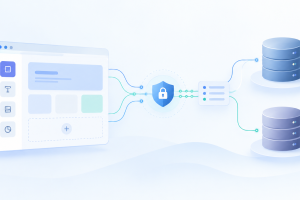
- A transactional inventory database as the source of truth. Product, SKU, location, stock balance, reservation, transfer, purchase order, supplier, and inventory-event records should use stable identifiers and relational links. Inventory adjustments should generate transaction records instead of silently replacing previous values. The application layer can then expose role-specific screens for store associates, warehouse teams, buyers, and administrators. POS systems, ecommerce platforms, scanners, accounting software, and supplier systems should connect through APIs, webhooks, or controlled integration services. Reorder logic can listen for threshold events, while barcode scans can trigger receiving, picking, transfer, and cycle-count workflows. Role-based permissions should determine who can receive inventory, approve corrections, initiate transfers, or alter configuration. Finally, every critical transaction should capture timestamp, user, location, previous state, new state, and transaction type so discrepancies can be reconstructed instead of guessed at later.
This is where many spreadsheet replacements fail. They reproduce the spreadsheet visually without solving concurrency, integration, identity, permissions, or transaction integrity.
Platforms such as Noloco now combine database-backed applications with workflow automation, barcode functionality, permissions, dashboards, and live data connections. That can make them suitable for relatively contained retail workflows.
But the design team still needs to answer harder questions. What happens if Shopify and the POS sell the final item simultaneously? Does an online cart reserve inventory immediately or only after payment? Which system wins if a store completes a return while another channel processes a stock correction?
Those are architecture decisions, not interface decisions.
Can No-Code Really Support Real-Time Inventory?
It can, but “real-time” needs a precise definition.
A dashboard refreshing every five minutes may be perfectly adequate for purchasing. It may be unacceptable for preventing overselling across ecommerce and physical stores.
A retail team should therefore define latency requirements for individual workflows.
Stock dashboards may tolerate seconds of delay. Checkout availability may require near-immediate synchronization. Purchase-order analytics may tolerate minutes. Financial reconciliation may run on scheduled batches.
Real-time inventory usually relies on events. When something sells, returns, transfers, or arrives, that transaction produces an event. Relevant systems then update their state or invalidate cached inventory information.
The no-code application can participate in this architecture if the underlying platform supports webhooks, APIs, database triggers, event-driven workflows, or real-time database subscriptions.
What leaders should avoid is chaining together several synchronous automations and calling the result real-time. One workflow triggers another, which updates a spreadsheet, which triggers another connector, which updates ecommerce. That architecture may work during a demonstration but becomes difficult to debug under concurrency, retries, API throttling, and partial failures.
Enterprise interest in low-code and no-code remains substantial, but deployment maturity varies. A 2025 enterprise technology survey found only 11.4 percent of respondents reported widespread low-code or no-code deployment, while about a quarter were using it selectively and another quarter were still evaluating platforms. Governance, maintainability, security, and lock-in remained important concerns.
That is a useful signal. No-code is becoming part of the engineering toolbox, not a replacement for architecture.
When Does a No-Code Inventory System Stop Being the Right Choice?
No-code works particularly well when the retailer has unusual operational workflows but moderate transaction complexity.
A retailer might need custom receiving rules, supplier approvals, store transfers, barcode scanning, reorder alerts, and dashboards that conventional inventory software handles poorly. Building those workflows visually can be considerably faster than commissioning a complete custom platform.
The equation changes when inventory becomes business-critical infrastructure.
High transaction volumes, complex pricing, distributed fulfillment, hundreds of stores, sophisticated reservation logic, offline operation, advanced warehouse management, extensive marketplace integrations, or strict reconciliation requirements may justify a coded backend or an established ERP, OMS, or WMS.
There is also a middle ground that is often overlooked.
A retailer can keep a robust backend and use low-code or no-code technology for operational applications around it. Store teams might use a visual application for cycle counts and receiving while inventory transactions ultimately flow into an established backend service.
Gartner’s 2025 assessment of enterprise low-code platforms points to the same broader direction: these platforms increasingly combine AI-assisted development, composable architectures, integrations, and governance rather than operating as isolated application builders.
That hybrid model is often more sustainable than forcing either custom engineering or no-code to solve everything.
Should Retailers Build This Internally or Work With a Technology Partner?
The decision depends less on who can build screens and more on who can design the inventory model, integration boundaries, failure handling, and future migration path.
Retailers evaluating external help have several types of partners available. Thoughtworks has substantial experience modernizing retail supply chain, order management, warehouse, and inventory platforms. Slalom works across retail, consumer goods, data modernization, and omnichannel systems.
GeekyAnts is another product engineering and consulting company that can fit situations where a retailer needs to combine rapid application development with deeper product engineering, integration, modernization, and customer-facing experience work. Its current engineering practice spans product engineering, application modernization, data and integration modernization, cloud infrastructure, and digital experience.
The relevant question is not which company can build a no-code application fastest.
It is whether the proposed architecture still makes sense after the retailer adds ten stores, another fulfillment channel, a warehouse, new supplier systems, and significantly more transaction volume.
Before implementation, engineering and operations leaders should therefore map the inventory lifecycle from supplier receipt through sale, return, transfer, adjustment, and reconciliation. That exercise usually reveals whether the business needs a configurable no-code application, a hybrid architecture, or a more substantial inventory platform.
For retailers already dealing with unreliable stock visibility, that architecture conversation is often a better first step than choosing a tool. A short technical discovery session can identify the authoritative data source, synchronization risks, required integrations, acceptable latency, and the point at which a no-code solution would need to evolve.
That gives the organization something more useful than another inventory dashboard: a system whose stock numbers can actually be trusted.


Add Comment