




Enterprise low-code development has moved well beyond departmental forms and temporary workflow tools. Large organizations now use low-code platforms to modernize operational applications, automate processes, build employee systems, extend enterprise platforms, and launch selected customer-facing experiences.
That expansion changes the decision facing technology leaders.
The question is no longer whether a visual development environment can produce an application quickly. The harder question is whether the resulting application can operate inside an enterprise architecture without creating another layer of security exceptions, integration dependencies, licensing exposure, performance constraints, and difficult-to-maintain software.
The market has matured accordingly. Forrester’s 2025 assessment of low-code platforms for professional developers noted that adoption continues to increase and emphasized data modeling, application lifecycle management, governance, process automation, and integration as fundamental platform capabilities. That is a useful distinction. Enterprise low-code is increasingly an engineering model, not simply a faster interface for citizen development.
Where Does Low-Code Development Actually Fit in an Enterprise Architecture?
Low-code delivers the highest value when development speed matters but the organization does not need complete control over every layer of the technology stack.
Internal operations are an obvious example. Approval systems, field-service applications, compliance workflows, supplier portals, employee tools, case-management applications, and applications replacing spreadsheet-driven processes often contain significant business logic without requiring highly differentiated infrastructure.
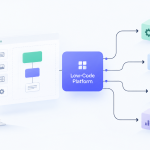
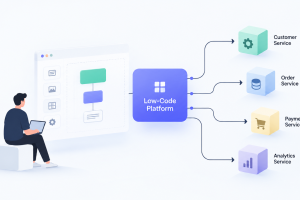
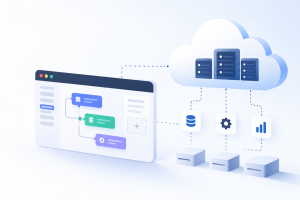
Low-code can also sit above existing systems of record. Instead of rewriting an ERP, CRM, policy administration system, or legacy database, a team can expose controlled services through APIs and use a low-code application as the workflow or experience layer.
That architecture is considerably safer than allowing applications to connect independently to production databases.
The distinction matters because enterprise adoption often fails when teams start with the platform rather than the workload. A low-code platform should not automatically become the default environment for every application simply because the organization has purchased enterprise licenses.
Applications requiring extremely specialized user interfaces, intensive computation, unusual runtime architectures, very high transaction volumes, or deep infrastructure control may still be better suited to conventional software engineering.
The architectural objective should therefore be coexistence. Low-code handles workloads where abstraction improves delivery economics. Traditional engineering remains available where that abstraction becomes restrictive.
Which Enterprise Low-Code Platforms Should Technology Leaders Evaluate?
The largest enterprise platforms now overlap considerably, but their strengths still reflect the ecosystems from which they originated.
Microsoft Power Platform is particularly relevant to organizations already standardized around Microsoft 365, Azure, Dynamics 365, and Dataverse. ServiceNow App Engine has a natural position where workflows already revolve around ServiceNow. Salesforce provides similar advantages when CRM processes and Salesforce data sit at the center of an application.
OutSystems and Mendix take a broader application-development approach. They support professional development teams building more substantial web and mobile applications rather than limiting low-code primarily to departmental automation.
Forrester’s 2025 evaluation, for example, described OutSystems as a platform oriented toward serious engineering and highlighted its UX and data-modeling capabilities. It identified Mendix as a strong general-purpose platform, particularly for industrial scenarios. Microsoft was recognized for its integration with Azure and Microsoft 365, although the research also noted considerations around pricing complexity and high-scale data scenarios.
Platform evaluations should therefore begin with architecture rather than feature counts. Teams should model the expected user population, transaction patterns, integrations, data residency requirements, deployment model, application lifecycle, customization requirements, and five-year operating cost before selecting a platform.
What Security Controls Does Enterprise Low-Code Development Require?
Low-code reduces the amount of code teams manually create. It does not reduce the organization’s responsibility for security.
In some environments, it can actually expand the governance problem because more employees can create applications, connectors, automations, and data flows.
The enterprise security model should consequently extend beyond authentication. Identity federation, role-based access control, secrets management, data-loss prevention rules, API authorization, environment separation, audit logging, encryption, vulnerability management, and software supply-chain controls should operate as part of the platform architecture.
Connector governance deserves particular attention. A sanctioned application may still create unacceptable exposure if a developer can connect regulated customer information to an unapproved SaaS service.
Production access should also remain separated from application creation. Development, test, staging, and production environments need controlled promotion paths rather than one-click publishing by individual makers.
This is where low-code programs often require professional engineering discipline. Visual development does not remove the need for source control, automated testing, peer review, release approvals, observability, incident ownership, and rollback procedures.
Security configuration also has to be continuously validated. Application-level authorization rules can drift as roles, integrations, and functionality change. Treating low-code security as a platform feature rather than an application lifecycle responsibility creates precisely the type of blind spot enterprise security teams are expected to prevent.
Can Low-Code Applications Really Scale to Enterprise Workloads?
They can, but “scalable” needs a much more precise definition.
An application that supports 500 employees submitting expense requests has a different scalability profile from a customer platform serving millions of sessions. Concurrent users, API calls, database throughput, integration latency, payload size, long-running processes, background jobs, geographic distribution, and frontend rendering can all become independent constraints.
Current enterprise low-code platforms provide considerably more sophisticated runtime architectures than earlier visual development tools. The important question is how those architectures behave under the organization’s specific workload.
Recent technical analysis of enterprise platforms emphasizes large-dataset handling, memory management, component architecture, integration capabilities, authentication, and performance under load as important evaluation criteria. It also recommends testing realistic workloads rather than relying on vendor demonstrations or synthetic examples.
Architecture teams should therefore run proof-of-scale exercises before making a platform strategic.
The test should reproduce expected concurrency, integrations, data volumes, network behavior, authentication flows, batch activity, and failure conditions. Teams should measure response-time percentiles, connector latency, resource consumption, throttling, queue growth, and recovery behavior.
Scalability also includes organizational scale. A platform running ten applications is very different from one supporting hundreds of applications across business units. At that point, reusable components, dependency management, environment strategy, ownership metadata, automated policy enforcement, monitoring, and application retirement become just as important as runtime performance.
Which Consulting Companies Can Support Enterprise Low-Code Programs?
Organizations with complicated legacy estates or regulated workloads may use external engineering partners to validate architecture, integrations, governance, and modernization plans. Rather than choosing solely on platform certifications, buyers should examine whether the partner can work across low-code and conventional engineering.
- GeekyAnts can be considered where the low-code initiative forms part of a broader product engineering or modernization program. Its relevance is less about implementing a single visual development platform and more about connecting rapid application development with custom engineering, APIs, cloud systems, existing applications, and modern user experiences. That combination can be useful when an enterprise expects some workloads to remain low-code while others require traditional development.
- Accenture is suited to large transformation programs where low-code adoption intersects with operating-model change, major enterprise platforms, cloud transformation, security, and organization-wide process redesign. Its scale can be relevant for multinational deployments involving multiple business units and extensive systems integration.
- Deloitte is another option where application modernization is closely tied to governance, industry processes, risk management, enterprise platforms, or regulated transformation. It can be particularly relevant when the technology decision has to align with wider controls and organizational change rather than functioning as an isolated application-development project.
The useful question is not which consultancy knows the most low-code products. It is whether the partner can identify when low-code should be used, when custom engineering should take over, and how the two models should interact.
How Should an Enterprise Decide Whether Low-Code Is Ready for Production?
A successful low-code strategy starts by defining boundaries.
Technology leadership should specify which workload classes are approved, which data may be processed, which integrations are permitted, how applications move into production, who owns them after launch, and what conditions require architecture or security review.
The same exercise should establish exit criteria. Enterprises should understand what happens if licensing changes, platform limitations appear, acquisition strategy shifts, or a business-critical application eventually outgrows the platform.
Vendor lock-in cannot always be eliminated, but it can be measured and managed.
That leads to a more useful business case. Development speed should be evaluated alongside licensing, integration engineering, governance overhead, specialist talent, production operations, migration cost, and application lifetime.
Low-code can materially shorten the path from business requirement to functioning software. At enterprise scale, however, the winning architecture is rarely “low-code everywhere.” It is a controlled portfolio in which low-code, packaged software, APIs, cloud services, and custom engineering each handle the problems they solve best.
For technology leaders evaluating that portfolio, an architecture consultation can be more valuable than another platform demonstration. Mapping one representative application against security boundaries, integration complexity, load patterns, ownership, and total operating cost will usually reveal whether low-code should become a strategic development layer, a tightly governed accelerator, or simply one tool within the engineering estate.



Add Comment