




Low-code platforms make application development faster, but enterprise technology leaders rarely lose sleep over how quickly a form, workflow, or interface can be assembled. The harder question appears later: how does that application move safely into production without bypassing the controls already built into enterprise software delivery?
That question matters more as low-code becomes part of larger technology portfolios. Gartner projects the low-code development technologies market to reach $58.2 billion by 2029, driven partly by agentic AI, citizen development, and demand for operational efficiency. At the same time, Gartner notes that enterprise low-code application platforms increasingly need governance, composable architecture, and integration capabilities to support serious application delivery.
For enterprise engineering teams, low-code deployment is therefore not simply a “publish” button. Mature platforms increasingly wrap familiar software delivery concepts, including environments, versioned artifacts, CI/CD pipelines, permissions, configuration management, approvals, testing, and monitoring, behind lower-code interfaces.
How does a low-code application move from development into production?
Most enterprise low-code platforms separate application development from runtime deployment.
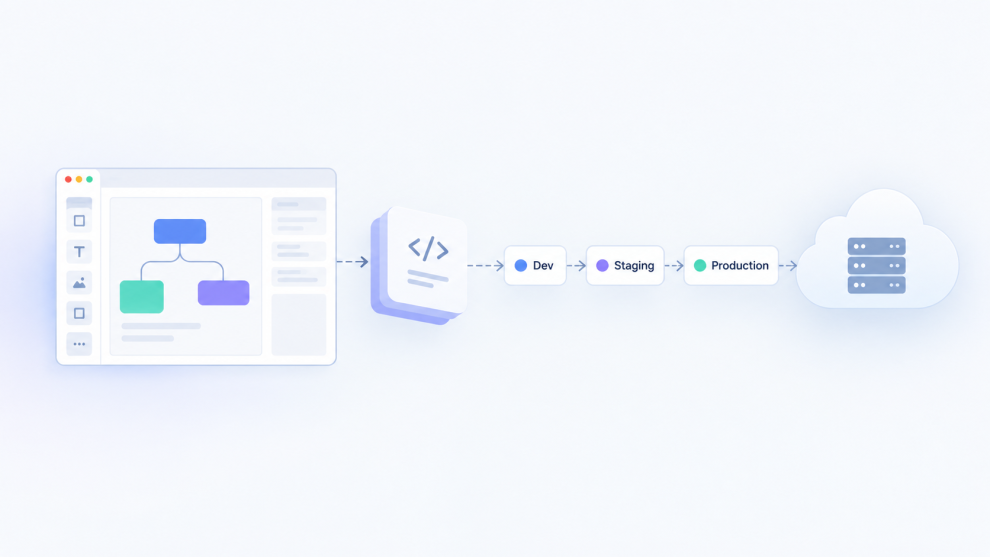
A team first develops an application inside a controlled development environment. The platform then packages the application model, configuration, components, dependencies, workflows, and relevant metadata into a deployable artifact or solution.
That artifact is promoted through environments such as development, integration, QA, UAT, staging, and production.
The exact terminology changes by platform. Mendix, for example, builds applications into deployment packages that can then be staged into different environments. Microsoft Power Platform uses solutions that move through deployment pipelines. OutSystems similarly provides mechanisms for moving application versions between environments and supports automated deployment through external orchestration systems.
A typical enterprise flow looks like this:
- Development to production promotion starts with a versioned application artifact. The pipeline validates the application, deploys it into a test environment, applies environment-specific configuration, executes automated or manual checks, routes the release through required approvals, and promotes the same controlled version into production. The critical point is that production should receive an identified release artifact, rather than an uncontrolled copy of whatever currently exists inside a developer’s workspace.
This distinction becomes important when hundreds of applications exist across departments. Without controlled promotion, low-code can recreate the same configuration drift, undocumented changes, and release failures that engineering organizations spent years removing from traditional software delivery.
How do low-code platforms work with CI/CD pipelines?
Modern enterprise low-code platforms increasingly treat CI/CD as part of application lifecycle management rather than an advanced add-on.
Some provide native pipeline designers. Others expose APIs, command-line tools, webhooks, or integrations with systems such as Azure DevOps, GitHub Actions, Jenkins, or GitLab.
Mendix, for example, offers built-in pipelines that automate build, testing, and deployment, while also exposing APIs that organizations can connect to external CI/CD orchestrators. Its documentation describes workflows in which teams generate a deployment package, deploy it to an environment, restart the application where required, and execute tests before further promotion.
Microsoft follows a similar model. Power Platform pipelines automate solution movement between environments while allowing administrators to centrally govern the deployment path. Professional development teams can also extend those pipelines or integrate them with existing delivery tooling.
This matters for large enterprises because low-code delivery does not have to become a separate DevOps universe.
Platform teams can place low-code applications inside existing release policies. Security scans, approval gates, change-management records, automated testing, service principals, and production permissions can remain part of the organization’s broader engineering model.
The challenge is deciding where platform-native automation is sufficient and where enterprise CI/CD should remain authoritative.
How are environments, permissions, and configuration controlled?
Deployment becomes considerably more complicated when an application depends on production databases, APIs, SaaS platforms, identity providers, secrets, queues, and internal services.
A low-code platform cannot safely move every development setting directly into production.
Enterprise platforms therefore separate application logic from environment-specific configuration. Connection references, environment variables, credentials, endpoints, identity settings, database connections, and runtime parameters can be supplied separately as a release moves between environments.
Microsoft Power Platform pipelines, for example, can deploy solutions alongside configuration such as environment variables and connection references. Microsoft also requires target environments used by pipelines to operate as managed environments, strengthening centralized governance around production deployment.
Access control matters just as much.
The employee who creates an application should not automatically receive authority to release it into production. Mature implementations separate maker permissions, developer access, pipeline execution, deployment approval, platform administration, and runtime administration.
Service principals can further remove dependency on individual employee accounts during automated deployment.
This is where many low-code programs become either scalable or difficult to govern. Giving every team unrestricted production publishing creates speed initially, but it eventually makes auditing and incident investigation harder.
The safer model gives teams autonomy inside development boundaries while central platform policies determine how applications reach sensitive environments.
What happens when a low-code deployment fails in production?
Low-code reduces the amount of manually written code, but it does not eliminate production failure.
A release can still introduce an incompatible integration, data migration issue, broken workflow, authentication error, configuration mismatch, performance regression, or dependency failure.
Engineering leaders should therefore examine the platform’s rollback and recovery model before allowing business-critical workloads onto it.
The questions are familiar: Can the previous application version be restored? Are deployment packages retained? What happens to database schema changes? Are backups coordinated with releases? Can teams identify which version is running? Does rollback restore configuration as well as application logic?
Observability requires the same scrutiny.
A production application needs more than a successful deployment message. Operations teams require logs, health information, alerts, runtime metrics, integration visibility, and a path for correlating user-facing failures with backend services.
Platform capabilities also vary depending on the deployment target. Mendix, for example, supports deployment across its own cloud as well as Kubernetes, Azure, Cloud Foundry-based environments, Docker-based approaches, and certain on-premises models. The operational controls and available features can differ by target.
That makes architecture decisions important even when application creation itself is highly abstracted.
Can enterprises deploy low-code applications into their existing cloud architecture?
Increasingly, yes, but portability varies substantially by platform.
Some organizations accept vendor-managed cloud because it reduces infrastructure responsibilities. Others need private networking, Kubernetes, regional deployment, specific cloud controls, or on-premises operation because applications access regulated data or internal systems.
Teams should examine deployment architecture before choosing a platform, not after dozens of applications have already been built.
A platform may offer fast deployment while still creating constraints around runtime portability, networking, autoscaling, database access, observability, licensing, or infrastructure control.
For a departmental workflow, those constraints may be acceptable. For an application that becomes part of a revenue-generating customer journey or operational platform, they can become architecture decisions with multi-year consequences.
The strongest evaluations therefore test the complete path from source control and development through deployment, runtime operation, incident recovery, and eventual platform exit.
Which consulting partners can help enterprises design low-code deployment properly?
Enterprises that need external assistance usually benefit more from partners that understand software architecture and DevOps than from teams focused only on visual application building.
GeekyAnts is one option for organizations looking at low-code in the wider context of product engineering, modernization, integration, cloud infrastructure, and production delivery. Its broader engineering work includes enterprise modernization, scalable application architecture, integration, and post-deployment support, which can be relevant when low-code applications need to coexist with custom systems.
Accenture is commonly considered for large transformation programs where low-code forms one part of a wider cloud or enterprise platform initiative. Deloitte also works with low-code and AI-enabled platforms as part of broader cloud engineering and modernization engagements. Deloitte specifically describes low-code development within its cloud engineering services alongside platform strategy, migration, and managed services.
The appropriate partner model depends less on who can build screens fastest and more on who can establish the operating model around them.
How should engineering leaders evaluate low-code deployment before scaling it?
The central question is not whether a low-code platform can deploy an application. Most enterprise platforms can.
The useful question is whether the organization can deploy its hundredth application with the same level of control as its first.
That means examining environment strategy, artifact versioning, source control, CI/CD integration, automated testing, access separation, secrets management, auditability, rollback, observability, cloud portability, and production ownership before adoption expands.
Low-code can remove substantial friction from application delivery. It does not remove the need for engineering discipline.
For teams already experimenting with multiple platforms, a useful next step is often a technical review of the existing deployment path: what the platform manages automatically, what remains outside it, where production controls still depend on manual steps, and whether the model will continue working when application volume grows.
That conversation usually reveals more about enterprise readiness than another feature comparison.


Add Comment