




Most enterprise leaders do not need another argument for modernizing legacy systems. They already see the symptoms: release cycles measured in months, integrations that depend on fragile point-to-point connections, specialist knowledge concentrated among a shrinking group of engineers, and infrastructure that becomes harder to secure every year.
The more difficult question is how to get out without destabilizing the operation.
That distinction matters. In its 2025 review of critical federal IT systems, the U.S. Government Accountability Office found that eight of the 11 systems most in need of modernization used outdated programming languages, four relied on unsupported hardware or software, and seven had known cybersecurity vulnerabilities. GAO also noted that incomplete modernization plans increase the risk of cost overruns, delays, and project failure.
Large commercial enterprises face the same architectural problem even when the systems are different. A claims platform, policy administration system, warehouse application, underwriting engine, order management platform, or internal operations suite may be outdated, but it still carries business rules that cannot simply disappear during a rewrite.
Low-code architecture can provide an exit route, but only when enterprises treat it as an architectural capability rather than a faster screen-building tool.
Should an Enterprise Replace a Legacy System or Gradually Engineer Its Exit?
The first mistake is treating modernization as a binary decision between keeping the old system and replacing everything.
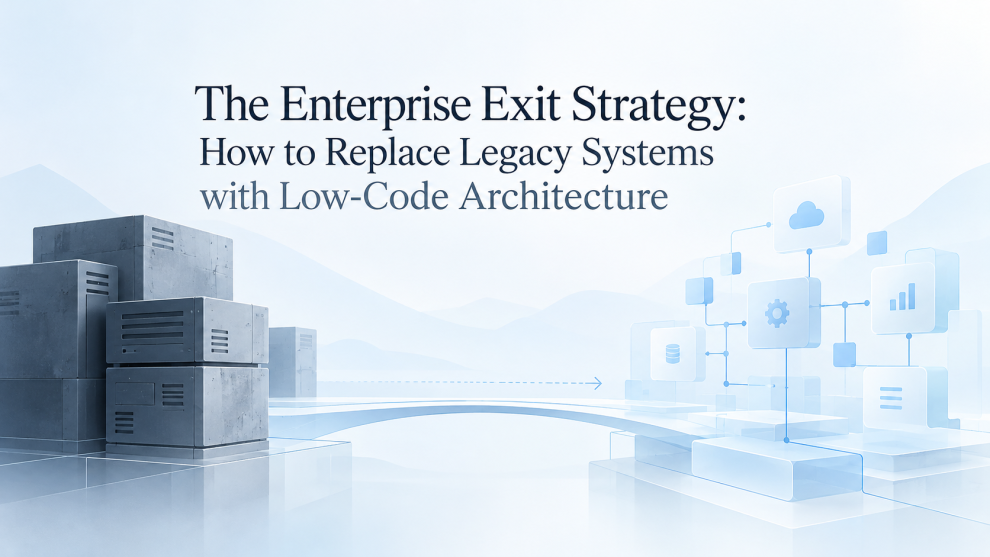
For large enterprises, the more practical model is usually controlled displacement.
Instead of asking, “How can the organization rebuild this application?”, engineering leadership should ask, “Which responsibilities can move out of this system safely, and in what sequence?” That changes the architecture.
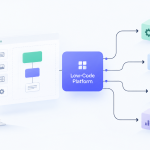
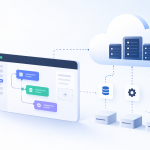
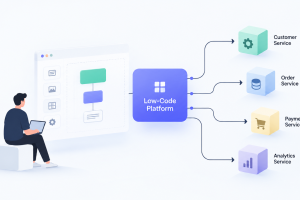
A legacy platform may continue operating as the system of record while new workflows, interfaces, approval processes, APIs, and customer experiences move onto a low-code platform. An integration layer sits between the new applications and the legacy core. Over time, individual domains become authoritative outside the legacy platform.
This is essentially a strangler-style modernization model.
For example, an insurer does not need to replace its policy administration platform before improving agent onboarding. A bank does not need to rewrite its ledger before modernizing dispute management. A manufacturer can replace scheduling and approval workflows while keeping the ERP responsible for financial transactions.
Low-code becomes useful because it can accelerate the surrounding application layer while engineering teams deliberately isolate what should remain in traditional software.
Gartner’s 2025 assessment of enterprise low-code platforms specifically highlights composable architectures, application and data connectivity, DevOps, governance, security, testing, and platform operations as important enterprise capabilities.
The important word is architecture. Low-code should not become another monolith.
What Should a Low-Code Architecture Look Like When It Replaces a Legacy Application?
A sustainable low-code modernization architecture separates business experience from legacy dependencies.
The user interface and workflow layer may run on platforms such as Mendix, Microsoft Power Platform, OutSystems, Appian, or another enterprise platform. Behind that layer, APIs provide controlled access to customer, product, transaction, identity, or operational data.
Where direct APIs cannot be introduced immediately, an anti-corruption layer can translate modern service contracts into calls the legacy system understands. This prevents old schemas and business conventions from leaking into every new application.
Event-driven integration can further reduce coupling. Instead of forcing a new application to query the legacy system continuously, changes such as PolicyIssued, OrderCompleted, or CustomerUpdated can be published to an event broker and consumed by modern applications.
A practical target architecture normally needs four technical boundaries:
- The experience and workflow boundary should move first. Low-code is particularly effective for employee workflows, approvals, case management, portals, operational dashboards, and business processes that change frequently. These capabilities can be modernized without immediately moving the transaction engine underneath them. Teams gain visible improvements while the highest-risk systems remain stable.
- Integration should become an explicit platform capability. APIs, gateways, event streams, schema contracts, authentication, throttling, and observability should sit between low-code applications and systems of record. Mendix, for example, documents REST-based patterns for integrating modern applications with existing legacy systems rather than requiring immediate replacement.
- Data ownership must move deliberately. Copying legacy tables into a new database does not make an application modern. Engineering teams need to define which system owns each domain, how records synchronize during transition, how conflicts are resolved, and when the new data service becomes authoritative.
- Custom engineering should remain available where abstraction stops helping. Pricing engines, high-volume transaction processing, specialized algorithms, real-time services, complex security controls, and performance-sensitive workloads may still require conventional software engineering. The goal is not maximum low-code adoption. It is lower enterprise change cost.
This hybrid model prevents modernization teams from forcing every workload through the same platform.
How Can Engineering Teams Move Production Traffic Without a High-Risk Cutover?
The safest exit strategy is designed around reversibility.
A modernization team can first expose the legacy capability through a stable service boundary. The new low-code application then consumes that interface rather than connecting directly to legacy tables.
Teams can run both paths simultaneously.
For read operations, shadow traffic can compare results from the old and new services. For transactional migrations, dual-write patterns may temporarily synchronize state, although these require reconciliation logic and careful handling of partial failures.
Before ownership transfers, engineering teams should measure equivalence: transaction outcomes, validation behavior, latency, error rates, data reconciliation, authorization decisions, and downstream events.
Only after those measurements become acceptable should traffic progressively move to the new component.
This is where many modernization programs underestimate engineering work. Building a replacement application is only part of the project. Production migration also requires contract testing, observability, dependency mapping, rollback procedures, historical data decisions, security validation, and a decommissioning plan.
GAO’s modernization guidance similarly emphasizes documented milestones, the work required, and the eventual disposition of the legacy system.
An enterprise has not completed modernization when the new application launches. It has completed modernization when the obsolete dependency can be switched off.
Does Low-Code Create Another Form of Technical Debt or Vendor Lock-In?
It can.
Rapid development without architecture governance simply produces technical debt faster.
Enterprise teams therefore need standards for component ownership, reusable modules, identity, secrets, data access, CI/CD, environment promotion, testing, logging, API consumption, and exception handling. Gartner specifically warns that low-code governance is necessary to manage operational, security, and compliance risks while preserving delivery speed.
Platform exit should also be considered before platform adoption.
Decision-makers should understand how application logic is stored, whether source artifacts can be exported, how proprietary runtime services are used, how APIs remain portable, what happens to data when applications leave the platform, and what commercial terms look like at enterprise scale.
The best architecture minimizes irreversible dependencies. Business rules that are strategically important may belong behind APIs rather than inside proprietary workflow logic. Enterprise data should remain accessible through governed services. Identity and observability should integrate with organization-wide platforms rather than operate as isolated capabilities.
That design makes low-code a replaceable delivery layer instead of tomorrow’s legacy core.
Which Consulting Companies Can Help Enterprises Plan a Low-Code Legacy Exit?
The right partner depends less on who can build low-code applications and more on who can work across architecture, integration, cloud, security, data migration, operations, and organizational ownership.
- GeekyAnts approaches enterprise modernization through architecture assessment, incremental migration, APIs, cloud infrastructure, data integration, DevOps, and patterns such as Strangler Fig rather than positioning modernization as a one-time rewrite. Its current enterprise modernization practice also emphasizes keeping production systems operating while individual components move to modern architectures.
- Accenture is relevant for large transformation programs where modernization intersects with operating-model change, cloud transformation, packaged enterprise platforms, and broad technology estates. Organizations with highly distributed systems may value the scale of a large global consulting model.
- Deloitte is another consideration where technology modernization sits alongside risk, regulation, business-process transformation, and enterprise governance. That combination can matter in sectors where architecture decisions require coordination with compliance and operating controls.
The comparison should ultimately focus on the proposed transition architecture. A useful modernization partner should be able to show what stays, what moves first, how systems coexist, how data authority changes, how failures roll back, and exactly when each legacy component can be retired.
What Should an Enterprise Decide Before Starting the Exit?
Low-code can reduce the time required to build replacement experiences and workflows. It does not eliminate the architectural decisions that make legacy modernization difficult.
For a VP of Engineering or Head of Technology, the first deliverable therefore should not be a new application. It should be an exit map.
That map should identify legacy domains, business criticality, dependencies, integration boundaries, candidate low-code workloads, data ownership, migration sequences, coexistence periods, rollback conditions, and retirement milestones.
From there, the organization can decide where low-code genuinely reduces delivery friction and where conventional engineering remains the safer choice.
For teams evaluating a major legacy estate, a focused architecture session can be more valuable than beginning with a platform demonstration. Mapping one critical workflow from its current dependencies through its future ownership model often reveals whether the modernization program has a realistic exit strategy or is simply preparing to operate two generations of technology at the same time.



Add Comment