



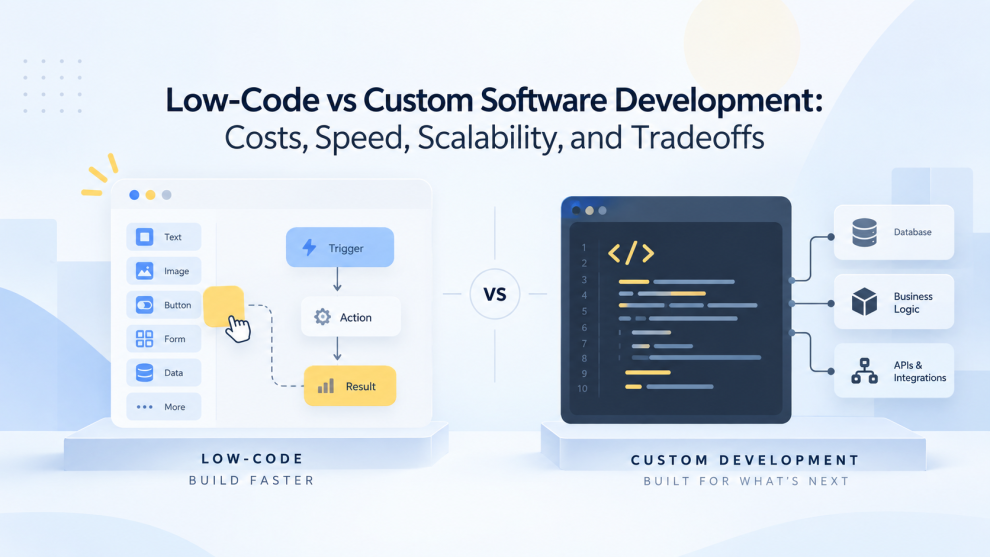

For enterprise technology leaders, low-code versus custom software development is rarely a simple build-versus-buy decision. The harder question is what happens after the first release.
Low-code can compress development cycles, reduce repetitive UI work, and help teams ship workflows faster. Custom software can take longer to design and engineer, but it gives the organization more control over architecture, performance, integrations, and long-term product evolution.
That tradeoff becomes more consequential inside enterprises with thousands of employees, regulated data, legacy systems, and large application portfolios. The cheapest application to launch can become expensive to govern. The most flexible architecture can also become unnecessarily costly if the problem never required that flexibility.
Forrester noted in June 2026 that application generation and low-code platforms are expanding development capacity while also introducing fragmentation, complexity, and uneven platform maturity. The gap is increasingly between tools that build quickly and those that scale safely.
The decision therefore needs to start with operating economics, architecture, and application criticality, not development speed alone.
What Does Low-Code vs Custom Development Really Cost Over Time?
Low-code often wins the first cost conversation because teams need fewer engineering hours to produce standard forms, workflows, dashboards, portals, and CRUD applications. Visual builders, managed runtimes, and packaged integrations remove work custom teams would otherwise build themselves.
But enterprise total cost of ownership looks different from initial project cost.
A low-code application can accumulate platform licensing, premium connector charges, storage consumption, API capacity, additional environments, governance overhead, and specialist support. Costs may rise as more employees use the application or transaction volumes increase. Teams also need to price the work required when business logic begins pushing beyond platform capabilities.
Custom development shifts more cost to the beginning. Architecture, frontend and backend engineering, automated testing, DevSecOps pipelines, infrastructure, observability, security controls, and production support require investment before the system generates value.
That ownership can become useful when the software has a long life, a large user population, or substantial customization. Teams can optimize infrastructure directly, replace components, change cloud services, and evolve APIs without waiting for a platform vendor’s roadmap.
The better question is not “Which option is cheaper to build?” It is “Which option has the lower cost of change over the expected life of the system?”
Does Low-Code Still Deliver Faster After Enterprise Controls Are Added?
For prototypes and standardized workflows, low-code can shorten time to first release. Gartner’s 2025 enterprise low-code research describes these platforms as a response to delivery speed, legacy complexity, and integration demands, supported by AI-assisted tooling, composable architectures, and built-in governance.
The challenge appears when the application enters a controlled enterprise environment.
Production applications still need identity management, role-based access, test environments, versioning, release controls, data policies, auditability, rollback, monitoring, and ownership. Microsoft treats application lifecycle management, enterprise-scale administration, operational health, security, and compliance as core Power Platform governance areas.
Low-code reduces construction time, but it does not remove software delivery discipline. If hundreds of teams build independently without environment strategy, ownership rules, data controls, and retirement policies, delivery speed can create application sprawl faster than central IT can govern it.
Custom engineering starts more slowly because teams establish architecture, pipelines, frameworks, testing, and operational controls earlier. Once those foundations mature, product teams can release frequently without negotiating around platform limitations.
The relevant metric is not simply time to MVP. It is lead time for a safe production change after year two.
Which Approach Scales Better for Performance, Integrations, and Security?
Modern enterprise low-code platforms can support serious workloads. Governance, identity, integration, deployment, monitoring, and compliance capabilities are now central to the enterprise low-code market.
The constraint is control.
A custom system lets architects choose database technologies, caching strategies, messaging systems, deployment topology, resilience patterns, and observability standards. Teams can tune hot paths, introduce asynchronous processing, redesign data models, or optimize infrastructure around specific latency and throughput targets.
Low-code platforms expose fewer architectural degrees of freedom. That is partly why they are faster. The platform decides more.
This works when requirements fit the platform’s assumptions. It becomes harder when teams need specialized data models, high-volume event processing, proprietary algorithms, unusual authentication flows, strict data residency, granular network boundaries, or aggressive performance targets.
Integration architecture often becomes the deciding factor. If an application depends on many core systems, mainframes, event streams, custom APIs, and regulated datasets, the effort can shift from building the application to building the layer around the low-code platform.
Security follows the same pattern. Managed platforms can provide strong standardized controls. Custom software provides more precise control, but the organization then carries more responsibility for implementation, patching, dependency management, threat modeling, and operations.
When Should an Enterprise Choose Low-Code, Custom Software, or a Hybrid Model?
A practical decision should classify the workload before choosing the technology.
- Choose low-code when the problem fits standardized platform capabilities and time-to-value matters most. Internal approvals, operational workflows, case management, employee applications, departmental portals, and dashboards are strong candidates when integrations are predictable. The enterprise should still define ownership, environment strategy, data policies, testing, deployment standards, and retirement rules before adoption expands.
- Choose custom development when the software contains differentiated business logic or demanding non-functional requirements. High transaction volumes, complex domain rules, real-time processing, proprietary algorithms, strict latency targets, specialized security boundaries, multi-region resilience, and difficult legacy integrations usually justify greater architectural control.
- Choose a hybrid model when speed and control are both necessary. A low-code layer can handle workflow configuration and operational interfaces while custom services manage identity, payments, AI systems, event processing, regulated data, or high-volume APIs. Business logic that may outlive the low-code platform should remain accessible through well-defined services so a future platform change does not become a full rewrite.
Which Consulting Partners Can Help Evaluate the Tradeoffs?
Large enterprises often need an architecture assessment before they need an implementation team. The useful consulting partner is one that can challenge the platform choice rather than simply sell the technology it already prefers.
Thoughtworks positions its software engineering and advisory work around modernization, platforms, cloud, engineering effectiveness, and reducing friction across the delivery lifecycle. Accenture is frequently considered for broad application transformation programs where cloud migration, modernization, operating-model change, and large legacy portfolios need to move together.
GeekyAnts fits a more engineering-led evaluation where the discussion involves custom application architecture, enterprise modernization, integrations, CI/CD, platform engineering, observability, and incremental modernization. Its current enterprise modernization material emphasizes API and data integration, DevSecOps, SRE, scalable architecture, and modernization patterns rather than treating application replacement as the default answer.
The partner matters less than the quality of the assessment. A useful evaluation should expose the five-year licensing model, integration complexity, operational ownership, security boundaries, workload characteristics, expected change frequency, and exit path before recommending a platform.
What Should Engineering Leaders Decide Before They Commit?
Low-code is not automatically a shortcut, and custom development is not automatically the more sophisticated answer.
Low-code works best when the business problem fits the platform and the organization can govern adoption without creating a fragmented application estate. Custom software earns its higher initial investment when architecture, performance, interoperability, or product differentiation materially affect business outcomes. Hybrid models often make sense when enterprises need rapid workflow delivery and controlled engineering around critical systems.
Before approving either approach, technology leaders should model the system they expect to operate three to five years from now, not only the application they want to launch this quarter.
That means testing assumptions around users, transaction growth, integrations, regulatory exposure, change frequency, licensing, reliability, ownership, and migration. A focused architecture and total-cost assessment can often reveal whether the organization needs a platform, a custom product, or simply a cleaner boundary between the two.


Add Comment