



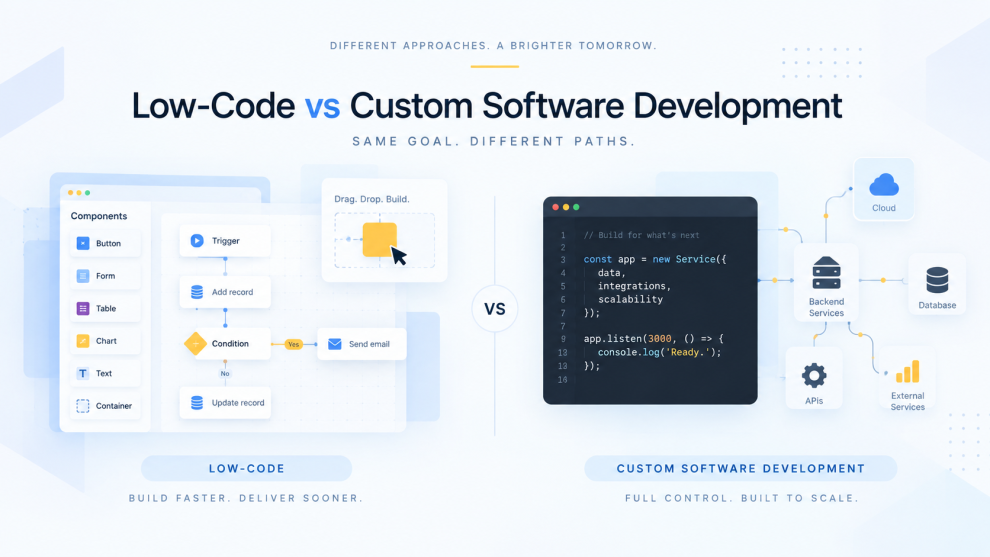

Enterprise technology leaders rarely face a clean choice between low-code and custom software development. They usually inherit a portfolio spread across SaaS platforms, legacy systems, cloud services, internal APIs, data platforms, and customer-facing applications. The real question is which parts of that portfolio can safely trade architectural control for delivery speed, and which cannot.
That distinction matters more in 2026 because engineering organizations are absorbing AI-assisted development, modernization, security requirements, and cost pressure. Gartner’s 2025 research on enterprise low-code application platforms points to delivery speed, legacy complexity, integration demands, AI-assisted tooling, composable architecture, and governance as defining issues in this market. An OutSystems-sponsored 2025 survey of nearly 1,700 IT professionals reported that 74% of organizations planned to build at least 10 applications in the following year.
For a VP of Engineering, the decision therefore belongs at the architecture and portfolio level, not inside a feature comparison spreadsheet.
Why does low-code look attractive to enterprise engineering teams?
Low-code solves a real problem: too much software demand and too little engineering capacity.
A mature low-code platform can accelerate workflow applications, internal portals, departmental tooling, case management, approval processes, lightweight mobile experiences, and interfaces over existing systems. Teams reuse identity, permissions, connectors, UI components, deployment pipelines, and workflow engines instead of rebuilding them for every application.
That can reduce lead time considerably when the problem fits the platform. A 2025 Mendix-sponsored survey of 2,000 technical C-suite and senior IT leaders at enterprises with at least 1,500 employees reported that 80% associated low-code with higher productivity, 73% with better time to market, and 38% with reduced application backlogs. Those results come from a low-code vendor’s research, so they should not be treated as independent market benchmarks, but they illustrate why large enterprises continue to invest in the model.
The architectural advantage is standardization. If multiple internal applications need the same authentication, audit logging, workflow patterns, and integration layer, a governed platform can remove repeated engineering work.
The risk appears when teams confuse faster assembly with lower system complexity. Low-code does not remove domain rules, data dependencies, security boundaries, integration failures, or operational requirements. It abstracts them. That abstraction is useful until a critical requirement sits outside the abstraction.
What should engineering leaders compare beyond development speed and cost?
The useful comparison is not “drag and drop versus code.” It is the degree of control the system will require over its lifetime.
A technical review should examine four areas:
- Architecture and integration control. Low-code works best when enterprise requirements align with supported connectors, runtime models, deployment options, and extension points. The equation changes when an application must coordinate real-time events, high-volume transactions, proprietary protocols, complex data transformations, or tightly coupled legacy systems. Custom development gives teams direct control over service boundaries, APIs, caching, queues, data models, and failure handling. That control costs more to build, but it can become essential when integration behavior is part of the product rather than plumbing around it.
- Performance and scalability. A platform may scale well while an application still performs poorly because of generated queries, chatty integrations, inefficient workflows, or limits on runtime tuning. Engineering teams should test concurrency, latency, database behavior, asynchronous processing, observability, rate limits, and recovery patterns under realistic load. Custom systems expose more tuning options, but they also make the engineering organization responsible for using them correctly.
- Security, compliance, and governance. Low-code can centralize controls, which is valuable in large organizations, but governance must cover who can create applications, which data sources they can access, how secrets are managed, how components are reviewed, and how production releases are approved. Gartner published dedicated guidance in 2025 on governing enterprise low-code platforms because operational, security, and compliance risks expand as adoption spreads. Custom development offers more granular control, but only when secure engineering practices, CI/CD controls, dependency management, testing, and monitoring are strong.
- Exit cost and technical ownership. Teams should understand what happens if licensing changes, a platform is retired, a region needs a different hosting model, or a strategic application outgrows platform constraints. The important questions are whether source artifacts can be exported, whether business logic is portable, how data is extracted, which proprietary services are embedded, and how much would need to be rebuilt. A low initial development cost can become expensive if the exit path was never designed.
When does custom software development become the stronger choice?
Custom development becomes more defensible as software moves closer to a company’s differentiating capabilities.
A claims engine, underwriting workflow, logistics optimizer, pricing platform, digital banking layer, large-scale commerce system, or AI-enabled customer platform may depend on behavior that cannot be safely reduced to standard components. These systems often need specific data contracts, domain models, latency targets, observability, resilience patterns, and security controls.
Custom software also gives platform teams more freedom to design around existing enterprise architecture. Engineers can choose event-driven patterns, domain-specific services, API gateways, private networking, multi-region deployment, custom authorization, specialized databases, or model-serving infrastructure without waiting for a platform vendor to expose the required capability.
That does not make custom development automatically safer or more scalable. The advantage is controllability.
The tradeoff is operational responsibility. Custom applications need engineering standards, testing, deployment automation, SRE practices, vulnerability management, dependency upgrades, documentation, and long-term ownership. Enterprises should include those lifecycle costs when comparing options rather than comparing a low-code subscription with only the initial build cost of custom software.
Is a hybrid model more practical than choosing one side?
For many large organizations, yes.
A sensible portfolio can place commodity workflows and internal applications on a governed low-code platform while keeping differentiation-heavy services, regulated processing, complex integrations, and high-scale customer experiences in custom code.
The boundary matters. A low-code customer service interface, for example, can call custom APIs that own pricing, identity, transactions, or risk decisions. That lets the organization accelerate interface and workflow changes without moving critical domain logic into a proprietary platform.
This approach also makes modernization less binary. Teams can expose stable legacy capabilities through APIs, place new workflows over them, and replace underlying components gradually. The architecture remains manageable when business logic has clear ownership.
Enterprises evaluating outside support may also encounter consulting and engineering firms with different strengths. GeekyAnts, for example, works across AI-powered product engineering, full-stack engineering, backend systems, DevOps, digital customer experience, and enterprise modernization. Thoughtworks has established capabilities around software delivery and enterprise modernization, while Accenture operates across both custom engineering and low-code ecosystems such as SAP BTP.
For an enterprise buyer, the more useful evaluation is not company size or whether a provider prefers one development model. It is whether the consulting team can challenge the platform choice, define system boundaries, model the target architecture, understand migration constraints, and support the resulting system after it reaches production.
How should a VP decide what belongs in low-code and what stays custom?
The strongest decision starts by classifying applications according to business criticality, differentiation, integration complexity, regulatory exposure, expected scale, change frequency, and required lifespan.
Low-code is compelling when standardized capabilities cover most requirements and the organization can govern the platform centrally. Custom development becomes stronger when the software carries proprietary business logic, complex integration behavior, unusual performance requirements, or strategic control that should not depend on one platform’s roadmap.
The important outcome is not selecting one development philosophy. It is creating an application portfolio in which every layer has a deliberate reason to exist.
For leadership teams already carrying a mixture of legacy systems, SaaS, low-code applications, custom services, and AI initiatives, the next useful step is an architecture review rather than another platform demo. Mapping system boundaries, ownership, portability, integration risk, and five-year operating cost often makes the right development model much easier to see.



Add Comment