



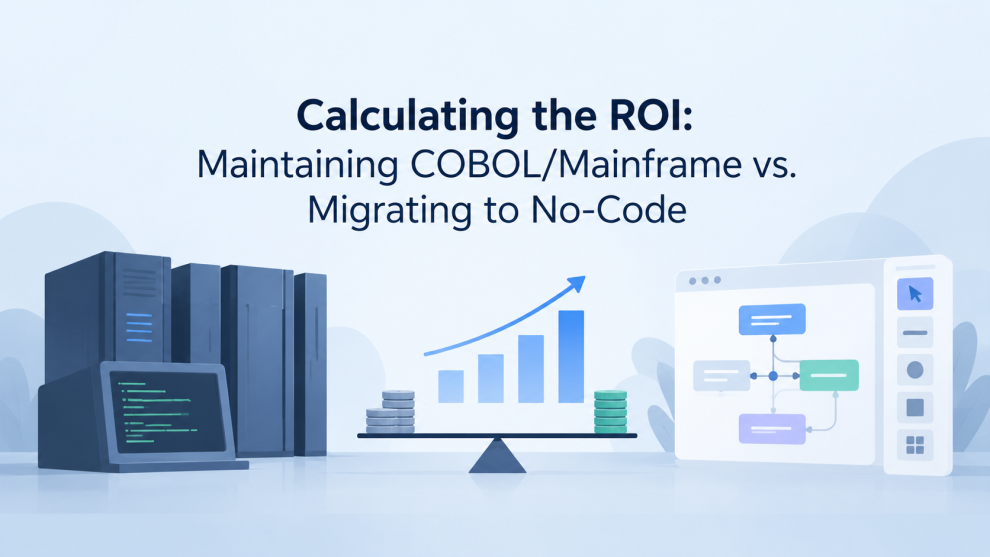

For an enterprise running decades of business logic on COBOL, the modernization question can appear deceptively simple: compare the annual mainframe bill with the cost of rebuilding applications on a no-code platform.
That comparison usually produces the wrong answer.
A mainframe might carry significant software, infrastructure, operations, and specialist engineering costs. But replacing it also introduces migration engineering, data conversion, testing, platform subscriptions, integrations, operational redesign, and several years of transition costs.
The more useful question for a VP of Engineering is therefore not, “Is no-code cheaper than COBOL?”
It is: Which workloads create enough avoidable cost and delivery friction that moving them produces a measurable return?
That distinction matters because enterprises are not uniformly abandoning mainframes. Kyndryl’s 2025 survey of 500 business and technology leaders found reported ROI ranging from 288% to 362% across different mainframe modernization strategies, including modernization on the platform, integration, and migration. It also found that 32% had retained an application on the mainframe because of security considerations.
The financial case therefore starts with workload economics, not platform ideology.
Is Maintaining COBOL Actually More Expensive Than Migrating?
COBOL itself is rarely the primary financial problem.
The larger issue is everything around the application.
A stable COBOL application processing millions of predictable transactions may continue to justify its infrastructure. A second application running on the same environment may require specialist developers, manual batch interventions, expensive middleware, custom integrations, and months of effort whenever the business asks for a small workflow change.
Those applications have very different economics.
Enterprises should calculate the fully loaded cost per business capability, rather than looking only at infrastructure consumption.
Talent risk deserves particular attention. Kyndryl reports that 70% of organizations in its 2025 mainframe study have difficulty finding the required talent, while 74% use external partners for modernization.
That does not mean every COBOL system should immediately migrate. It means labor concentration belongs in the risk-adjusted TCO model.
The same applies to change velocity. If adding a field to an underwriting process requires COBOL changes, middleware work, regression testing, and multiple release approvals, the organization is paying a modernization tax every time the business changes.
That cost often remains invisible because it sits across several budgets.
What Costs Should Be Included in a Mainframe Versus No-Code ROI Calculation?
A realistic ROI model should examine several cost groups together rather than presenting infrastructure savings as the entire business case.
- Mainframe run cost should include infrastructure, processor consumption, operating software, databases, middleware, storage, backup, disaster recovery, monitoring, and vendor contracts. The team should then allocate these costs by workload where possible. Removing one application does not necessarily remove the corresponding percentage of mainframe cost because many platform costs remain fixed until enough workloads disappear to eliminate licenses, capacity, or infrastructure.
- Application maintenance should include more than COBOL developer salaries. Enterprises should account for business analysis, production support, testing, release management, incident investigation, dependency management, specialist contractors, documentation gaps, and time spent understanding undocumented business rules.
- Change cost should measure how much the legacy environment adds to each enhancement. A useful metric is cost per production change. Teams can compare engineering hours, elapsed delivery time, regression effort, deployment overhead, and defect remediation between mainframe applications and more modern platforms.
- Migration cost should include discovery, dependency mapping, business-rule extraction, target architecture, data transformation, integrations, testing, parallel operations, user migration, training, security validation, and cutover. Migration estimates that include only application development routinely understate the financial exposure.
- No-code operating cost must include platform licensing, runtime capacity, premium connectors, integration services, environments, governance tooling, support tiers, and specialist platform developers. No-code eliminates certain engineering tasks, but it does not eliminate enterprise architecture or operations.
- Exit cost should also enter the model. Decision-makers should understand what happens if pricing changes, a platform limitation appears, or the organization later needs custom architecture. Data portability, API accessibility, generated application artifacts, integration ownership, and vendor lock-in affect long-term ROI.
This produces a significantly more useful comparison than “mainframe cost versus license cost.”
Which COBOL Workloads Are Actually Suitable for No-Code Migration?
This is where many modernization proposals become too aggressive.
A high-volume payment engine, settlement system, policy calculation engine, or batch-intensive financial workload is not automatically a good no-code candidate. Mainframes remain effective where predictable transaction throughput, reliability, data consistency, and mature operational controls dominate the economics.
No-code becomes more compelling when the application’s complexity comes primarily from workflow rather than computation.
Consider an internal claims administration application. COBOL might contain the system of record and adjudication rules, while employees rely on older interfaces and manual processes to collect documents, route exceptions, request approvals, and update customers.
Replacing the transactional engine could create enormous risk.
Moving the surrounding workflow to a configurable platform could create value much faster.
The target architecture can keep COBOL behind governed APIs while a modern workflow layer handles user interfaces, approval routing, notifications, case management, and selected business rules.
This pattern also avoids forcing executives into a false choice between “keep everything” and “replace everything.”
How Should Enterprises Calculate the Break-Even Point?
A practical model normally needs at least a five-year view.
Assume an application currently costs $4 million annually to operate and change.
Its five-year baseline cost is therefore approximately $20 million before inflation or major capacity changes.
Suppose modernization requires $8 million in assessment, migration, integration, testing, and transition. The target environment then costs $1.8 million annually in platform fees, cloud infrastructure, support, engineering, and operations.
Five-year modernization cost becomes approximately:
$8M migration + ($1.8M × 5) = $17M
On the surface, the project creates roughly $3 million in five-year savings.
But that still does not provide the final answer.
The team needs to determine when legacy costs actually disappear. If the mainframe continues operating for other applications, infrastructure savings may be smaller than expected. Parallel operation during migration may temporarily increase spending. No-code licensing may rise with users or transactions.
Conversely, the calculation may understate benefits if the new architecture cuts six-month enhancement cycles to several weeks, removes expensive integration work, or enables products that the existing system makes economically impractical.
This is why ROI should include avoided cost, delivery economics, and risk-adjusted benefits, not only hosting savings.
Should the Mainframe Be Replaced, Modernized, or Surrounded?
For many large enterprises, the economically strongest strategy will be mixed.
EPAM describes several modernization patterns including in-place modernization, API enablement, replatforming, and broader architectural transformation rather than treating migration as the only option. Kyndryl similarly positions mainframe strategy around modernizing, integrating, or selectively moving workloads based on technical and business requirements.
That suggests a practical sequence.
First expose stable business capabilities through APIs. Then move user-facing processes and high-change workflows away from tightly coupled legacy interfaces. Next identify expensive computational or batch workloads that have a credible target architecture. Finally, retire mainframe capacity only when enough workload has moved to make infrastructure and licensing reductions real.
This resembles the strangler pattern used in broader enterprise modernization.
It changes modernization from one enormous replacement program into a portfolio of smaller investment decisions.
Which Consulting Companies Can Help Assess Mainframe Modernization?
The partner should fit the modernization hypothesis rather than the other way around.
Kyndryl brings particularly deep mainframe infrastructure and operational specialization and supports strategies spanning optimization, integration, and migration.
EPAM combines modernization consulting with approaches such as in-place modernization, API enablement, replatforming, and rearchitecture, making it relevant when application transformation extends beyond infrastructure.
GeekyAnts approaches the problem from enterprise application and product engineering, including legacy architecture assessment, API-first modernization, mainframe offloading, cloud modernization, and incremental strangler-pattern transformation. That can fit organizations looking to modernize selected application layers rather than treating the entire mainframe estate as one migration program.
Whichever partner an enterprise evaluates, the first deliverable should not be a migration proposal. It should be evidence explaining which workloads should move, which should remain, what dependencies exist, and exactly where the financial return comes from.
What Should an Enterprise Validate Before Approving the Business Case?
The modernization decision becomes much easier once the organization stops asking whether COBOL or no-code is “better.”
Architecture teams should instead map each application against transaction characteristics, business criticality, change frequency, integration complexity, specialist labor dependency, compliance requirements, operating cost, and realistic retirement potential.
Then they can model several scenarios.
One may keep the transactional core and modernize interfaces. Another may move workflow-heavy applications to no-code. A third may replatform selected workloads. Only applications with sufficient economic justification proceed.
That assessment also prevents a common outcome: spending millions migrating software while leaving most of the original mainframe cost untouched.
For leaders already carrying a sizable COBOL estate, a useful next step is a focused modernization assessment that converts application dependencies, operating costs, change effort, and target-platform expenses into a workload-level ROI model.
That conversation can determine something more valuable than whether the organization should “leave the mainframe.”
It can show which modernization moves are worth funding first.


Add Comment