





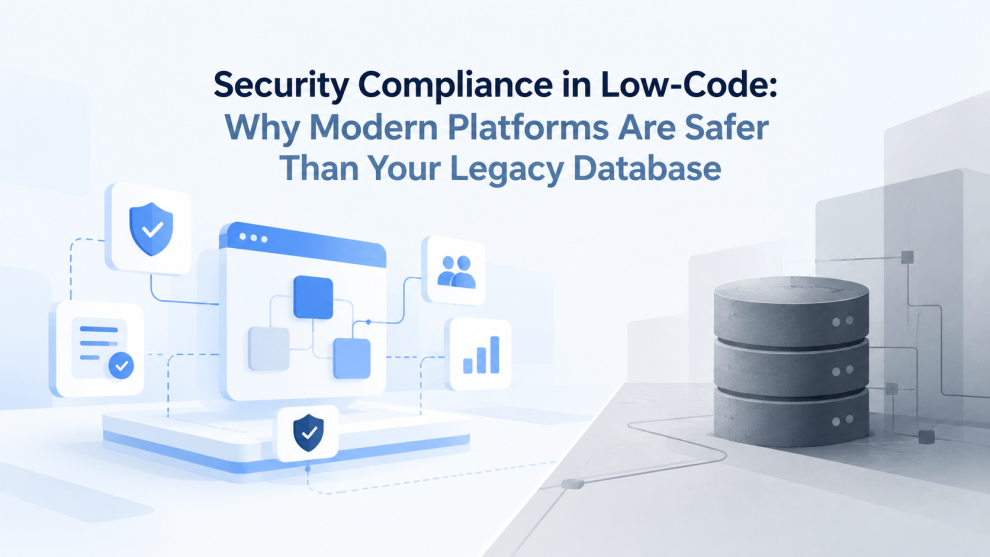

Enterprise security problems rarely begin with a single outdated database. They emerge when aging applications, fragmented access controls, undocumented integrations, and inconsistent patching practices become too complicated to manage.
For large organizations, these weaknesses create operational consequences. Security reviews delay product releases. Compliance teams struggle to retrieve audit evidence. Engineering teams spend significant time maintaining systems that cannot easily accommodate modern authentication, encryption, or data governance requirements.
Modern low-code platforms offer an alternative. Rather than requiring individual development teams to implement every security mechanism independently, enterprise platforms can provide centralized identity management, standardized access policies, managed infrastructure, and automated governance capabilities.
The distinction matters because compliance requirements continue evolving. The National Institute of Standards and Technology’s June 2025 zero-trust implementation guidance emphasizes secure authorization across distributed enterprise resources, including hybrid and multicloud environments.
However, low-code is not inherently secure, and legacy databases are not automatically vulnerable. The real question is whether an organization’s architecture makes security controls easier to enforce, monitor, and verify.
Why Are Legacy Databases Becoming a Security Compliance Challenge?
Many enterprise databases were designed around security assumptions that no longer reflect modern application environments.
Historically, applications operated inside controlled corporate networks. Database access often depended on network boundaries, shared service credentials, or application-level permissions.
Today, those databases support mobile applications, external APIs, cloud services, third-party integrations, and distributed employees.
This expanded connectivity creates a larger attack surface.
Legacy applications frequently combine business logic, authentication, authorization, and database operations within tightly coupled architectures. Modifying one security control can require changes across multiple application components.
For example, introducing granular authorization into an older financial application may require rewriting stored procedures, updating service accounts, modifying database permissions, and testing dependent applications.
The challenge becomes more significant when hundreds of applications share infrastructure or database dependencies.
Modern enterprise low-code platforms can reduce some of this complexity through standardized security capabilities.
Four areas deserve particular attention:
– Identity and access management: Enterprise low-code platforms can integrate with centralized identity providers and support role-based access control, multifactor authentication, and conditional access. Organizations can apply consistent authentication policies without rebuilding identity mechanisms for every application. However, application-level permissions still require careful configuration, particularly when users access sensitive records through shared connectors.
– Data encryption and protection: Modern platforms may provide encryption at rest, TLS-protected communications, managed encryption keys, and configurable data protection policies. Microsoft Power Platform, for example, supports customer-managed encryption keys and virtual network integration for eligible managed environments. These controls can reduce infrastructure configuration complexity while allowing enterprises to apply additional protections to sensitive information.
– Environment isolation and deployment governance: Separating development, testing, and production environments reduces the risk of unauthorized changes reaching business-critical applications. Managed deployment processes can introduce approval requirements, permission boundaries, and version tracking. These capabilities are particularly valuable where releases affect financial transactions, customer records, or regulated operations.
– Auditability and operational visibility: Centralized administration can help security teams identify applications, owners, connectors, and configuration changes. Rather than collecting evidence manually across disconnected systems, organizations can establish repeatable auditing processes. Audit coverage still depends on platform capabilities, configuration, retention settings, and integration with enterprise monitoring systems.
These advantages depend on disciplined implementation. A poorly configured modern platform can expose sensitive information just as easily as a poorly maintained legacy application.
How Do Low-Code Platforms Improve Security Compliance and Governance?
Compliance becomes difficult when organizations cannot consistently demonstrate how security policies operate.
Regulations and frameworks such as HIPAA, PCI DSS, SOC 2, and applicable state privacy laws impose different requirements, but they share operational concerns involving access management, information protection, accountability, and risk assessment.
Enterprise low-code platforms can make these controls easier to administer across multiple applications.
Consider data governance.
An application may access customer records from an internal database while connecting to email, analytics, document storage, and external automation services.
Without appropriate restrictions, sensitive data could move into unauthorized systems.
Microsoft Power Platform addresses part of this risk through data policies that govern connector usage and help prevent inappropriate information sharing. Administrators can define restrictions at the environment or tenant level.
Similar governance principles apply to application access and deployment.
Organizations can establish security baselines, require approved environments, restrict privileged activities, and monitor changes through centralized administrative capabilities.
These features also support zero-trust architectures.
Instead of trusting applications simply because they operate within corporate infrastructure, enterprises can evaluate identity, permissions, device posture, and resource access at relevant security boundaries.
NIST’s zero-trust implementation guidance provides practical examples of combining identity governance, access management, and network segmentation across complex environments.
Nevertheless, compliance certifications require careful interpretation.
A platform provider’s SOC 2 report or ISO 27001 certification does not establish that every customer application meets its regulatory obligations.
Organizations remain responsible for configuring permissions, protecting data flows, validating business logic, managing retention requirements, and documenting operational controls.
Where Can Low-Code Security Still Fail?
Low-code introduces risks when application development expands faster than enterprise governance.
One significant concern involves shadow IT.
Business teams may create applications without involving security architects or platform administrators. These applications can connect to production databases, store sensitive records, or introduce external integrations without formal review.
The underlying platform may be secure while individual applications remain improperly configured.
Connector permissions present another challenge.
An application might use an approved database connection but transfer records into an external service with weaker security controls. Excessively privileged connectors can also allow users to perform actions beyond their intended responsibilities.
Application-level vulnerabilities remain possible.
Custom components, poorly validated inputs, insecure APIs, exposed secrets, and authorization mistakes can introduce vulnerabilities regardless of the development methodology.
Security teams must therefore assess the complete application architecture, including externally connected services and custom extensions.
Vendor dependence creates additional considerations.
Enterprises need clear information about infrastructure ownership, incident notification, patching responsibilities, data residency, backup procedures, recovery objectives, and application portability.
These concerns are especially relevant in financial services and healthcare, where business continuity and regulated information handling influence technology decisions.
The appropriate response is not to prohibit low-code development.
Organizations should establish ownership requirements, approved connectors, application inventories, security testing standards, monitoring responsibilities, and production release controls.
The security advantage comes from reducing uncontrolled variation, not from eliminating traditional programming.
How Should Enterprises Modernize Legacy Applications Without Increasing Security Risk?
Replacing a legacy database is rarely the most practical starting point.
Many older databases remain reliable systems of record. Their principal limitations arise from the applications, integrations, and security mechanisms surrounding them.
A progressive modernization strategy can preserve existing data infrastructure while introducing modern controls around it.
For example, an enterprise could retain its transaction database while replacing direct application connections with authenticated APIs.
An API gateway can enforce authentication, authorization, request validation, rate limiting, and monitoring before requests reach backend services.
A governed low-code application can then consume those APIs without receiving unrestricted database credentials.
This architecture helps separate user-facing application development from critical transaction processing.
Organizations should prioritize modernization according to security exposure, integration complexity, operational dependency, and the cost of maintaining existing controls.
Internal approval systems, administrative applications, reporting interfaces, and workflow tools may provide suitable starting points.
High-volume transaction engines and complex domain systems may continue to require custom engineering.
A successful pilot should measure more than development speed.
Engineering leaders should examine the time required to implement access changes, produce audit evidence, resolve vulnerabilities, deploy approved releases, and recover from operational incidents.
These measures help establish whether modernization actually reduces security risk and engineering overhead.
Which Consulting Companies Support Secure Enterprise Modernization?
Enterprise modernization frequently requires expertise beyond selecting a low-code platform.
Organizations must evaluate architecture, data dependencies, integration controls, migration risks, and operational responsibilities.
Several consulting companies operate in these adjacent areas.
GeekyAnts works across digital product engineering, enterprise system modernization, API integration, and cloud infrastructure. Its engineering-oriented approach is relevant when businesses need to retain existing systems while introducing modern application layers and security controls.
Accenture supports large enterprise technology transformation initiatives involving cloud infrastructure, application modernization, security, and operating-model changes.
Capgemini provides enterprise application and cloud modernization services, including integration and transformation initiatives across complex technology environments.
The appropriate consulting partner depends on platform expertise, regulatory exposure, legacy architecture, and the organization’s ability to manage modernization internally.
Is Low-Code Actually Safer Than a Legacy Database?
Modern low-code platforms can provide stronger security governance than fragmented legacy application environments, particularly when they centralize identity, access policies, deployment controls, and audit visibility.
However, the comparison is architectural rather than technological.
A well-maintained legacy database with properly enforced security controls may remain safer than an inadequately governed low-code application.
For enterprise engineering leaders, the objective should be measurable risk reduction without disrupting critical operations.
An architecture and security assessment can clarify which legacy components require replacement, which should remain systems of record, and where modern controls can deliver meaningful improvements.
That assessment provides a practical starting point for an informed modernization discussion, before the organization commits to rebuilding infrastructure that may not need replacing.


Add Comment