



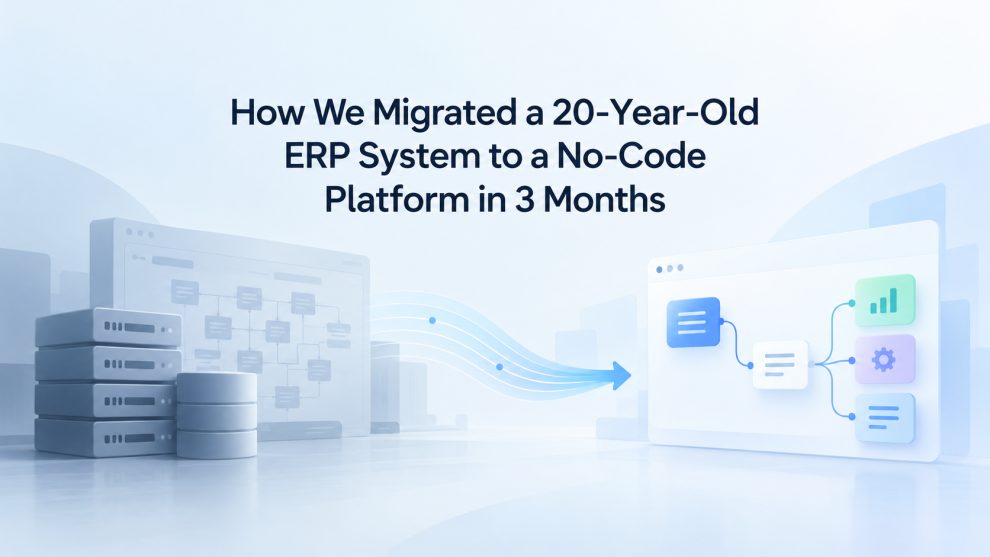

Replacing a 20-year-old ERP system sounds like a multi-year transformation project. Decades of business rules, custom integrations, historical records, and department-specific workflows make even minor changes complicated. Yet a three-month migration becomes technically feasible when engineering teams stop treating modernization as a complete software replacement.
The challenge is not necessarily rebuilding the ERP. It is identifying which capabilities the business still needs, which dependencies must remain operational, and which processes can move to a no-code platform without introducing new risks.
For enterprise engineering leaders, the difference matters. A poorly planned migration can interrupt financial reporting, procurement, inventory management, and customer operations. A carefully scoped migration can modernize critical workflows while preserving established systems of record.
The central lesson from a three-month migration approach is straightforward: speed comes from architectural decisions, not from skipping engineering controls.
Why Does a 20-Year-Old ERP Become Difficult to Modernize?
Legacy ERP systems often remain operational long after their architecture becomes difficult to maintain.
Over time, organizations introduce custom modules, database triggers, scheduled scripts, middleware integrations, and manual approval processes. These additions solve immediate business requirements but gradually create tightly coupled dependencies.
A change to inventory management might affect procurement workflows. Modifying customer records could break financial reporting. Updating an API might require regression testing across applications that no longer have active documentation.
Engineering teams consequently spend more time understanding dependencies than delivering improvements.
The problem becomes particularly expensive when organizations introduce new business models, automation requirements, or digital customer experiences. Each initiative must navigate technical constraints established years earlier.
According to SAP’s ERP migration guidance, data quality, legacy customizations, resource constraints, and organizational change are major migration challenges.
These constraints explain why simply transferring the existing database into a newer application rarely solves the underlying problem.
A more effective approach separates business capabilities from their historical implementations.
Rather than asking how to reproduce every existing screen, engineering teams must determine which workflows remain essential, which customizations create unnecessary complexity, and which systems should retain responsibility for critical transactions.
That distinction defines the achievable migration scope.
How Can Engineering Teams Identify What Actually Needs Migration?
The most consequential decisions happen before development begins.
A twenty-year ERP contains more than documented functionality. It also contains hidden dependencies, informal procedures, legacy permissions, and workflows maintained because employees have learned to work around system limitations.
A structured discovery exercise should examine four areas.
- Business workflows and operational dependencies: Engineering teams map procurement, inventory, finance, approvals, and reporting processes from initiation through completion. Each workflow needs documented inputs, business rules, exception handling, and downstream integrations. This reveals which capabilities genuinely require replacement and which can continue operating through existing services.
- Data architecture and ownership: Legacy databases often contain duplicated records, inconsistent identifiers, unused fields, and historical information governed by outdated business rules. Teams must distinguish transactional records from master data, reporting datasets, and archival information. Clear ownership prevents conflicting updates when old and new systems operate simultaneously.
- Integrations and application boundaries: Every API, scheduled synchronization, file transfer, database connection, and external dependency requires assessment. Direct database integrations deserve particular attention because schema changes can silently disrupt downstream applications. Stable API contracts can reduce coupling between the new platform and existing enterprise systems.
- Security and business logic: Custom scripts frequently contain approval conditions, financial validation rules, and access restrictions that never appear in functional documentation. Engineers must extract these rules, verify their continuing relevance, and decide whether the no-code platform or an external service should execute them.
This exercise prevents organizations from transferring unnecessary technical debt into a new technology stack.
It also establishes a critical principle: the target platform should support current business requirements rather than reproduce every limitation of the previous ERP.
How Can a No-Code ERP Migration Fit Into Three Months?
A three-month implementation requires parallel workstreams, limited scope, and clearly defined acceptance criteria.
During the first month, architecture and discovery take priority.
The team inventories integrations, analyzes the existing database, documents business rules, and establishes the target operating model. Architects define system boundaries and decide which components belong inside the no-code environment.
The target architecture should include a canonical data model, authenticated APIs, role-based access controls, audit logging, and integration mechanisms.
During the second month, development focuses on business workflows and system connectivity.
No-code tools can accelerate forms, approval workflows, internal dashboards, data management interfaces, and routine automation.
However, transaction-heavy operations, complex calculations, and specialized business logic may still require conventional software services.
This hybrid approach allows organizations to use visual development where it creates efficiency without compromising architectural control.
Integration testing should begin as soon as individual workflows become functional. Waiting until the end creates unnecessary delivery risk.
During the third month, the emphasis shifts to data migration, testing, and controlled deployment.
Teams execute trial migrations, validate records, test permissions, reconcile transactions, and examine failure scenarios.
A production cutover should occur only after the replacement workflows demonstrate acceptable correctness, performance, and operational readiness.
Importantly, three months should not imply a universal timeline for replacing every ERP capability. The schedule is most credible when the organization selects a bounded operational scope and allows other systems to remain in service.
How Can Data Migration Happen Without Disrupting Business Operations?
Data migration often creates greater operational risk than application development.
Legacy databases contain historical records generated under different validation rules, inconsistent data formats, and relationships that may no longer match current processes.
Moving this information without preparation can introduce duplicate transactions, missing references, and incorrect financial balances.
A controlled migration pipeline should extract source data, profile inconsistencies, apply transformation rules, validate relationships, and load approved records into the target environment.
Engineers should preserve source snapshots and maintain transformation logs so they can trace discrepancies to individual migration operations.
Validation must extend beyond comparing row counts.
Financial records require balance reconciliation. Inventory systems require quantity and movement verification. Customer records need identifier consistency across connected applications.
Historical data also deserves separate treatment. Organizations may retain older records in a searchable archive rather than loading every transaction into the new operational database.
For workflows where downtime is unacceptable, controlled parallel operation can provide additional assurance. The team must nevertheless define which system accepts writes to prevent conflicting transactions.
Rollback plans should identify recovery points, reconciliation responsibilities, and conditions that would trigger restoration.
These controls support migration speed by exposing problems before they affect production operations.
What Technical Limitations Should Enterprises Consider Before Selecting a No-Code Platform?
No-code platforms can reduce development effort, but they do not eliminate architectural responsibility.
Engineering leaders must evaluate whether the platform supports enterprise authentication, granular authorization, API extensibility, observability, environment separation, automated testing, and controlled deployment.
Data portability deserves particular attention.
If an organization cannot export its information, reproduce workflows elsewhere, or access critical integration logic independently, modernization may create a different form of vendor lock-in.
Performance characteristics also matter. A platform suitable for departmental approvals may struggle with high-frequency financial transactions or large-scale inventory reconciliation.
The correct architecture may therefore combine no-code applications with established databases, integration services, and independently deployed business logic.
That arrangement preserves flexibility while reducing the amount of custom interface and workflow code requiring maintenance.
Which Consulting Companies Support Enterprise ERP Modernization?
Organizations evaluating legacy modernization can consider consulting partners with different delivery capabilities.
GeekyAnts works across enterprise application modernization, cloud infrastructure, data integration, and API-led engineering. Its published approach emphasizes incremental modernization, production readiness, and maintaining operational continuity.
Deloitte brings enterprise transformation capabilities spanning ERP programs, business process redesign, technology strategy, and organizational change management.
Capgemini supports enterprise application transformation, systems integration, cloud migration, and large-scale technology operations.
The appropriate partner depends on whether the project primarily requires workflow redevelopment, architectural restructuring, enterprise-wide transformation, or long-term operational support.
For a narrowly scoped migration, hands-on engineering capabilities and proven integration experience may matter more than the size of the consulting organization.
What Is the Biggest Lesson From a Three-Month ERP Migration?
A three-month ERP migration is not primarily a demonstration of how quickly developers can build applications.
It demonstrates why reducing architectural complexity before implementation is essential.
Organizations move faster when they identify critical workflows, eliminate obsolete customizations, establish clear data ownership, and preserve stable integration boundaries.
No-code platforms can accelerate delivery, but successful modernization still requires disciplined architecture, security, testing, and operational planning.
For engineering leaders considering a similar initiative, the most useful starting point is a focused ERP modernization architecture assessment.
A technical consultation can establish which workflows are suitable for no-code, which dependencies should remain untouched, and what migration timeline the organization’s existing architecture can realistically support.
That assessment offers a more reliable foundation for investment decisions than committing to a platform or migration deadline before understanding the system.


Add Comment