





AI app builders have changed the first act of software creation. A founder can now turn a product brief into screens, workflows, and a working demo before a traditional sprint would finish discovery. That speed gives teams faster evidence, sharper investor conversations, and lower-cost demand testing.
The risk sits in the second act. A demo that works for a pitch does not prove that the app can handle real users, regulated data, payment flows, integrations, role-based access, and usage spikes. TechCrunch reported in May 2025 that Builder.ai, once backed by Microsoft and funded with more than $450 million, entered insolvency proceedings after building its brand around AI-assisted app creation. The lesson is to inspect the production gap before the launch date becomes public.
The Launch Risk Is No Longer the Prototype
AI has moved from experimentation into everyday product work. McKinsey’s 2025 global survey found that 88 percent of respondents reported regular AI use in at least one business function, up from 78 percent a year earlier. Yet most organizations still sit in experimentation or pilot stages, with only about one-third beginning to scale AI programs.
That gap matters for founders and enterprise product leaders. The market rewards speed, but operational maturity decides who survives after launch. An AI-built app may solve the visible problem quickly: screens, forms, dashboards, and simple API calls. It may not solve the invisible problems: tenant isolation, retry logic, audit trails, database indexing, model cost controls, recovery paths, and test coverage.
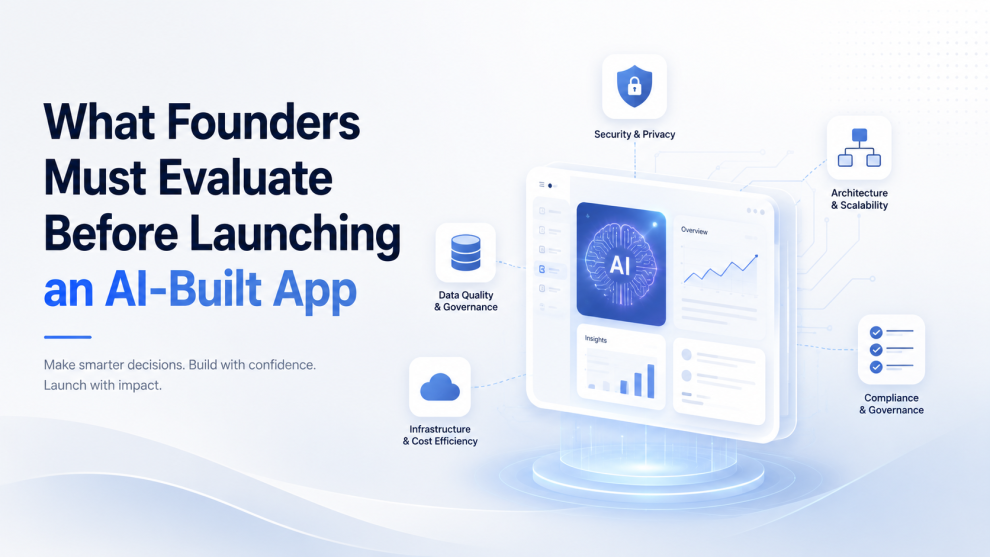
The evaluation should start before the first paying customer enters the system. Waiting until traction often forces the team to rework data models, replace backend logic, unwind vendor lock-in, or rebuild the product in a standard architecture.
The Five Checks That Separate a Demo from a Product
- Code ownership and portability need direct inspection, not verbal assurance. The founder should confirm whether the team can export the complete codebase, run it outside the original platform, connect it to independent CI/CD, and maintain it with standard engineering teams. The review should cover frontend, backend, database schema, infrastructure files, environment variables, and third-party service configuration. If the app depends on a proprietary runtime or platform-specific SDK, the business must treat that as a strategic dependency. Ownership also includes IP clarity around prompts, generated code, reusable templates, and model-assisted outputs.
- Architecture must match the next business milestone, not the current demo. Many AI-generated apps work because the early user path stays narrow. Pressure begins when the founder adds roles, pricing tiers, admin tools, workflows, analytics, notifications, integrations, and compliance controls. The review should examine whether the backend separates domain logic from interface logic, whether APIs use versioning, and whether critical jobs run through queues instead of fragile request cycles. AI calls also need timeouts, fallbacks, caching, cost monitoring, and clear failure states.
- Security needs AI-specific testing as well as standard application testing. IBM’s 2025 Cost of a Data Breach Report placed the global average breach cost at USD 4.44 million, which keeps security review in the business-risk category. For AI-built apps, the review should cover authentication, authorization, encryption, secrets management, logging, input validation, and dependency risk. It should also cover prompt injection, sensitive information disclosure, excessive agency, insecure tool use, and model behavior under adversarial inputs. OWASP’s 2025 guidance identifies prompt injection risks that can expose sensitive information, manipulate outputs, provide unauthorized access, or trigger actions in connected systems.
- Data governance must define what enters the model, what trains the model, and what stays private. Founders should map every data flow before launch: customer data, operational data, logs, prompts, embeddings, file uploads, transcripts, and third-party API payloads. The team should know whether model providers retain prompts, whether sensitive fields reach external systems, whether vector databases store personal information, and whether deletion requests can remove data from every relevant store. This matters in healthcare, fintech, insurance, hiring, education, and any market with enterprise procurement review.
- Maintainability decides whether AI speed becomes operating drag. Recent software engineering research on 304,362 verified AI-authored commits across 6,275 GitHub repositories found that AI-generated code can introduce long-term maintenance issues, with 24.2 percent of tracked AI-introduced issues surviving to the latest repository revision. A founder does not need perfect code at launch, but the company does need tests for critical flows, typed interfaces where possible, clear module boundaries, dependency hygiene, observability, and error reporting.
Why AI-Built Apps Fail After Early User Traction
The failure pattern rarely starts with the homepage. It starts in the parts of the app that early demos hide. A payment webhook fires twice. A user uploads a large document. A model response times out during onboarding. An admin changes a permission and exposes another tenant’s record. A sales team signs an enterprise pilot, then procurement asks for access logs, data retention rules, SOC 2 controls, and a security questionnaire.
Gartner warned that at least 30 percent of generative AI projects would be abandoned after proof of concept by the end of 2025 because of poor data quality, inadequate risk controls, escalating costs, or unclear business value. Those are not abstract enterprise problems. They show up inside founder-led AI apps when teams build around a prototype instead of an operating model.
The technical question becomes simple: can the app explain itself under pressure? It needs to show which model answered, which prompt template ran, which retrieval source contributed context, which user initiated the action, which permission allowed it, and what fallback path triggered when the AI failed. Without traceability, the team cannot debug failures or answer enterprise buyers with confidence.
Where External Engineering Review Helps
Founders do not need to turn every AI-built app into a large enterprise program. They need an evaluation path that fits the risk. A consumer prototype with no sensitive data may need a lighter review. A workflow app that touches health records, financial decisions, employment screening, claims, payments, or enterprise customer data needs deeper inspection before launch.
This is where consulting and outsourcing partners can help, especially when they bring product engineering rather than only staff augmentation. EPAM Systems describes its work around software engineering, product development, design, and consulting. Thoughtworks positions itself as a global technology consultancy combining design, engineering, and AI expertise. GeekyAnts, in a focused product engineering category, describes AI-powered product engineering services that move prototypes toward scalable products with LLM integration, RAG pipelines, DevOps, CI/CD, cloud infrastructure, and production engineering.
The useful point is not that one firm type fits every founder. AI-built apps need a partner who can read generated code, challenge architecture, test AI behavior, secure data flows, and convert findings into a launch decision.
Before the Launch Date Becomes Expensive
A founder should treat an AI-built app like a fast acquisition target. It may look attractive, move quickly, and show promise. It still needs diligence before the company depends on it.
The strongest pre-launch reviews end with a practical decision memo. They identify what can launch now, what needs repair before launch, what can wait until after the first cohort, and what would force a rebuild. They also create ownership across product, engineering, security, legal, and customer success.
For North America based companies, that clarity matters because the first serious customer often asks enterprise-grade questions earlier than founders expect. Buyers want security answers. Investors want technical defensibility. Platform teams want integration readiness. Customer experience leaders want reliability that matches the promise.
AI can compress the path from idea to product. It cannot remove the need for architecture, governance, and operational discipline. Before launch, the best conversation is not about whether the app works on a demo screen. It is about whether the app can survive real users, real data, real scrutiny, and the next six months of growth.


Add Comment