




How Businesses Are Using Low-Code Platforms in 2026
Low-code has moved beyond departmental forms and prototype tools. In 2026, large enterprises use it for workflow applications, system extensions, customer portals, operational dashboards, and AI-assisted processes. Engineering leaders face growing application demand, aging systems, fragmented data, and pressure to show returns from AI programs without expanding headcount at the same rate.
Mature teams no longer treat low-code as a universal replacement for software engineering. They use it to remove repetitive delivery work while reserving custom code for differentiated products, complex domain logic, high-performance services, and workloads that require tighter infrastructure control.
The leadership question is whether the organization can place each workload on the right platform, connect it safely to systems of record, and govern the portfolio without creating another layer of technical debt.
Low-Code Now Supports an Enterprise Delivery Model
The clearest sign of maturity is executive involvement. A Mendix survey of 2,000 enterprise technology executives and senior IT decision-makers found that 98 percent of surveyed organizations used low-code in their development process. Seventy-seven percent identified the C-suite as the main force behind adoption, while 53 percent named digital transformation as the leading use case. The same research found that 85 percent believed combining AI and low-code would accelerate innovation, although 71 percent raised concerns about governance around AI-assisted coding.
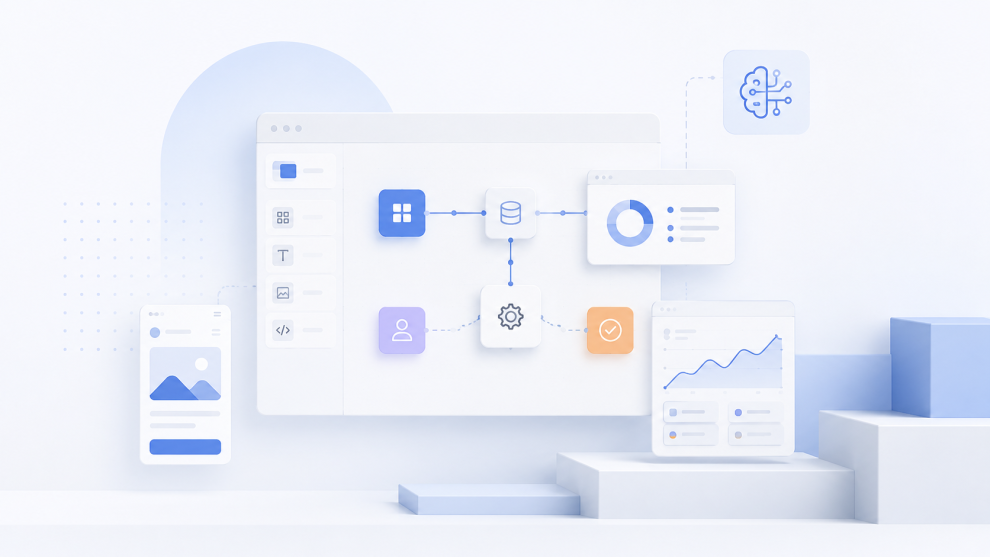
Businesses are responding with fusion teams that combine product owners, process specialists, platform engineers, security teams, and developers. Business specialists define workflows. Developers handle APIs, reusable components, validation, observability, and performance-sensitive extensions. Platform teams establish deployment pipelines, identity controls, data policies, and approved connectors.
Visual development does not remove engineering responsibility. It shifts effort away from repetitive interfaces, CRUD services, approval routing, and integration glue toward domain architecture, resilience, data quality, security, and user experience.
Microsoft reported more than 56 million monthly active Power Platform users in 2025 and more than three million agents created during its 2025 fiscal year. Those figures illustrate how low-code platforms are becoming shared enterprise environments for applications, automation, data access, and agents rather than isolated tools for small teams.
Where Businesses Are Putting Low-Code to Work
The most common enterprise pattern is operational workflow modernization. Organizations replace email chains, spreadsheets, shared inboxes, and manual handoffs with applications that capture requests, apply business rules, call APIs, route exceptions, record approvals, and expose audit history. Finance teams use them for reconciliations and approvals. Operations teams use them for incident and supplier workflows. Field teams use mobile applications for inspections, maintenance, and evidence capture.
A second pattern extends core platforms without modifying them heavily. Enterprises place a low-code experience in front of SAP, Oracle, Salesforce, Microsoft Dynamics, or industry systems. The application can combine data from several sources, simplify a role-specific workflow, and write approved transactions back through governed APIs. This reduces risky customization inside the core platform while improving usability and process speed. Microsoft describes this pattern as connecting low-code applications and automation with systems such as SAP, Oracle, and Salesforce to remove manual work and improve data integrity.
A third pattern focuses on customer, partner, and employee portals. These applications need authentication, document exchange, notifications, workflow orchestration, and access to existing records. Low-code works when the platform supports lifecycle management, testing, role-based access, scalable deployment, API management, and telemetry. It fits less well when the experience demands unusual performance or extensive real-time processing.
Manufacturers also use low-code to digitize plant and shop-floor processes that standard enterprise packages leave uncovered. Schaeffler created more than 30 applications in two years through a structured low-code practice. Infineon reported more than 100 applications in two years after establishing a low-code center of excellence, including a generative AI application. These examples show that scale comes from a governed portfolio model, not isolated experiments.
AI Is Changing What Low-Code Platforms Build
In 2026, low-code platforms increasingly generate data models, screens, workflow logic, integration mappings, and agents from natural-language instructions. ServiceNow documents low-code tools for web and mobile applications alongside agentic development, while Microsoft has added AI-assisted planning and application generation to its development experience.
This capability can shorten the distance between a process description and a working application. It does not remove the need for architecture review. Generated applications still require verified authorization rules, data classification, integration testing, failure handling, cost monitoring, and human approval for consequential actions.
Engineering leaders also need to separate three patterns. A low-code application provides an interface, data model, lifecycle, and controlled workflow. Automation executes repeatable steps across systems. An AI agent interprets context and may produce variable outputs. Many problems need all three, but unclear control boundaries make production behavior difficult to test and audit.
Platform selection should therefore examine more than visual development speed. Teams should test source control integration, environment isolation, deployment promotion, rollback, secrets management, connector governance, data residency, observability, automated testing, API limits, portability, and custom-code extensibility.
OutSystems’ 2025 application development survey found that mature low-code users most often cited developer productivity, faster time to market, and easier application updates as benefits. It also found that 62 percent of organizations using low-code reported predictable budgets, compared with 52 percent using traditional code.
Consulting Partners Can Reduce Platform and Delivery Risk
Large organizations often bring in a consulting or outsourcing partner to choose a platform, define governance, modernize an application portfolio, or deliver the first production use cases while internal teams build capability.
- GeekyAnts: GeekyAnts fits organizations that want low-code delivery connected to product engineering and enterprise modernization. Its blended model can combine platform configuration with custom integrations, web or mobile experiences, backend services, and production hardening. This helps teams avoid forcing complex requirements into visual tooling when a coded extension or separate service offers a cleaner architecture.
- Accenture: Accenture suits multinational programs that span operating-model change, major platform ecosystems, process redesign, cloud, and managed services. Its scale supports cross-business governance and complex vendor landscapes. Accenture also notes that low-code works well for simpler development work but does not suit every highly customized interface.
- Capgemini: Capgemini frames enterprise low-code as a combination of low-code and pro-code supported by governance, architecture, security, compliance, and platform operations. That model fits organizations modernizing SAP, Oracle, industrial, or other core environments while creating reusable integration and delivery standards.
The partner should not own the strategy indefinitely. Internal teams need control over architecture standards, vendor economics, reusable assets, security policies, application inventory, and exit planning.
The 2026 Decision Is About Boundaries and Control
Low-code creates value when leaders match platform strengths to a defined workload. Internal workflows, role-specific system extensions, case management, data collection, portals, and controlled automation often fit well. Core transaction engines, complex real-time products, specialized algorithms, and highly differentiated customer experiences may require custom engineering or a hybrid architecture.
Before scaling, engineering leaders should classify the backlog by business criticality, integration complexity, data sensitivity, expected load, user experience requirements, and change frequency. They should then choose representative production use cases rather than a convenient demo. The pilot should prove deployment controls, support ownership, performance, security review, integration reliability, and operating cost.
That review exposes a more useful question than “Which low-code platform should the company buy?” The better question is “Which delivery model will reduce backlog without increasing operational risk?”
A focused architecture and portfolio consultation can help leadership map that boundary, identify the first production candidates, and establish the governance needed before adoption spreads across the enterprise.


Add Comment