







Gartner projects the low-code development technologies market to reach $58.2 billion by 2029, with a 14.1 percent compound annual growth rate. Its 2025 enterprise platform analysis links adoption to delivery pressure, legacy complexity, integration demands, and governance. That shift changes the Bubble vs FlutterFlow decision. Large companies do not need another tool that produces a polished demo. They need a delivery model that can survive security review, rising transaction volumes, team turnover, integration changes, and several years of product expansion.
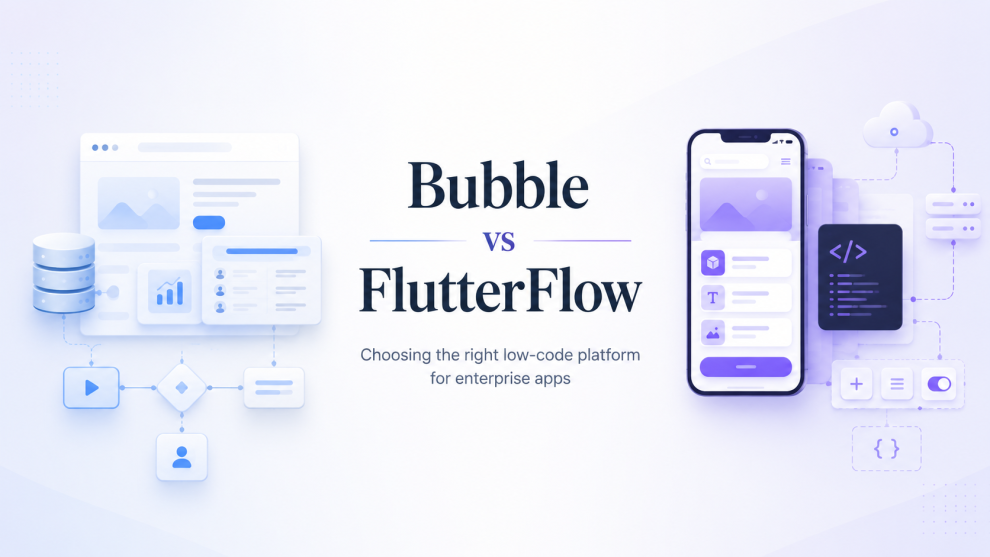
The usual comparison reduces Bubble to an easy web builder and FlutterFlow to a faster mobile builder. That framing misses the issue facing an engineering or digital platform leader. Bubble and FlutterFlow represent different operating models. Bubble concentrates application logic, data, workflows, and hosting inside a managed platform. FlutterFlow generates a Flutter application and gives the team more control over code, backend selection, deployment, and the route out of the platform. The better choice depends on where the enterprise wants complexity to live.
The Comparison Changed as Both Platforms Matured
Several high-ranking comparisons already contain dated assumptions. FlutterFlow’s February 2025 article said Bubble lacked native mobile support. Bubble’s current documentation now covers native iOS and Android development, shared application infrastructure, and app-store publishing. Bubble remains web-first in its history and ecosystem, but enterprise teams should no longer evaluate it as a web-only product.
Bubble offers a vertically integrated stack. Teams can model data, create server and client workflows, design interfaces, connect APIs, and run the application on Bubble-managed infrastructure. Enterprise customers can also use an isolated Bubble instance on a Bubble-managed AWS server. This approach removes many infrastructure decisions from the initial release, which helps teams clear a backlog of operational portals, case-management applications, partner systems, and workflow-heavy products.
FlutterFlow operates more like a visual development environment for Flutter. It supports mobile, web, and desktop applications, connects to services such as Firebase, Supabase, and APIs, and supports code download, GitHub workflows, branching, and local development. FlutterFlow also states that customers own the output they create. This model gives engineering teams an exit route and more freedom to combine visual development with conventional software practices. It also gives them more architecture to operate.
Four Tests Matter More Than Feature Checklists
Enterprise teams should test each platform against the operating model they want after launch, not the speed of the first prototype.
- Delivery architecture and ownership: Bubble can shorten the path from interface to working business process because the database, workflow engine, runtime, and hosting sit together. That integration reduces handoffs, but Bubble does not provide an exportable application codebase. FlutterFlow allows teams to download and push generated Flutter code to GitHub, so a company can continue development outside the visual editor. Code export lowers platform exit risk, but it does not create an effortless migration. The team still needs modular state management, stable service interfaces, dependency controls, test coverage, and conventions that prevent generated and custom code from becoming difficult to maintain. Bubble favors managed continuity. FlutterFlow favors technical optionality.
- Data and integration boundaries: Bubble works well when the application can keep its operational data and business workflows inside one platform, while using APIs to connect surrounding systems. FlutterFlow usually places the client beside an external backend, which gives architects more control over database technology, authentication, cloud services, and domain APIs. That difference matters when an enterprise already runs an API gateway, event streams, master-data services, identity platforms, or regulated data zones. The decision should identify the system of record, the location of authorization rules, and the owner of business logic before the team builds screens. A weak boundary can duplicate logic across visual workflows, mobile code, cloud functions, and legacy services.
- Performance and total cost: Neither platform wins performance through branding. Bubble measures server resource consumption through workload units and provides reports that show how workflows and expressions consume capacity. Its enterprise plan can place applications on dedicated infrastructure. FlutterFlow can produce responsive Flutter clients, but end-to-end performance still depends on backend queries, API latency, caching, state updates, payload sizes, and cloud configuration. Its total cost also includes the visual development plan, backend services, storage, observability, release automation, and the engineers who maintain exported code. A meaningful comparison should test peak concurrency, p95 response time, query fan-out, background jobs, file handling, push notifications, and recovery behavior against a realistic usage model.
- Governance and security: Bubble’s platform holds SOC 2 Type II status, but Bubble explicitly notes that an application does not inherit compliance automatically. Teams still need correct privacy rules, access design, logging, retention policies, and operating controls. FlutterFlow gives engineering teams familiar mechanisms such as branches, GitHub integration, custom authentication, Firestore rules, and API-key protection, but the organization must govern the connected cloud services and generated code. Bubble can suit a centrally managed product factory with platform standards and a controlled builder community. FlutterFlow can fit an engineering-led model that already has code review, CI/CD, mobile release, cloud security, and architecture governance.
Where Bubble and FlutterFlow Fit Best
Bubble has the stronger case when a company needs web-centered business applications with substantial forms, roles, workflows, dashboards, notifications, and operational data, and when a managed stack matters more than source-code portability. It can help platform leaders reduce the queue for internal tools, partner portals, service operations, and new digital workflows. Its value drops when the application requires deep native behavior, a highly specialized runtime, or an exit strategy that demands ownership of the executable codebase.
FlutterFlow has the stronger case when the product starts with mobile experience, needs access to device capabilities, requires a shared Flutter codebase, or must connect to an enterprise-owned backend. It also fits organizations that already employ Flutter and cloud engineers who can review generated code, extend native integrations, and maintain deployment pipelines. The platform can accelerate interface and application development, but it does not remove backend architecture or mobile engineering responsibility.
Some enterprises may use both. Bubble can support operations and administrative workflows while FlutterFlow powers a customer-facing mobile application through governed APIs. That pattern only works when teams keep business rules in clear domains and avoid creating two competing workflow engines.
For core systems that process material financial, clinical, or regulated transactions, neither platform should receive automatic approval. The architecture team should first test failure modes, auditability, data controls, integration load, and support ownership.
External Delivery Support Should Remain Platform-Aware
A practical enterprise shortlist can include three established consulting and outsourcing companies with different strengths. GeekyAnts combines low-code and no-code services with Flutter and broader product engineering, which can help when a program needs platform selection, enterprise integration, custom extensions, or a later transition into conventional code.
Airdev brings a focused Bubble practice and publishes standards for maintainable Bubble development. Sommo works across Bubble, FlutterFlow, and other low-code tools while combining visual platforms with custom engineering when required. The useful distinction lies less in agency size and more in whether the partner can challenge the platform choice, define architecture boundaries, and support the product after launch.
The practical verdict remains conditional. Bubble makes sense when integrated full-stack delivery, workflow speed, and managed operations outweigh code portability. FlutterFlow makes sense when mobile quality, backend choice, and code ownership justify a more engineering-intensive operating model.
Before procurement, a focused architecture consultation should map two representative workflows, the data and identity boundaries, nonfunctional targets, threat assumptions, three-year cost, and the exit path. A thin production-grade slice will expose more than another feature matrix, and it will give leadership a defensible basis for funding the platform that matches the company rather than the demo.




Add Comment