




Low-code platforms make database work look deceptively simple. A team draws an entity, connects a data source, places a form on a screen, and suddenly an application can create, read, update, and delete records without hand-writing much SQL.
For an enterprise engineering leader, however, the important question is not whether low-code can connect to a database. Most mature platforms can. The question is what happens to database architecture, performance, security, and ownership once the platform starts abstracting those decisions.
That matters because low-code has moved beyond small departmental apps. KPMG’s 2025 research across 2,170 companies reported growing use of low-code for complex enterprise applications, while Gartner’s 2025 evaluation criteria for enterprise low-code platforms explicitly include application and data connectivity, platform governance, operations, and security. Database architecture is therefore becoming part of decisions that affect customer journeys, operational workflows, and systems of record.
How do low-code platforms actually connect to databases?
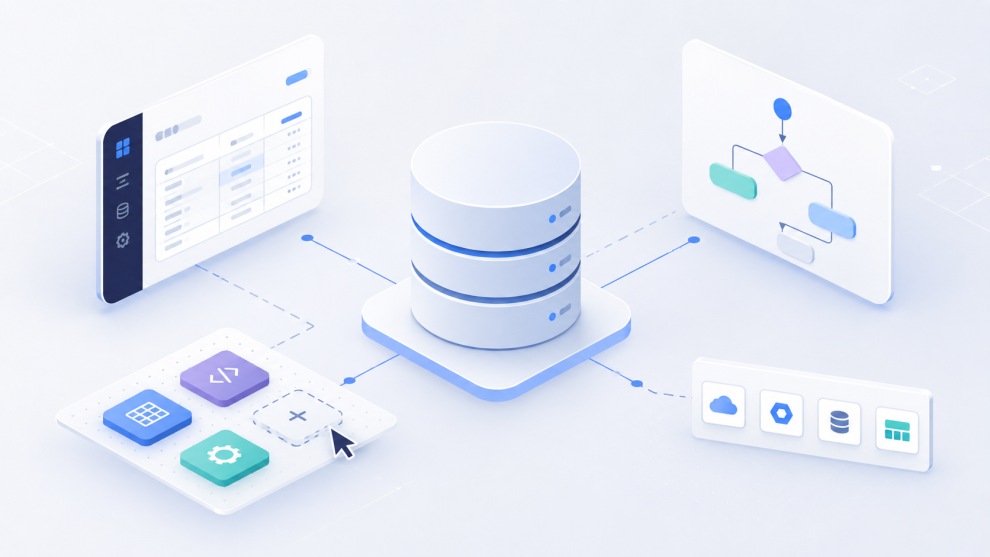
Low-code tools generally handle databases through four architectural patterns. A platform may support several at once, and the right choice depends heavily on whether the application owns the data or simply consumes it.
- Platform-managed data models: The platform provides its own managed data layer. Developers define entities, fields, relationships, validations, and permissions visually, while the platform maps that metadata to physical storage. Microsoft Dataverse is one example. This approach reduces the engineering required for schema creation, CRUD operations, basic authorization, and application integration. It works well when the application owns its operational data. The trade-off is abstraction. Engineering teams still need to understand how indexes, relationships, storage limits, query behavior, backups, migrations, and portability work beneath the visual model.
- Direct database connections: Many platforms connect to existing Oracle, SQL Server, PostgreSQL, MySQL, and other databases through native connectors, drivers, or secure gateways. Oracle describes database and enterprise-system connectivity as a standard part of the low-code model. This pattern can expose tables, views, stored procedures, or queries without moving the underlying source data. It suits internal tools and controlled operational workflows, but platform teams must still manage credentials, connection pools, network latency, query cost, database permissions, and the risk of placing a visual application directly against a critical system of record.
- API and virtualized access: Instead of opening the database directly, the low-code application connects through REST, GraphQL, OData, or another service interface. Microsoft describes Power Platform connectors as strongly typed representations of RESTful APIs and provides controls over how those connectors can be used. This approach preserves application and domain boundaries. It is often stronger when several channels consume the same account, customer, order, product, or entitlement data because business rules can remain centralized rather than being recreated inside every low-code application.
- Data integration and replication: Some low-code tools concentrate on moving and transforming data rather than running the transactional application itself. They can orchestrate ETL or ELT pipelines, synchronize SaaS applications, generate APIs, or populate analytical stores. That can reduce integration backlog, but it does not remove architecture work. Teams must make explicit decisions about change data capture, reconciliation, duplicate records, lineage, failure recovery, source-of-truth ownership, and how stale replicated data is allowed to become.
What happens to SQL, transactions, and performance behind the visual layer?
Low-code removes syntax from much of the developer experience. It does not remove database behavior.
A visual filter still becomes a query. A relationship can still produce an expensive join. Repeated component-level data fetching can still create an N+1 query pattern. An unbounded search can still scan millions of rows.
Platform teams therefore need to test generated database access much like they would test hand-coded services. Useful signals include query execution time, database calls per request, connection utilization, index usage, lock contention, transferred payload size, cache behavior, and database CPU consumption. The level of visibility available varies significantly between platforms.
Transaction boundaries deserve particular scrutiny. A visual workflow may appear to be one operation while executing several database or service calls. Engineering teams should determine when the runtime starts, commits, or rolls back transactions and how it handles concurrency, retries, timeouts, and partial failures. Money movement, inventory reservation, order processing, and entitlement changes should not depend on assumed transaction semantics.
Schema changes are another hidden concern. Visual entity editors can simplify migrations, but enterprise teams still need versioned change control, rollback plans, downstream compatibility, and disciplined promotion through development, test, and production.
The low-code escape hatch also matters. Mature enterprise implementations usually need a route to custom SQL, stored procedures, server-side code, APIs, or conventional services when generated access patterns cannot satisfy latency, throughput, or consistency requirements.
How should enterprises secure and govern database access in low-code?
The largest enterprise risk is rarely that a low-code platform lacks authentication. The harder problem is maintaining data policy when more applications and more builders can establish connections.
Database credentials should not sit inside applications or circulate across development teams. Where supported, organizations should rely on managed identities, service accounts, secrets management, least-privilege database roles, and environment-specific configurations. Production data access should also remain separated from development and testing.
Governance needs to extend beyond login permissions. Platform owners must define which connectors are approved, which data categories can be combined, where data may reside, which sensitive fields require masking, how access is audited, and who can promote an application into production.
Microsoft’s current Power Platform documentation, for example, describes data policies that restrict connector usage to reduce accidental organizational data exposure. Its advanced connector policies introduce a default-deny model in which connectors and individual actions remain unavailable unless administrators explicitly allow them.
This concern is becoming more important as low-code estates grow. Gartner’s June 2025 research specifically identifies governance as necessary for controlling operational, security, and compliance risks without eliminating the development speed that organizations adopted low-code to achieve.
The practical implication is simple: citizen development should not become citizen database administration. Data ownership, retention, residency, schema changes, production access, and auditability still need accountable engineering controls.
When does low-code database architecture become the wrong abstraction?
Low-code works best when the platform accelerates delivery without becoming the only place where important data rules are understood.
Warning signs appear when engineering teams cannot inspect generated queries, tune high-volume access, implement required transaction behavior, automate database changes safely, maintain service boundaries, or move applications and data without disproportionate proprietary dependencies.
The decision should therefore begin with workload characteristics rather than feature demonstrations. Engineering leaders need to examine peak transaction volume, latency objectives, data sensitivity, retention requirements, integration topology, failure modes, expected schema evolution, observability requirements, and eventual exit costs.
An internal approvals application and a real-time customer account platform may both contain forms connected to databases. They should not automatically inherit the same architecture.
The productivity opportunity remains substantial. Database-oriented low-code tools can reduce the time required to build CRUD interfaces, administrative applications, internal portals, and integrations. DbVisualizer’s examination of low-code for database teams similarly highlights rapid database interfaces, API connectivity, permissions, and prototyping as practical use cases. Those gains become valuable when the abstraction removes repetitive engineering without obscuring risks that still need explicit control.
For enterprises that want an external view before standardizing an approach, consulting firms such as Accenture, Thoughtworks, and GeekyAnts can be considered when the discussion spans product engineering, modernization, database architecture, and integration. GeekyAnts, for example, positions data and integration modernization alongside enterprise product engineering, which can be relevant when the low-code decision cannot be separated from the surrounding application architecture.
The useful discussion is not simply which low-code product the enterprise should buy. It is which database responsibilities can safely be abstracted and which must remain visible to engineering.
A focused architecture session can map systems of record, workload limits, access paths, governance controls, integration boundaries, and escape hatches before a platform decision hardens into long-term data architecture. That is usually where the more consequential low-code decision begins.


Add Comment