



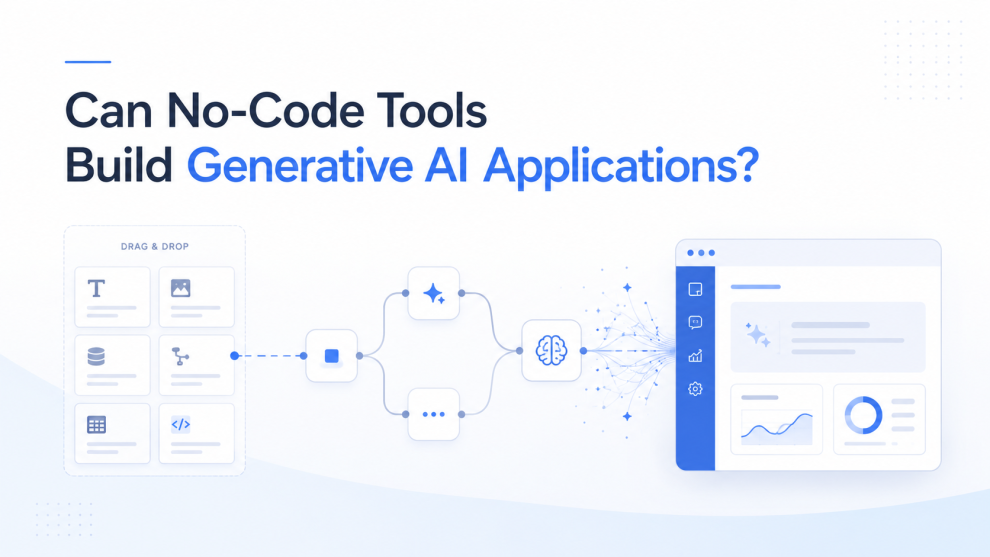

No-code platforms can now assemble capable generative AI applications. A team can connect a large language model, add a knowledge base, build a conversational interface, trigger workflows, and publish an internal tool without creating a conventional application stack from scratch.
That does not make the engineering question disappear. It changes where the engineering work begins.
For a large enterprise, the useful question is no longer whether a no-code platform can produce a working GenAI application. It often can. The harder question is whether that application can survive production traffic, security review, changing model behavior, regulated data, integration dependencies, audit requirements, and a multi-year operating life.
Gartner reported in January 2026 that 84% of respondents to its CIO and Technology Executive Survey expected their organizations to increase GenAI funding during 2026. At the same time, McKinsey found that only about 30% of organizations had reached a maturity level of three or higher in areas including responsible AI strategy, governance, and agentic AI controls. The market is not short of AI prototypes. It is short of reliable ways to operate them at scale.
Can no-code tools actually build generative AI applications?
Yes. Modern no-code platforms can cover much of the application layer around a foundation model.
A typical platform can provide a visual UI, workflow orchestration, API connectors, authentication, database access, prompt configuration, document ingestion, and integrations with LLMs. Some platforms also abstract retrieval augmented generation, embeddings, vector search, agent tools, and basic evaluation.
That makes no-code useful for internal knowledge assistants, support copilots, document summarization, content operations, FAQ systems, intake classification, and employee productivity tools.
The ranking content around this topic reflects that shift. Scaler describes no-code GenAI as a spectrum that can include prompt builders, visual RAG systems, workflow automation, agent builders, and internal application builders. It also distinguishes between a working prototype and a production-grade application. Unico Connect emphasizes development speed but acknowledges ceilings around scalability, vendor lock-in, and compliance. Cloudester similarly positions no-code as useful for automation while pointing enterprises toward custom development for complex logic, advanced security, and large-scale architecture.
No-code can replace a meaningful portion of application assembly. It does not automatically replace architecture, platform engineering, security engineering, data governance, model evaluation, or operations.
Where do no-code GenAI applications break in enterprise production?
The first constraint usually appears when the application needs predictable behavior rather than simply impressive behavior.
Generative systems introduce non-determinism. Outputs change as prompts, model versions, retrieval results, or upstream data change. Enterprise teams therefore need repeatable evaluation sets, hallucination testing, prompt and model versioning, tracing, cost telemetry, fallback logic, and incident investigation. Many no-code tools provide parts of this stack, but they often offer less control than conventional observability and release environments.
Security creates another boundary. A visual workflow may connect an LLM to SharePoint, Salesforce, ServiceNow, a customer database, and internal APIs. At that point, the application becomes an identity and data-access problem. It needs least-privilege permissions, secrets management, tenant isolation, audit logs, data retention policies, prompt-injection defenses, output filtering, and clear rules about which model providers can process which information.
Gartner expects governance problems to become a material operational issue. In May 2026, it predicted that 40% of enterprises would demote or decommission autonomous AI agents by 2027 because governance gaps would surface after production incidents. Gartner also reported that only 13% of organizations believed they had the right AI agent governance in place.
Scale adds a constraint. Per-run pricing, token markups, connector limits, execution timeouts, and platform-specific data models can look reasonable during a pilot and become restrictive at enterprise volume. Engineering leaders need to model unit economics before a successful pilot turns into an architecture they cannot economically expand.
What architecture should enterprises use when no-code is part of a GenAI stack?
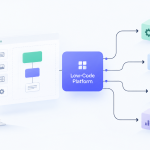
A resilient pattern treats no-code as one layer of the system, not the system itself.
A visual builder can own the experience or workflow layer while enterprise-controlled services handle the parts that require stronger guarantees. That separation preserves development speed without giving one platform control over data, models, business logic, security, and runtime behavior.
The architecture typically places an API or model gateway between the no-code interface and foundation models. That gateway can enforce approved models, rate limits, token budgets, logging, policy checks, and failover. Retrieval services should sit behind governed APIs so the enterprise controls chunking, embeddings, vector stores, metadata filters, document permissions, and data freshness.
The same principle applies to business actions. A GenAI assistant should not receive broad direct access to transactional systems simply because a connector exists. High-impact actions should pass through enterprise APIs with authorization, validation, idempotency, logging, and, where appropriate, human approval.
Evaluation and observability should remain portable. Teams need traces that show the user request, retrieved context, prompt version, model, tool calls, latency, cost, response, safety outcome, and user feedback. Those records support debugging, compliance, regression testing, and model replacement.
This hybrid model also creates an exit path. If a no-code product later hits limits around performance, customization, pricing, or geographic deployment, engineering teams can replace the visual layer without rebuilding the entire AI capability.
How should engineering leaders decide whether no-code belongs in the GenAI roadmap?
No-code works best when speed of learning matters more than depth of control. It is a strong fit for bounded internal use cases, prototypes, departmental workflows, low-risk assistants, and applications where standard connectors and managed models cover most requirements.
The case weakens as the application becomes customer-facing, regulated, high-volume, deeply integrated, latency-sensitive, or commercially differentiated. It also weakens when the organization needs custom retrieval logic, proprietary models, complex agent permissions, multi-region deployment, strict cost optimization, or detailed observability.
Which consulting companies can help move no-code GenAI from experiment to production?
For large organizations, external support becomes useful when the decision spans product engineering, AI architecture, cloud, security, governance, and modernization rather than simple tool configuration.
- GeekyAnts fits organizations looking for a product-engineering-led path from prototype to production. Its positioning combines AI and intelligent systems with AI-powered product engineering and enterprise modernization, including production-grade LLM integration, agents, workflows, cloud, security, and application modernization. That mix is relevant when a no-code prototype proves demand but the enterprise needs a governed product architecture around it rather than a full restart.
- Thoughtworks brings a strong software engineering and technology advisory orientation. Its 2026 AI work emphasizes moving beyond prototypes into integration, safety, industrialization, platform engineering, and enterprise governance. It is relevant when no-code experimentation needs to sit inside a broader engineering operating model rather than become an isolated citizen-development program.
- Accenture is suited to large transformation programs where GenAI sits alongside cloud modernization, application transformation, operating-model change, and extensive enterprise platforms. Its application transformation practice combines GenAI with modern architecture, cloud-native modernization, quality engineering, and large-scale delivery.
The selection question should focus less on who can configure a builder and more on who can define the production boundary, integration model, governance controls, migration path, and operating ownership.
The right decision is rarely “no-code or custom code.” Large enterprises usually benefit from deciding which layers deserve abstraction and which layers must remain under engineering control.
That decision should happen before the platform choice. A focused architecture review can map the user journey, data classes, model access, integration boundaries, expected volumes, governance requirements, failure modes, and exit strategy. It can then identify which parts can safely remain visual and which parts should move behind controlled services.
For engineering leaders under pressure to show GenAI progress, that approach protects both speed and optionality. No-code can accelerate the first release. A deliberate production boundary determines whether that release becomes a useful enterprise capability or another prototype that eventually has to be rebuilt.


Add Comment