







No-code development has moved well beyond simple forms and departmental prototypes. Enterprises now use visual development platforms to automate workflows, build internal applications, and put new digital services in front of employees and customers. That makes the limitations more consequential. A platform that saves eight weeks during delivery can still create years of architectural friction if engineering teams discover too late that they cannot control performance, integration behavior, security boundaries, or portability.
The broader low-code market shows how seriously enterprises now treat these issues. KPMG’s 2025 survey of 2,170 companies found that 28% extensively leverage low-code to develop complex enterprise applications with embedded AI capabilities. In the same research program, 85% identified security as a top platform-selection priority, 84% prioritized ease of integration, and 83% cited backend integration and API management. Those numbers point to the real enterprise question: not whether no-code can build an application, but whether the application will remain controllable after it matters to the business.
Why do no-code tools become harder to manage after the first release?
No-code optimizes the creation layer. Visual components, workflow designers, reusable connectors, and managed hosting remove work that engineering teams would otherwise perform in frameworks, infrastructure, and deployment pipelines. That acceleration is valuable when the application fits the platform’s assumptions.
Problems appear when requirements move outside those assumptions. A workflow gains exception paths. A dashboard becomes a customer-facing product. A departmental database starts handling regulated information. An integration that once moved hundreds of records must process millions. At that point, the team is no longer asking how quickly it can configure the platform. It is asking how much control the platform exposes over execution, data, observability, deployment, and failure recovery.
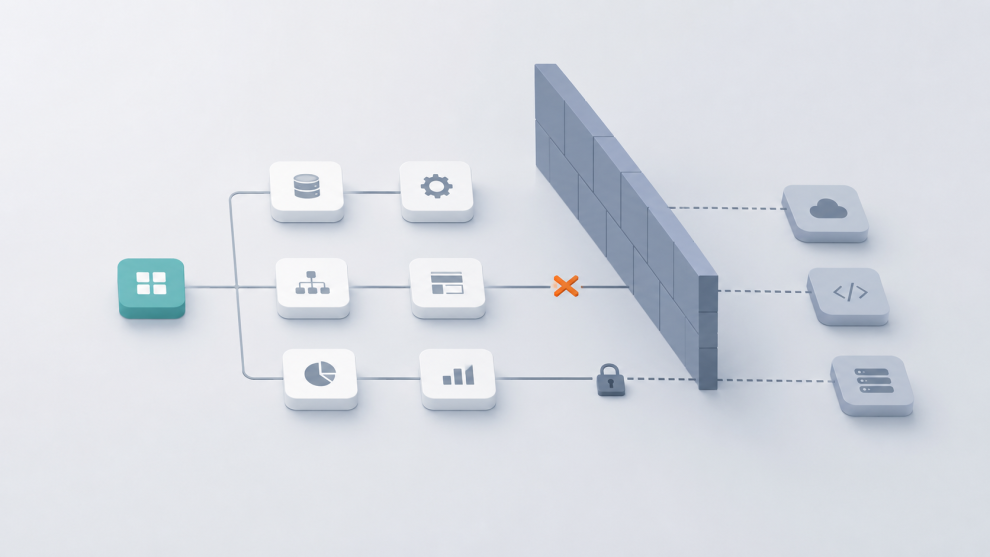
This is why enterprise teams should treat no-code as an architectural dependency rather than only a productivity tool. Every abstraction hides implementation decisions. In conventional development, engineers can usually inspect, profile, refactor, replace, or independently deploy those decisions. In no-code, the vendor determines which parts are visible and which remain behind the platform boundary.
What are the biggest limitations of no-code development tools?
- Customization eventually reaches a platform ceiling. No-code systems work fastest when teams can express requirements through supported UI components, data models, workflow primitives, and configuration rules. Enterprise products often require behavior that does not fit those primitives, including complex state management, specialized authorization, highly tailored interfaces, domain-specific algorithms, offline synchronization, or unusual transaction patterns. Workarounds can keep delivery moving, but repeated workarounds create brittle logic. The engineering problem then shifts from writing maintainable code to managing increasingly complex configurations that are harder to test, review, and reason about.
- Performance and scalability controls can be too coarse. A platform may scale infrastructure automatically while still limiting how application teams optimize queries, caching, concurrency, background jobs, data partitioning, memory usage, or network behavior. That distinction matters for high-volume customer applications and operational systems with strict latency targets. If a visual workflow triggers excessive database calls or serial API requests, teams may have fewer profiling and remediation options than they would in a code-first stack. Platform scalability therefore does not automatically equal workload scalability.
- Integration becomes difficult when enterprise systems do not match prebuilt connectors. Large North American enterprises rarely operate on clean, modern API estates. They combine SaaS platforms, mainframes, ERPs, custom services, event streams, identity systems, data warehouses, and acquired technology stacks. No-code connectors can accelerate common integrations, but complex orchestration may require custom authentication, transformation, retries, idempotency, asynchronous messaging, schema evolution, or private-network access. Once custom middleware becomes necessary, the organization can end up maintaining a coded integration layer around a supposedly code-free application.
- Vendor lock-in affects both technology and operating economics. No-code applications can depend on proprietary schemas, workflow engines, component models, hosting environments, plugins, and platform-specific security models. Exporting data is not the same as exporting a functioning application. A migration may require rebuilding business logic, interfaces, automations, and integrations elsewhere. The risk grows when hundreds of citizen-developed applications accumulate without ownership, lifecycle rules, or decommissioning plans. KPMG reported that 39% of surveyed organizations had established, or were in the final stages of establishing, defined low-code governance structures, showing that adoption can move faster than operating discipline.
Can no-code platforms meet enterprise security and governance requirements?
They can, but the platform does not remove the engineering obligation. It relocates part of that obligation into configuration, identity, connectors, environment policies, component marketplaces, and vendor controls.
OWASP’s Citizen Development Top 10 highlights risks such as blind trust in generated or prebuilt components, account impersonation, authorization misuse, sensitive-data leakage, insecure communication, vulnerable components, security misconfiguration, injection, asset-management failures, and weak logging or monitoring. The important point for engineering leaders is that abstraction can reduce visibility at the same time that it increases the number of people able to create software.
Governance therefore needs more than a procurement approval. Enterprises need environment separation, role-based access, connector policies, secrets management, data-loss controls, centralized asset inventory, audit logs, release gates, ownership records, dependency review, and retirement procedures. Microsoft continues to expand Power Platform governance around tenant-wide inventory, application lifecycle management, security, monitoring, and large-scale administration, illustrating how much operational machinery enterprise low-code can require.
When should an engineering organization avoid no-code?
No-code is a weak default for systems where differentiation depends on software behavior itself. High-throughput transaction services, complex multi-tenant SaaS products, latency-sensitive experiences, heavily regulated platforms, deeply integrated core systems, and products with unusual security or data-residency requirements usually demand architectural control that visual tooling may not expose.
It can still work well at the edges. Internal CRUD applications, approval flows, simple portals, prototypes, departmental automation, and constrained workflow tools can produce strong returns when the platform’s boundaries match the business requirement.
The decision should therefore depend on reversibility and consequence. If an application can be rebuilt cheaply, has limited data sensitivity, and does not sit on a critical transaction path, no-code constraints may be acceptable. If failure creates revenue loss, regulatory exposure, customer disruption, or a difficult multi-year migration, the platform needs a much deeper architecture review before adoption.
How should leaders decide whether no-code belongs in the enterprise architecture?
Engineering leaders should evaluate the hardest future state, not the easiest first release. A useful assessment tests expected data volume, peak concurrency, integration failure modes, authorization depth, observability, deployment promotion, automated testing, disaster recovery, data portability, custom-code escape hatches, pricing at scale, and the cost of leaving the platform.
External review can help when internal teams lack experience across both visual platforms and code-first architecture. Consulting and engineering companies with relevant capabilities include KPMG, Accenture, and GeekyAnts, covering areas such as low-code adoption, enterprise platforms, modernization, and custom software engineering. The useful contribution is not choosing a platform by brand recognition. It is identifying where a platform’s abstraction creates acceptable leverage and where it creates unacceptable dependency.
For large enterprises, the strongest no-code strategy is usually a bounded one. No-code should absorb the work it handles predictably while core engineering retains control over the services, data, integrations, and product capabilities that determine resilience and differentiation.
Before a platform becomes a default across business units, a focused architecture fit session can map those boundaries against the organization’s real workloads. The output should be a decision model, not a platform pitch: what can safely stay no-code, what needs low-code extensibility, and what should remain code-first. That conversation costs far less before rollout than after a portfolio of critical applications has hardened around the wrong abstraction.




Add Comment