




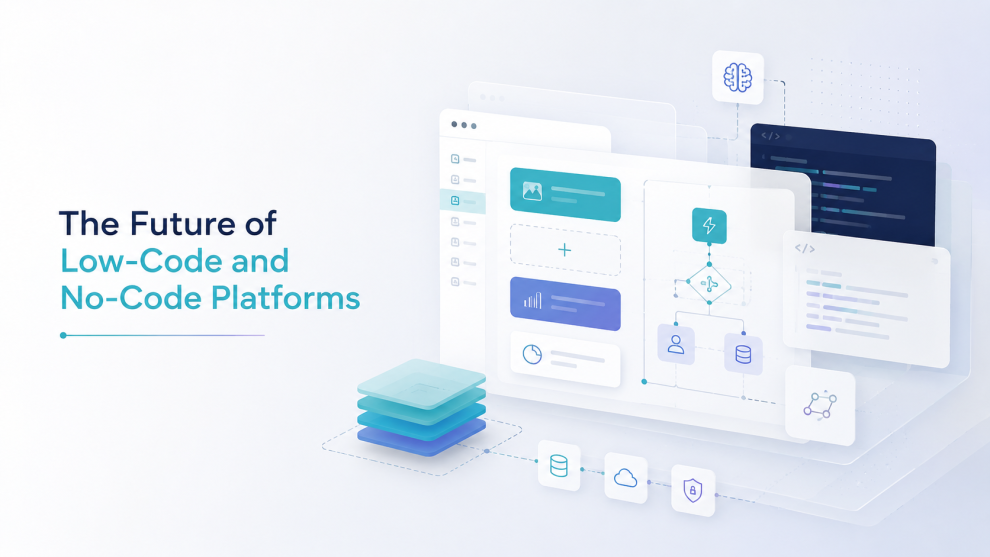

Low-code and no-code platforms are entering a more demanding phase. The early promise centered on visual development, faster prototypes, and citizen developers building departmental tools without waiting for central IT. That value remains, but it no longer defines the category.
Enterprise buyers now face a harder question: can these platforms support AI-assisted delivery, regulated workflows, complex integrations, and production operations without creating another layer of application sprawl?
Gartner projects worldwide low-code development technologies to reach $58.2 billion by 2029, growing at a 14.1 percent compound annual rate. It identifies agentic AI, citizen development, and operational efficiency as key growth drivers. The stronger signal is the shift from visual app builders toward platforms that combine model-driven development, generative AI, reusable components, and enterprise governance. ng leaders, the future of low-code and no-code will depend less on how quickly a team can assemble a screen. It will depend on whether the organization can treat the platform as part of its software delivery system.
Natural Language Will Replace Part of the Visual Canvas
Traditional low-code platforms abstracted code through forms, workflow diagrams, connectors, and reusable interface components. Generative AI introduces another abstraction layer: intent.
A product manager may describe an approval workflow, data model, access policy, or customer journey in natural language. The platform can then generate interface components, workflow logic, integration mappings, tests, and deployment configurations. Current platform strategies already position agents as participants across planning, development, orchestration, and operations. eliminate the visual canvas. It changes its purpose. Visual models will increasingly help teams inspect, constrain, and validate what AI generates. The canvas becomes a control surface rather than the primary authoring environment.
Natural-language generation can produce an application quickly, but speed does not guarantee correct authorization boundaries, resilient integration patterns, efficient queries, or auditable business rules. An AI agent may generate a working flow that calls an internal API, but the platform team must still verify identity propagation, rate limits, retries, transaction handling, logging, and data residency.
Future platforms must therefore preserve intent as structured metadata. Requirements, generated logic, data lineage, policy decisions, test results, and deployment history need traceability. Without that chain, enterprises will gain faster development while losing control over how software behaves.
The Winning Architecture Will Combine Low-Code, Pro-Code, APIs, and Events
Low-code will not replace conventional engineering across the application estate. It will become one delivery layer inside a composable architecture.
The strongest fit will remain workflow-heavy applications, internal operations tools, case management, partner portals, approval systems, and experience layers built over stable enterprise services. Low-code can accelerate these workloads because the platform handles repeated concerns such as forms, state transitions, authentication integration, basic observability, and deployment packaging.
Performance-sensitive transaction engines, advanced data processing, proprietary algorithms, real-time control systems, and deeply differentiated experiences will continue to require pro-code engineering. The practical enterprise model will connect both approaches through versioned APIs, event streams, shared identity, governed data products, and reusable domain services.
Many low-code failures begin with workload misclassification. A pilot performs well with a small user base, then becomes difficult to scale after teams add complex branching logic, synchronous integrations, large data volumes, and custom extensions. Developers eventually spend more time working around abstractions than delivering features.
Architecture teams should define a complexity ceiling before development starts. That ceiling should consider latency targets, transaction volume, integration count, regulatory controls, data sensitivity, offline behavior, portability, and expected product lifetime. Applications that cross the threshold should move critical logic into external services while retaining low-code for workflow or presentation where it still adds value.
Governance Will Become a Product Capability, Not an Approval Gate
Enterprise adoption will fail if governance arrives after hundreds of apps, flows, connectors, and agents already exist. Microsoft’s current guidance extends established low-code governance models to AI agents, including controls for environments, data access, operations, and lifecycle management. erating model needs four connected controls:
- Portfolio and workload governance: Teams need an application registry that records ownership, business criticality, data classification, dependencies, recovery requirements, platform costs, and retirement status. This prevents abandoned automations from remaining connected to production data.
- Architecture and security guardrails: Platform teams should publish approved connectors, integration patterns, identity standards, reusable components, data loss prevention policies, and reference architectures. The platform should enforce these controls during development rather than relying on manual reviews before release.
- Software delivery discipline: Low-code assets need source control, environment promotion, automated testing, release approvals, rollback procedures, vulnerability checks, and production telemetry. Critical applications should enter the same reliability processes as conventional software.
- Agent operations: AI-enabled platforms require model and prompt versioning, tool permissions, evaluation suites, human approval points, cost monitoring, audit trails, and kill switches. An agent that can update records or trigger workflows carries operational authority and must be governed accordingly.
These controls do not need to slow delivery. When platform engineering teams package them as reusable paved roads, builders gain approved ways to create applications quickly. Governance becomes an accelerator because teams spend less time negotiating security, integration, and deployment requirements for every project.
Platform Choice Will Shift From Feature Comparison to Exit Risk
Most platform evaluations overemphasize component libraries, demo speed, and connector counts. Those factors matter, but they do not predict the five-year cost of operating a large portfolio.
Engineering leaders need to examine how the platform stores application models, exposes generated code, integrates with external CI/CD systems, supports automated testing, isolates environments, manages custom extensions, and exports data and business logic. They also need to understand pricing behavior as users, transactions, automations, AI calls, and environments scale.
Vendor lock-in will not disappear, but enterprises can control its impact. A low-code application should avoid owning every layer of the system. Domain logic can live in independently deployable services. Core data can remain in governed systems of record. Integration contracts can use standard APIs and events. Identity can stay centralized. This keeps the platform replaceable at the experience or workflow layer.
External consulting and outsourcing support may help when internal teams lack platform architecture or governance experience. GeekyAnts combines low-code and no-code delivery with custom product engineering, which can suit organizations that may move selected components into pro-code as complexity grows. Accenture brings broad transformation and application management capabilities for large multinational estates. Capgemini explicitly frames enterprise low-code as a fusion of low-code and pro-code supported by governance, security, compliance, architecture, and platform operations. selection criterion is not brand size alone. It is whether the partner can define workload boundaries, establish platform guardrails, integrate with existing engineering systems, and leave the client with an operable internal capability.
The Future Is Faster Delivery With Stronger Engineering Boundaries
Low-code and no-code platforms are not disappearing. They are being absorbed into a broader AI-assisted software delivery model. Natural language will generate more of the first version. Visual tools will help teams inspect and govern it. Professional developers will build the services, extensions, and controls that protect scalability and differentiation.
The organizations that gain the most will not measure success by the number of citizen developers or apps launched. They will measure lead time, reuse, production reliability, portfolio cost, policy compliance, and the percentage of applications that remain maintainable after their original builders move on.
For technology leaders, the immediate task is not another platform pilot. It is a portfolio and architecture decision. A focused consultation can classify candidate workloads, identify where low-code creates leverage, define the point at which pro-code must take over, and establish the governance model before adoption expands. That conversation will reveal whether the platform can reduce delivery pressure or simply move technical debt into a new interface.


Add Comment