





Enterprise technology teams rarely lack application ideas. They struggle to deliver them while maintaining security, integration quality, reliability, and architectural control. Business units want workflow tools in weeks. Engineering teams already face modernization commitments, platform backlogs, cloud cost targets, security reviews, and customer-facing roadmaps.
That pressure explains the interest in low-code and no-code development. SAP cites a projection that the global market could approach $65 billion by 2027. Meanwhile, the US Bureau of Labor Statistics projects 15 percent employment growth for software developers, quality assurance analysts, and testers from 2024 to 2034, with about 129,200 openings each year. The market is not eliminating professional engineering. It is seeking ways to use scarce capacity more effectively.
The difference between low code and no code therefore goes beyond who builds the application. It affects control over business logic, APIs, deployment, testing, observability, security, and future migration. Both approaches accelerate delivery, but they solve different problems.
What Is the Difference Between Low Code and No Code?
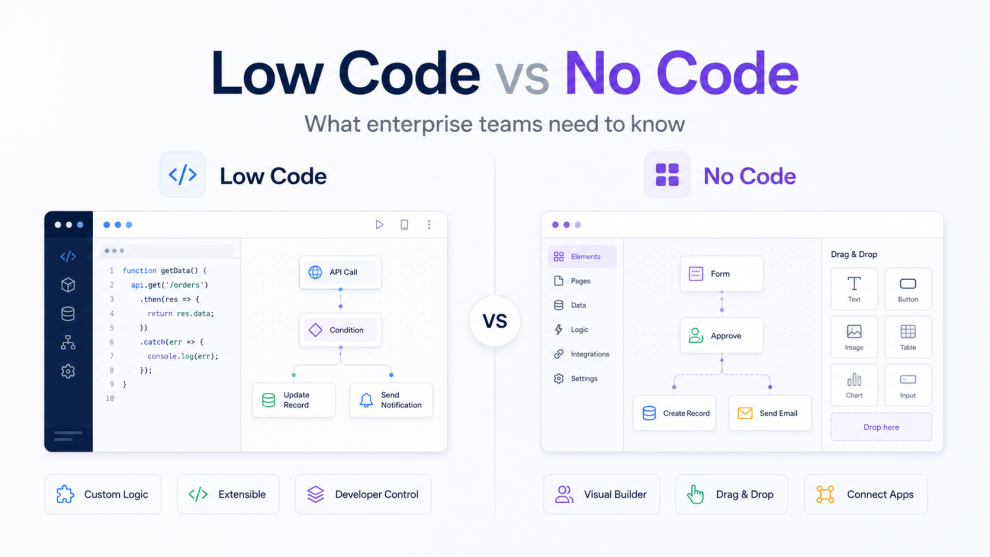
Low-code platforms use visual models, reusable components, generated code, and prebuilt connectors to reduce manual development. Professional developers or technical teams can add custom logic, integrate external services, define data models, and extend platform behavior. IBM describes low code as a middle ground between traditional development and no code because users can supplement generated functionality with code.
No-code platforms remove most direct programming. Business users configure screens, forms, rules, connections, and workflows through visual interfaces. The platform controls the runtime and exposes a limited set of supported behaviors. This creates speed, but it also creates a firmer boundary around customization.
For enterprise evaluation, six differences matter:
- User profile and ownership: Low code works best when developers, architects, platform teams, and business technologists share responsibility. No code targets domain experts who understand a process but do not write software. A finance team may own an expense approval workflow, but IT still needs accountability for identity, data access, retention, incidents, and platform continuity.
- Extensibility and business logic: Low-code applications can usually call custom APIs, invoke functions, use scripts, and implement logic that standard components cannot express. No-code tools depend more heavily on templates, rules engines, and approved connectors. Complex pricing, event processing, advanced validation, or industry-specific calculations usually push the workload toward low code.
- Integration depth: No code performs well when an app connects to supported SaaS products through standard authentication and predictable data structures. Low code becomes more suitable when the solution must connect with legacy systems, private APIs, event streams, custom identity providers, or several systems of record.
- Deployment and lifecycle control: Low-code platforms often provide environments, versioning, test support, deployment pipelines, and administrative controls. No-code products may simplify publishing but offer weaker separation between development, testing, and production. Leaders should examine rollback, release approval, dependency tracking, and environment promotion.
- Scalability and performance: A no-code workflow can succeed within one department and fail when transaction volume, concurrency, data size, or geographic reach increases. Low code offers more tuning options, but its runtime still creates constraints. Teams should test API limits, database behavior, background jobs, caching, and service-level commitments.
- Portability and vendor dependence: Both approaches create platform dependency. No code often creates more because logic, interfaces, and workflows may exist only as proprietary metadata. Low code can provide better escape routes through APIs, custom services, or exportable code. Contract reviews should cover data export, source access, licensing changes, connector replacement, and migration support.
IBM similarly positions low code as the stronger option when an application requires complex integrations, multiple data sources, enterprise scalability, or stronger IT guardrails. No code remains better aligned with simple interfaces, administrative workflows, reporting tools, and standalone departmental applications.
The Architecture Matters More Than the Interface
Drag-and-drop design is the visible part of these platforms, not the most important part. Underneath it, the platform still manages application state, data access, authentication, execution, logging, deployment, and integration. Enterprise teams should evaluate that runtime with the same discipline applied to other strategic platforms.
A suitable architecture separates platform-generated experiences from critical systems of record. The visual layer can manage forms, workflows, task routing, and departmental experiences, while stable APIs protect customer, payment, policy, inventory, or employee data. This prevents the platform from becoming an uncontrolled integration hub.
Low code supports this model when developers need adapters, API facades, event handlers, or reusable components. It can fit a composable architecture where custom services manage differentiated logic and the platform accelerates the experience layer. No code works better when the process stays bounded, data sensitivity remains manageable, and standard connectors meet the requirement.
The technical review should also test failure behavior. Teams need to know what happens when an API times out, a connector changes its schema, a workflow partially completes, or a user submits duplicate data. Weak retry controls, idempotency, tracing, and error queues can shift work from development into production support.
Licensing architecture also deserves attention. A platform may appear inexpensive during a departmental pilot but become costly when pricing expands by user, application, workflow execution, connector, data capacity, or environment. Leaders should model production usage rather than relying on the initial license tier.
Governance Determines Whether Speed Becomes Technical Debt
No-code adoption can expand faster than central IT can monitor it. IBM notes that shadow IT risk rises when business teams can build applications with little IT involvement. SAP also identifies data breaches, regulatory noncompliance, duplicate systems, fragmented data, and inconsistent standards as governance concerns.
Security teams should not assume that generated applications are secure because the platform abstracts the code. OWASP’s Citizen Development Top 10 covers risks associated with low-code, no-code, AI-assisted development, and agent technologies. Its guidance warns against blind trust in generated components and highlights security misconfiguration.
An enterprise operating model should classify applications by data sensitivity, business criticality, user reach, integration complexity, and transaction volume. A scheduling tool should not follow the same process as a customer-facing lending workflow, but both need ownership, access controls, documentation, and retirement criteria.
Platform teams also need component and connector policies. Approved templates should include identity integration, audit logging, secrets management, telemetry, accessibility, and error handling. Central teams can provide reusable building blocks while business teams configure workflows within controlled boundaries.
When external support is required, enterprises may evaluate consulting and outsourcing firms with different strengths. GeekyAnts brings a digital product engineering approach that can connect low-code or no-code delivery with custom applications and modernization. Capgemini offers enterprise low-code adoption, governance, and center-of-excellence support. Thoughtworks adds software engineering and architecture experience while taking a cautious view of low code beyond suitable boundaries. A credible partner should challenge the use case, not simply implement the selected platform.
That challenge matters because an unsuitable platform can still produce an impressive prototype. The weaknesses usually appear later, when the enterprise introduces real transaction volumes, regulatory controls, custom integrations, multiple development teams, or production support requirements.
Choosing Low Code, No Code, or Traditional Development
No code fits bounded internal workflows, simple data collection, departmental dashboards, basic approvals, prototypes, and automations that use supported systems. It creates value when domain experts can iterate quickly and platform limits remain less costly than custom development.
Low code fits applications that need faster delivery but still require professional engineering, custom logic, enterprise integrations, controlled deployment, and a path to scale. It reduces repetitive work while engineers concentrate on architecture, security, performance, and differentiated functionality.
Traditional development remains appropriate for systems with complex domain logic, strict performance requirements, unusual experiences, advanced data processing, deep infrastructure control, or long-term portability requirements. SAP frames pro code and low code or no code as complementary rather than mutually exclusive. Large enterprises often need all three.
The decision should begin with the workload, not the platform demonstration. Technology leaders need a clear view of criticality, expected scale, integration depth, data classification, compliance obligations, operating ownership, and exit options. A structured consultation can then determine which capabilities belong in no code, which require low code, and which should remain under full engineering control.
The objective is not simply to write less code. It is to deliver more business capability without creating an application estate that becomes harder to secure, integrate, operate, and modernize. When enterprises match the development model to the workload and govern the platform, low code and no code can reduce backlogs without transferring hidden costs into the next planning cycle.


Add Comment