




Speed has stopped being a competitive advantage—it has become a baseline expectation. Across North America, product leaders are under pressure to validate ideas in weeks, not quarters. Internal stakeholders want faster experimentation cycles. Customers expect rapid iteration. Meanwhile, engineering teams are already operating at capacity.
This is where the renewed interest in no-code MVP development is coming from not as a trend, but as a response to delivery bottlenecks.
Startups have moved first. They are quietly launching functional MVPs using no-code and low-code platforms in days, sometimes even hours. The question enterprise leaders are now asking is not whether this is possible, but whether it is sustainable, secure, and scalable enough to matter.
The Real Bottleneck Isn’t Development—It’s Validation
Most MVP strategies fail long before code becomes the issue.
In traditional enterprise environments, MVPs often resemble “mini-products” rather than experiments. Teams over-engineer early versions, integrate too many dependencies, and delay release cycles in the name of long-term scalability. By the time the MVP reaches users, the opportunity window has already shifted.
Insights from startup communities and practitioner discussions highlight a recurring theme:
founders are not using no-code to avoid engineering—they are using it to avoid premature engineering.
A common pattern emerging from early-stage builders includes:
- Using tools like Bubble, Webflow, and Zapier to simulate product workflows
- Prioritizing user feedback loops over backend robustness
- Replacing APIs with manual or semi-automated processes initially
This aligns with what many product leaders already suspect internally:
the fastest way to validate an idea is not to build it fully—it’s to test its core assumption with minimal infrastructure.
No-Code Is Not a Shortcut—It’s a Different Layer of Abstraction
There’s a tendency to either overhype or dismiss no-code entirely. Both positions miss the operational reality.
No-code platforms do not eliminate complexity. They relocate it.
Instead of managing infrastructure, teams manage platform constraints. Instead of writing backend logic, they orchestrate workflows. Instead of debugging code, they troubleshoot integrations.
From a systems perspective, this introduces a different set of trade-offs:
- Vendor dependency replaces infrastructure ownership
- Speed increases, but customization becomes constrained
- Governance shifts from code reviews to platform controls
For startups, this trade-off is acceptable. For enterprises, it raises immediate concerns around compliance, data security, and long-term maintainability.
This is where many internal MVP initiatives stall—teams either go all-in on no-code without guardrails or reject it entirely due to perceived risks.
Neither approach works.
How Startups Are Actually Building MVPs Today
Looking at real-world implementations, including insights from founders and builders, a more structured approach to no-code MVPs is emerging.
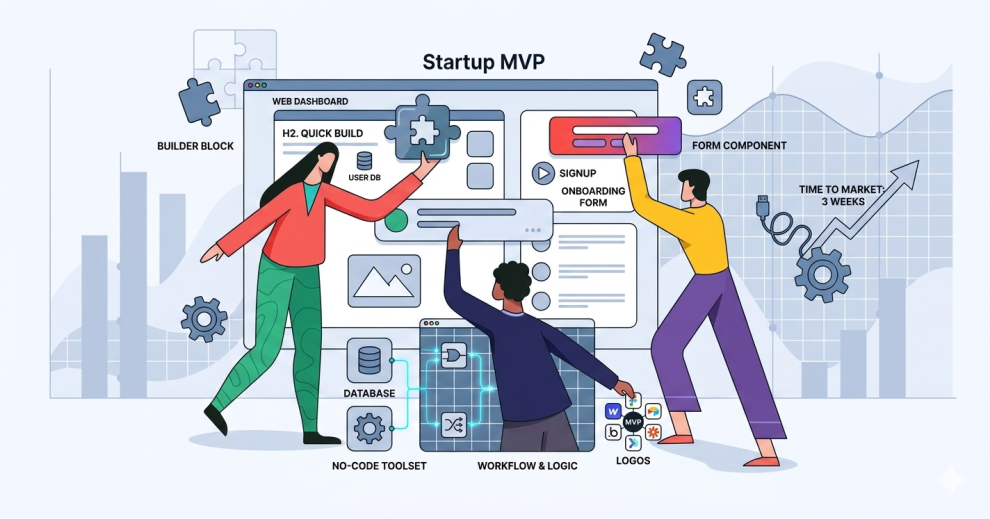
Startups are not building entire products blindly on no-code stacks. They are designing MVPs around specific layers:
1. Frontend and Experience Layer
Tools like Webflow and FlutterFlow are used to quickly build user-facing interfaces without involving frontend engineering teams.
2. Workflow Automation Layer
Platforms like Zapier, Make (Integromat), and Airtable handle business logic, notifications, and lightweight data operations.
3. Temporary Backend Substitutes
Instead of building full backend systems, startups often use:
- Google Sheets or Airtable as databases
- Notion or CMS tools for content-driven products
4. Human-in-the-Loop Operations
One of the most overlooked aspects: many MVPs are partially manual behind the scenes. What looks automated to users is often supported by internal workflows.
This hybrid approach drastically reduces time-to-market while still delivering usable products.
However, it comes with an expiration date. The moment usage scales or complexity increases, these systems begin to show limitations.
How Engineering-Led Firms Are Structuring No-Code MVPs
Leading digital engineering firms are not treating no-code as a replacement for engineering—they are integrating it into structured delivery models.
Companies like GeekyAnts, ThoughtWorks, and Netguru are increasingly incorporating no-code and low-code approaches into early-stage product development, especially for enterprise clients exploring new digital initiatives.
Their approach tends to follow a consistent pattern:
- Start with no-code for rapid validation of user journeys
- Introduce modular architecture early to allow gradual transition
- Define clear migration paths from no-code to scalable systems
- Align MVP scope strictly with business hypotheses, not feature completeness
For example, teams working on Flutter-based ecosystems often use no-code tools to prototype flows before translating validated patterns into production-grade Flutter applications.
The key difference is discipline.
These firms are not using no-code to cut corners—they are using it to compress the feedback cycle while preserving architectural intent.
The Enterprise Challenge: Governance Without Slowing Down
For large organizations, the biggest barrier is not capability—it’s control.
No-code introduces decentralized development. Business teams can build workflows without engineering oversight. While this increases speed, it also creates fragmentation risks:
- Data silos across tools
- Inconsistent security practices
- Lack of auditability
This is why many enterprise MVP initiatives fail to scale—they lack a governance framework.
A more effective approach is emerging among platform engineering leaders:
- Establishing approved no-code tool stacks
- Defining data access policies upfront
- Integrating no-code platforms into existing cloud ecosystems
- Monitoring usage through centralized dashboards
This allows organizations to retain control without reintroducing bottlenecks.
When No-Code Works—and When It Doesn’t
Not every MVP should be built using no-code. The decision should depend on the nature of the problem being solved.
No-code is most effective when:
- The MVP focuses on validating user behavior or demand
- Business logic is relatively simple
- Time-to-market is critical
It becomes less effective when:
- The product requires complex real-time processing
- Security and compliance requirements are high
- Deep system integrations are unavoidable
The mistake many teams make is treating no-code as a binary choice. In practice, the most effective MVP strategies combine no-code with traditional engineering.
A More Practical Way to Think About MVP Development
The conversation around MVPs is shifting from “how fast can this be built?” to “how fast can this be validated and evolved?”
No-code tools are part of that shift, but they are not the entire answer.
What matters more is how teams structure their experimentation cycles, how quickly they learn from users, and how effectively they transition from validation to scale.
This is where many organizations are beginning to reassess their internal processes—not just their tools.
Some are starting to treat MVP development as a distinct capability, separate from core product engineering. Others are bringing in external partners to accelerate early-stage validation before committing internal resources.
Either way, the focus is changing—from building products to testing assumptions.
Conclusion
The growing adoption of no-code MVP development is less about technology and more about decision-making speed.
Startups have demonstrated what’s possible when constraints are removed. Enterprises now have to figure out how to replicate that speed without compromising control.
That balance does not come from tools alone. It comes from how teams structure their workflows, define ownership, and align engineering efforts with business outcomes.
For leaders evaluating their next MVP initiative, the more relevant question may not be “Should we use no-code?” but rather:
What is the fastest way to validate this idea without creating long-term technical debt?
That discussion is rarely solved in isolation. It typically requires a closer look at current delivery models, platform strategies, and organizational constraints—often in a more consultative setting than a technical one.
FAQs
1. Can startups really build a full MVP using only no-code tools?
Yes, but typically only for early validation. Most successful startups eventually transition to custom-built systems as they scale.
2. How long does it take to build an MVP using no-code?
In many cases, a functional MVP can be built within days or weeks, depending on complexity and scope.
3. Is no-code secure enough for enterprise use?
It depends on the platform and governance model. Enterprises need strict controls around data access, compliance, and integrations.
4. What are the biggest limitations of no-code MVPs?
Scalability, customization constraints, and vendor lock-in are the most common challenges.
5. How do companies transition from no-code to full-stack systems?
By designing modular architectures early and gradually replacing no-code components with custom-built services.
6. Are no-code tools replacing developers?
No. They are shifting how developers spend their time—focusing more on complex systems rather than basic workflows.
7. Which industries benefit most from no-code MVPs?
Fintech, healthcare, SaaS, and marketplaces—especially where rapid validation of user demand is critical.



Add Comment