





The Backlog Is Not Just an IT Problem
According to Gartner, the low-code development market is projected to reach $44.5 billion by 2026, with 75% of new enterprise applications expected to be built on low-code platforms. Forrester separately reports that 87% of enterprise developers already use low-code in some form. These are not fringe tools anymore. They are the new default for application delivery.
For small and mid-size businesses in the US and Canada, the math is harder. They face the same operational complexity as larger enterprises ,multi-department workflows, compliance requirements, customer portals ,but with a fraction of the developer headcount. The result is a permanent state of backlog, where the tools people actually need to do their jobs never get built on time, or don’t get built at all.
Low-code platforms do not eliminate the need for developers. What they do is change who can contribute and how fast. According to industry data, companies using low-code platforms reduce application development time by up to 90% compared to traditional methods, and organizations save an average of $187,000 annually from the combination of reduced development costs and faster time to market.
Where Low-Code Is Actually Delivering Results
The use cases that produce the clearest ROI tend to cluster around a few categories. Here is where enterprises ,and increasingly, smaller companies ,are seeing measurable outcomes:
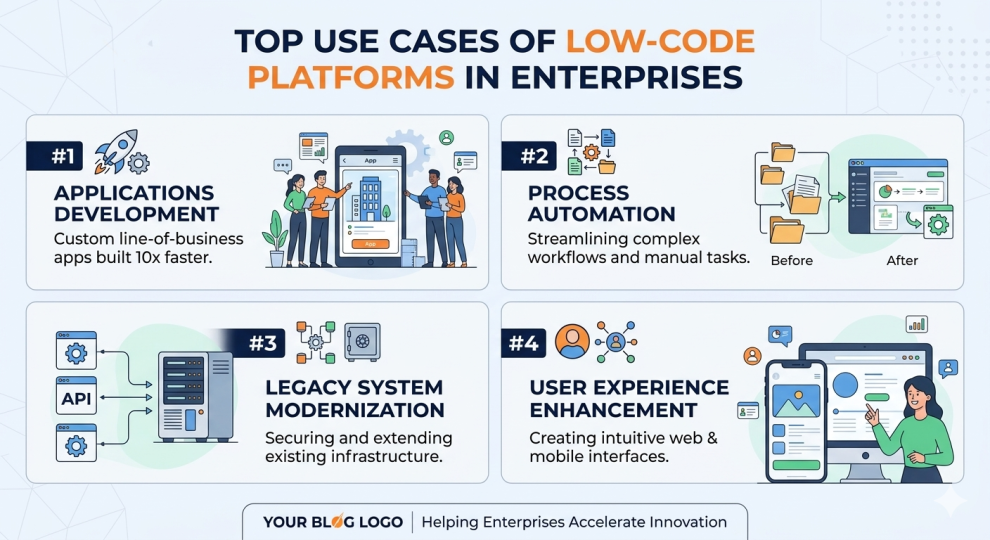
Workflow and Process Automation. This is the most common entry point. Teams replace email chains, paper approvals, and fragmented spreadsheet processes with automated workflows built in days instead of months. According to market research, 49% of companies cite business process and workflow apps as a top low-code use case. Finance teams automate invoice approvals. HR departments build onboarding workflows without touching IT. Operations teams create escalation logic for customer service queues. The work that used to sit in someone’s inbox now moves on its own.
Internal Tools and Dashboards. Nearly 60% of custom business apps are now built outside the IT department, per industry data from 2025. Teams that once waited months for a data dashboard now pull one together in a week. Sales operations teams build pipeline trackers. Logistics teams build shipment visibility tools. The constraint shifts from “can we build it” to “what do we build next.”
Customer-Facing Forms and Portals. This is where revenue impact becomes direct. Customer intake forms, self-service portals, application flows ,these are the touchpoints that affect conversion and satisfaction scores. Low-code platforms let marketing and product teams build and iterate on these without a development sprint. In healthcare, nursing staff have used platforms like Microsoft Power Apps to build patient intake forms, reducing administrative overhead without involving central IT.
Legacy System Modernization. This use case is growing rapidly as enterprises find that full re-architecture is too slow and too expensive. Low-code acts as a bridge layer ,wrapping legacy systems with modern interfaces and API connectors, without requiring a full rebuild. A KPMG survey found that 47% of executives now report using low-code for complex enterprise applications, not just lightweight departmental tools.
Citizen Developer Programs. As of 2025, 41% of businesses have active citizen development programs where non-technical employees build and maintain apps. This is not about replacing developers. It is about relieving them from low-complexity requests so they can focus on architecture and infrastructure that actually requires their expertise.
How Companies Are Operationalizing This
The challenge most enterprises face is not finding a low-code platform ,it is figuring out what to build first and how to govern what gets built. This is where experienced implementation partners become critical.
GeekyAnts, a US-based engineering studio with offices in California and clients including Darden Restaurants, PayPoint, and AirOps, takes an approach that combines low-code tools with custom engineering. Their model uses platforms alongside RPA and workflow automation to convert mapped business processes into executable applications ,stress-testing every workflow before deployment and establishing governance structures that keep citizen development within IT-defined boundaries.
Their BPM practice, for example, targets 25–40% faster cycle times across core functions like HR, finance, and operations, and 20–30% fewer manual errors through automated validation. That is not a platform promise ,it is an outcomes-based engagement model that answers the question executives actually care about: what does this change about our numbers?
Companies like Appian, OutSystems, and Salesforce (with its low-code Salesforce Platform) take a similar maturity curve approach at the enterprise level ,starting with high-frequency, low-complexity use cases and graduating to mission-critical applications as governance frameworks mature.
The Risks Companies Still Underestimate
Not everything works out of the box. Nearly 47% of organizations worry about scalability issues with low-code platforms. 37% cite vendor lock-in as a concern, and 25% flag security. Perhaps most telling: only 12% of enterprises currently use these tools to manage critical business processes, despite years of adoption. The gap between buying a platform and actually extracting value from it is real, and it costs companies time and internal credibility.
The organizations that avoid this trap share one common trait. They invest in governance before they invest in scale. They define what citizen developers can and cannot build. They set integration standards before tools proliferate. They treat the platform as infrastructure, not a shortcut.
The companies winning with low-code right now are not the ones who moved fastest. They are the ones who moved deliberately.
Frequently Asked Questions
Q: What is a low-code platform and how is it different from no-code?
Low-code platforms allow users to build applications using visual drag-and-drop interfaces with minimal hand-written code. They are designed for professional developers who want to accelerate delivery, and for technically capable business users. No-code platforms require zero coding knowledge and are typically aimed at non-technical teams building simpler applications. Low-code handles more complex, enterprise-grade use cases.
Q: Are low-code platforms suitable for small businesses, or only large enterprises?
Both. Small and medium enterprises are actually the fastest-growing segment of low-code adoption, with an 18.7% CAGR in related tool adoption. The same capability gaps that plague large IT departments ,developer shortages, backlogged requests, outdated internal tools ,exist in smaller organizations at proportionally the same scale.
Q: How long does it take to build an application using a low-code platform?
It depends on complexity. Simple workflow applications and internal forms can be built and deployed in days. More complex applications involving integrations with legacy systems, role-based permissions, or multi-stage approvals typically take two to six weeks. That compares favorably to traditional development timelines of three to twelve months for equivalent functionality.
Q: What are the most common mistakes enterprises make when adopting low-code platforms?
The most frequent failure modes are: adopting a platform without a governance framework, allowing sprawl where teams build in silos with no IT visibility, underestimating integration complexity with existing systems, and measuring success by the number of apps built rather than the business outcomes they produce.
Q: How do companies ensure security and compliance when using low-code tools?
Most enterprise-grade platforms today offer SOC 2, GDPR, and HIPAA-compliant features. The critical factor is configuration, not just capability. Enterprises in regulated industries should work with implementation partners experienced in compliance architecture, and establish role-based access controls, audit logging, and data residency policies before deploying citizen developer programs at scale.


Add Comment