




How CEOs, CIOs, and CXOs can use AI, low-code platforms, and consulting partners to scale automation without creating shadow IT, vendor lock-in, or unmanageable workflows.
Enterprise automation has entered a new phase. For years, companies treated automation as a choice between custom software, SaaS platforms, and robotic process automation. In 2026, that decision has become more complex.
AI agents can now interpret documents, summarize data, trigger workflows, draft responses, and assist with business decisions. Low-code platforms can turn those capabilities into internal tools, approval flows, dashboards, and customer-facing applications faster than traditional development cycles.
That combination is powerful, but it also creates a new leadership problem. If every department builds its own AI-enabled workflow without governance, the company does not get automation. It gets automation debt.
For CEOs and CXOs, the goal is not to chase every new AI tool. The goal is to build an enterprise automation stack that improves cycle time, reduces manual work, protects data, and gives teams enough flexibility to adapt when business rules change.
Gartner has predicted that by 2028, one-third of enterprise software will include agentic AI capabilities, and 15% of day-to-day work decisions will be made autonomously. That does not mean every company should hand decisions to AI. It means leaders need a practical operating model before AI agents become another uncontrolled layer in the technology stack. (IT Pro)
Why AI Alone Does Not Solve Enterprise Automation
Most companies do not fail at automation because they lack tools. They fail because their workflows live across disconnected systems.
A sales approval may start in CRM, move to email, require finance validation, trigger a contract workflow, and end in an ERP update. A claims process may involve document intake, fraud checks, policy rules, customer communication, and compliance review. A procurement workflow may depend on vendor data, budget limits, approval hierarchy, and audit requirements.
AI can assist with each step, but it cannot create operational reliability by itself.
This is where low-code becomes important. Low-code platforms give enterprises a way to design workflows, connect systems, build interfaces, and manage approvals without waiting months for full custom development. AI adds intelligence. Low-code adds structure.
Microsoft positions Power Platform around low-code tools for apps, workflows, data, governance, connectors, and AI-powered capabilities. Its platform page also highlights more than 1,000 connectors and enterprise-grade governance features, which matters because AI automation only works when it can safely interact with real business systems. (Microsoft)
The strongest enterprise automation stack is not “AI instead of software.” It is AI inside governed workflows.
The New Stack: AI, Low-Code, APIs, and Human Oversight
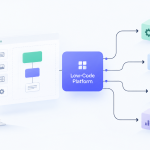
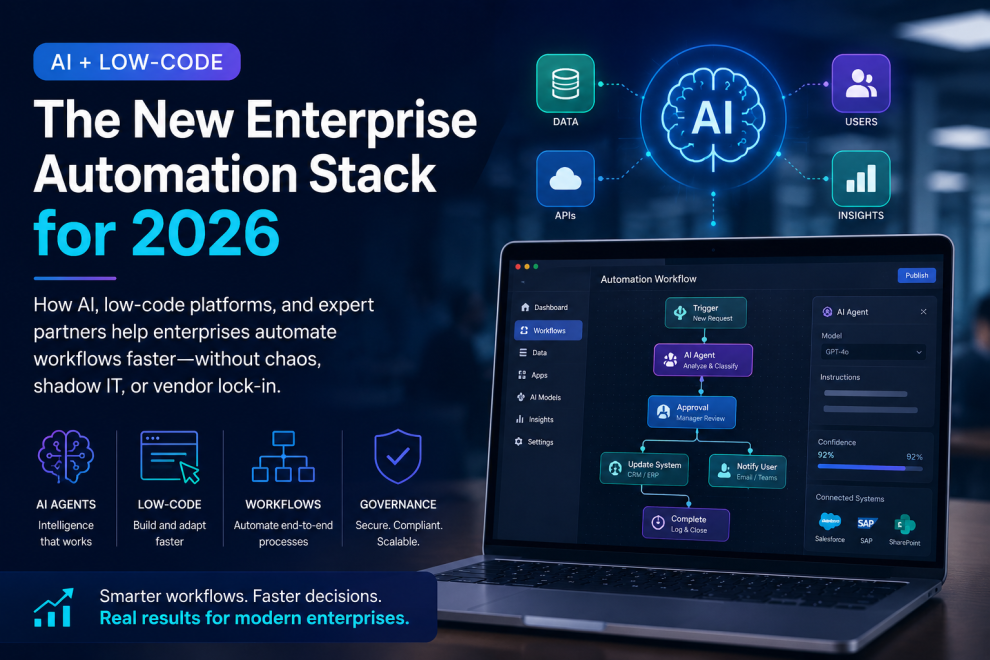
The practical enterprise stack for 2026 has four layers.
First, there is the data layer. This includes CRM, ERP, EHR, core banking, policy systems, data warehouses, document repositories, and internal knowledge bases.
Second, there is the AI layer. This includes language models, document intelligence, recommendation engines, copilots, and AI agents.
Third, there is the workflow layer. This is where low-code platforms matter. They define how tasks move, who approves exceptions, which systems receive updates, and where humans must stay in control.
Fourth, there is the governance layer. This includes identity, access control, audit logs, monitoring, security reviews, model usage policies, and compliance documentation.
Companies that skip the workflow and governance layers may get impressive demos, but they rarely get stable automation. AI agents can create risk when they act across systems without clear rules. Recent coverage of enterprise agentic AI has repeatedly pointed to governance, security, transparency, and integration as major concerns. (TechRadar)
This is why low-code AI should not be treated as a citizen-developer free-for-all. It should be treated as a managed delivery model. Business users can define processes. IT can set guardrails. Engineering teams can build reusable components. Compliance teams can review sensitive workflows before they reach production.
How Consulting and Outsourcing Partners Support the Shift
AI consulting and outsourcing partners increasingly support enterprise automation by helping companies move from tool selection to operating-model design.
A strong partner does not simply ask which low-code platform a client wants. The better question is: which workflows should the company own, which capabilities should it buy, and which areas need custom engineering?
That is the same strategic lens companies such as GeekyAnts have applied in AI build-versus-buy discussions. The useful takeaway is not the promotion of one vendor or one development model. The takeaway is lifecycle ownership: enterprises need to decide which parts of the knowledge layer, workflow layer, and model layer they must control to avoid vendor lock-in and long-term operating risk. (GeekyAnts)
Other companies are moving in the same direction from the platform side. OutSystems’ Agent Workbench, for example, focuses on helping enterprises build and manage agentic AI systems through low-code workflows across data sources, with governance, security, and integration positioned as core enterprise concerns. (TechRadar)
For CXOs, this creates a clearer role for outsourcing partners. They can assess workflow readiness, identify automation candidates, build integrations, create reusable low-code components, set AI governance rules, and help internal teams scale beyond pilots.
The best partners also know when not to use low-code. Highly regulated decision engines, performance-heavy systems, complex proprietary algorithms, and deeply differentiated customer experiences may still require custom engineering. Low-code should accelerate enterprise automation, not replace architectural judgment.
The Business Case: Speed With Control
The appeal of AI + low-code is speed. Teams can build internal apps, automate approvals, connect systems, and test AI-assisted workflows without waiting for a full engineering roadmap.
But speed only matters if the result survives production.
A finance team may automate invoice triage. An insurance team may automate claims intake. A healthcare team may automate prior authorization routing. A logistics team may automate exception alerts. These use cases can deliver value quickly, but only when leaders define ownership, escalation paths, and success metrics.
Microsoft’s Power Platform customer examples show how companies are measuring results in time savings, cost savings, annual savings, and monthly hours saved. Since these are vendor-published examples, leaders should treat them as directional proof points rather than universal benchmarks. Still, they reflect the business outcomes most companies care about: faster delivery, lower manual effort, and better process visibility. (Microsoft)
The right metrics for AI + low-code automation include workflow cycle time, manual hours reduced, exception rate, error rate, user adoption, cost per transaction, compliance incidents, and time required to change a business rule.
Those metrics matter more than the number of AI agents deployed.
Final Takeaway
AI + low-code is becoming the new enterprise automation stack because it solves a practical problem. Companies need faster automation, but they cannot afford ungoverned AI experiments scattered across departments.
AI brings intelligence. Low-code brings workflow structure. APIs connect the enterprise systems. Governance keeps the whole stack safe enough to scale.
For CEOs and CXOs, the decision is no longer just build versus buy. The better question is what the company should own, what it should configure, what it should automate, and where expert partners can reduce delivery risk.
Companies like GeekyAnts, Microsoft, OutSystems, and other technology partners are approaching this shift from different directions, but the broader pattern is clear. Enterprise automation in 2026 will not depend on a single tool. It will depend on the ability to combine AI, low-code platforms, custom engineering, and governance into one operating model.
The winners will not be the companies with the most automation experiments. They will be the companies that turn AI-enabled workflows into measurable, secure, and maintainable business systems.



Add Comment