




Most product backlogs are not bottlenecked by ideas. They are bottlenecked by engineering time. And as companies reach for AI-powered no-code platforms to close that gap, the question is no longer whether these tools work,it is whether leadership knows when to use them and when not to.
Here is the real pressure: a mid-market company needs to ship a customer-facing portal, an internal reporting dashboard, and an onboarding automation workflow, simultaneously. The engineering team is stretched across a product roadmap that already has eight quarters of backlog. Hiring takes four to six months. Agencies are expensive and slow to ramp. This is not a hypothetical. This is where most companies actually sit.
AI-powered no-code platforms,tools like Webflow, Bubble, Retool, Glide, and services from companies like GeekyAnts that combine low-code infrastructure with AI-assisted development,have matured enough to handle a serious range of these problems. The question decision-makers now face is not whether the tools are real. It is whether their teams are applying them to the right problems.
65%
of app development will use low-code or no-code by 2026 (Gartner)
4–6 mo
average time-to-hire for a mid-level software engineer
$137K+
median U.S. software developer annual salary (BLS, 2024)
Where AI-Powered No-Code Wins on Speed and Cost
The clearest signal that a company should reach for no-code is when the core requirement is delivery speed on a known problem. Internal tools, customer portals, workflow automations, CRM integrations, approval flows,these are solved problems dressed up in company-specific clothing. Building them from scratch with developers is not engineering, it is expensive translation work.
Companies like GeekyAnts, the React Native and cross-platform app studio, have incorporated AI-assisted no-code tooling into their delivery stack specifically to reduce the time between client brief and working prototype. Similarly, Shopify merchants build and iterate on storefronts and automation flows using their no-code ecosystem without touching a line of code. Zapier and Make (formerly Integromat) handle millions of enterprise workflow automation triggers monthly,many replacing what would have been custom API integration projects.
The pattern is consistent. When the desired output is a working interface or automated workflow, and when the underlying data model is not deeply novel, no-code wins on timeline and cost,almost every time.
“The companies that are winning are not the ones that hired the most engineers. They are the ones that figured out which problems actually needed engineers.”
Airbnb uses Retool heavily for internal tooling,letting operations teams build their own dashboards without pulling engineering resources. DoorDash has done the same. These are companies with large engineering teams who have consciously decided that not every internal problem deserves a custom build. That is a strategic discipline, not a shortcut.
Where Developers Still Win,and Why This Matters
The case for no-code is real. But so is its ceiling. And the companies that hit that ceiling badly,mid-launch, mid-scale, or mid-audit,tend to have one thing in common: leadership applied no-code to a problem that needed custom engineering.
There are specific situations where developers remain the right answer. Systems that require deep custom logic (a proprietary pricing engine, a complex multi-sided marketplace algorithm), applications with serious compliance and data residency requirements, infrastructure that will be the foundation of the product itself rather than a peripheral workflow,these belong in engineering hands. No-code platforms abstract the underlying stack, and that abstraction has a cost when the business needs to inspect, audit, or fundamentally alter what sits beneath.
Performance at scale is another limit. A Bubble-built MVP that works beautifully at 500 users can degrade at 50,000 without significant architectural intervention. The platform vendors are closing this gap, but it is not closed yet. Companies that know they are building toward millions of transactions per day need to plan for that from the start.
The criteria for using custom developers instead of no-code generally look like this:
- The core differentiator of the business lives inside the logic being built,it is not just a wrapper around existing data.
- The system will handle sensitive regulated data (healthcare, financial, legal) where auditability of code is not optional.
- The expected load or transaction volume places the system well beyond the performance envelope that no-code platforms currently support reliably.
- The company needs full ownership and portability of its codebase,vendor lock-in is a strategic risk they cannot absorb.
The Signal: How Companies Are Actually Deciding
The most sophisticated operators are not choosing between no-code and developers as competing philosophies. They are running them in parallel based on where each creates the most leverage.
GeekyAnts applies this layered model in its client engagements: AI-assisted no-code for the front-facing interfaces and automation layers, custom engineering for the core logic and data infrastructure. This is not a compromise,it is an architecture decision. The goal is to ship faster on the parts of the product where speed compounds and invest engineering hours where correctness and depth are irreplaceable.
HubSpot built significant portions of its partner ecosystem tooling and onboarding flows on no-code infrastructure. Notion and Airtable have entire enterprise customer segments who use their platforms to replace custom internal applications that used to take months to build. The velocity advantage is measurable and it is compounding.
The framing that helps most leadership teams is this: treat no-code like a tool selection problem, not an identity problem. The right question is not “are we a no-code company or a dev shop?” It is “what is the fastest path to the right outcome for this specific requirement, and what are we actually risking if we abstract the engineering?”
~$52B
Projected global low-code/no-code development platform market by 2030, growing at roughly 26% CAGR (Statista, 2024). The shift is structural, not cyclical.
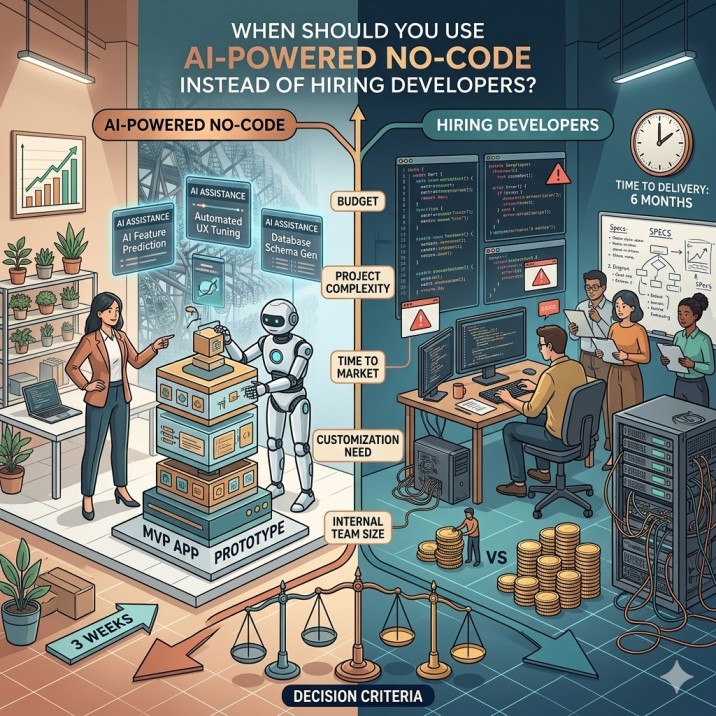
Companies that navigate this well tend to maintain a decision criteria document,a short internal framework that routes new requirements toward no-code, hybrid, or full custom build based on a small set of questions: How regulated is the data? How novel is the business logic? How fast does this need to ship? What does failure cost us? That document, reviewed quarterly, does more to reduce wasted engineering spend than most org redesigns.
The companies spending the most on developer salaries are not necessarily shipping the best products. And the companies treating no-code as a silver bullet are running into walls. The ones compounding the fastest have gotten disciplined about the difference, and they have built internal processes to make the right call quickly, without ideology getting in the way.
Frequently asked questions
Can a company migrate off a no-code platform if the product outgrows it?
Yes, but it requires planning. Most no-code platforms allow data export and API access, which makes migration possible. The practical challenge is that the business logic encoded in a platform’s visual builder does not translate cleanly into custom code,it typically needs to be re-engineered, not ported. Companies that anticipate this build clean data models from the start and avoid deep platform-specific logic in mission-critical workflows.
Is AI-powered no-code suitable for enterprise-grade applications?
For internal tooling, operational dashboards, and workflow automation,increasingly yes. For customer-facing applications at enterprise scale with strict SLA, security, and compliance requirements, the answer is more nuanced. Platforms like Retool, Appsmith, and certain GeekyAnts delivery frameworks target exactly this segment, with self-hosted deployment options and audit controls. The honest answer is: it depends on the specific platform, the compliance regime, and the architecture decisions made at the start.
How do companies evaluate no-code vs. hiring developers for a net-new product?
The most useful starting point is separating the core value proposition of the product from everything around it. If the novel thing,the reason a customer would pay,lives in the logic being built, it usually warrants custom engineering. If the novel thing is a business model, a distribution channel, or a customer segment, and the software is enabling infrastructure, no-code often ships faster with acceptable trade-offs. Most net-new products benefit from a no-code MVP validated with real users before committing to a full custom build.
What is the hidden cost of no-code that companies underestimate?
Platform dependency and per-user pricing at scale. Many no-code tools are priced on a per-seat or per-workflow-run model that looks manageable at 20 users and becomes significant at 2,000. The other underestimated cost is the time required to work around platform limitations as requirements evolve,what started as a two-hour configuration task can become a week-long workaround project when the platform was not designed for the edge case the business has discovered.
Do professional services firms like GeekyAnts recommend no-code to their clients?
Firms that are doing this well,GeekyAnts among them,have moved toward a pragmatic stack model where no-code and AI-assisted tooling handle specific layers of the product, and custom engineering handles others. The recommendation depends on the client’s timeline, budget, technical debt appetite, and the nature of what is being built. A dogmatic preference for either full custom build or pure no-code is usually a sign that the firm is optimizing for their own delivery model rather than the client’s outcome.


Add Comment