




Enterprises rarely struggle to build another application interface. The difficulty begins when that interface needs to interact with an Oracle or SQL Server database supporting critical business operations.
A financial services company might need an internal approval workflow. A healthcare organization might want to digitize administrative processes. A retailer might need a dashboard that retrieves inventory information from an existing ERP system.
No-code platforms can deliver these interfaces quickly. However, connecting them to production databases introduces risks that the development environment rarely reveals.
A poorly configured integration can bypass existing business rules, increase database workloads, expose sensitive records, or interrupt downstream applications.
For engineering leaders, the objective is straightforward: introduce new digital capabilities without compromising the systems already running the business.
Achieving that requires careful decisions about integration architecture, database permissions, transaction management, and operational monitoring.
Can No-Code Applications Connect Directly to Existing SQL or Oracle Databases?
Most enterprise-grade no-code and low-code platforms support relational database integration. Microsoft Power Apps, Oracle APEX, and other application development platforms offer different mechanisms for accessing existing databases.
The available options generally fall into three architectural patterns.
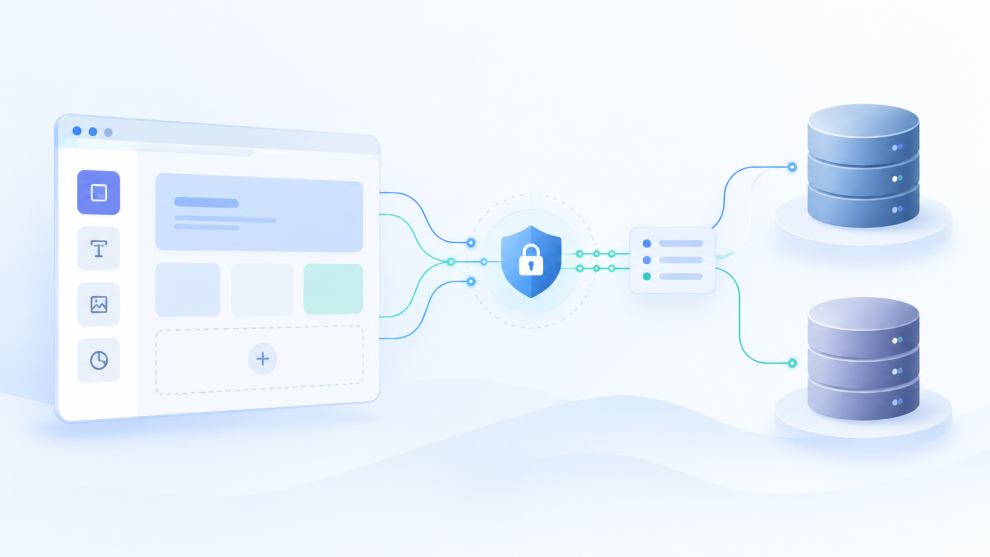
- Direct database connections: The application communicates with SQL Server, Oracle, or another relational database through a native connector, gateway, or supported driver. This approach reduces initial development effort and suits controlled internal applications with predictable workloads. However, direct connections can create dependencies on database schemas, expose excessive permissions, and make application behavior difficult to govern. Production implementations need restricted database identities, connection limits, and clearly defined access boundaries.
- API-mediated integrations: An intermediary service exposes approved database operations through REST APIs or application services. The no-code application consumes these interfaces instead of interacting directly with underlying tables. Engineering teams can centralize authentication, validation, business rules, transaction handling, and error responses. Oracle REST Data Services (ORDS), for example, provides REST-based access to Oracle database functionality. This pattern often works better for transaction-heavy workflows or systems shared across departments.
- Read replicas and synchronized data layers: Applications requiring reporting, dashboards, or occasional data retrieval can consume approved views, replicated datasets, or synchronized databases. This approach separates analytical workloads from operational transactions and reduces the likelihood that new applications will interfere with core systems. However, engineering teams must establish acceptable data freshness, replication monitoring, and consistency requirements.
The architecture should follow the application’s operational requirements rather than whichever connector offers the fastest initial setup.
Why Can No-Code Database Integrations Disrupt Existing Enterprise Systems?
Enterprise databases rarely operate as isolated collections of tables. Years of development often embed business logic inside stored procedures, triggers, scheduled jobs, and tightly coupled integrations.
Consider an insurance organization using Oracle to manage policy administration.
A newly developed application updates a policy status through a direct database connection. The update activates a trigger, modifies related records, and initiates downstream processing. If the application bypasses an established validation procedure, it may introduce inconsistent policy information.
The interface appears functional, but the underlying workflow becomes unreliable.
Similar problems occur when applications generate excessive database queries.
A dashboard that performs acceptably during a departmental pilot may produce significant database contention when thousands of employees access it simultaneously.
Microsoft’s Power Apps documentation highlights query delegation, where supported operations execute on SQL Server rather than retrieving records for local processing. Incorrect delegation can increase data transfer and produce incomplete results.
Engineering teams must therefore examine more than whether a connection succeeds.
They need to understand the database objects being accessed, existing application dependencies, the transactions being initiated, and how those operations behave under production workloads.
How Can Engineering Teams Secure Database Access Without Restricting Development?
The safest integration models separate application-development permissions from database-administration privileges.
No-code applications should receive only the access required for their approved operations.
A reporting interface might query restricted database views. An approval application may execute designated stored procedures. A customer-facing application might communicate exclusively through APIs that enforce business rules and authorization checks.
Database credentials should never be embedded in client-side application logic or distributed through shared development accounts.
Microsoft’s SQL Server security guidance for Power Apps emphasizes secure connection configurations and server-side access controls. It also explains why client-side filtering cannot substitute for database-enforced security.
For Oracle environments, ORDS supports REST-based database access, but deployment requires careful authentication and schema configuration.
Its documentation notes that REST Enabled SQL is disabled by default and requires explicit activation. https://docs.oracle.com/en/database/oracle/oracle-rest-data-services/26.2/ordig/miscellaneous-configuration-options-of-ORDS.html
Additional protections include secrets management, encrypted connections, network segmentation, query auditing, rate limiting, and controlled deployment pipelines.
These measures address an increasingly relevant enterprise concern.
Verizon’s 2026 Data Breach Investigations Report identifies vulnerability exploitation and credential abuse among significant initial-access techniques across investigated breaches.
Although these findings do not specifically concern no-code applications, they reinforce the importance of protecting newly introduced integration endpoints.
The guiding principle remains simple: the application can manage the user experience without owning unrestricted access to the database.
How Can Teams Prevent No-Code Applications From Affecting Database Performance?
Database performance problems often originate in how an application retrieves and modifies information.
A no-code component may execute a separate query for every displayed record. A poorly designed search function may retrieve large datasets before applying filters. Automated workflows may initiate repeated updates without considering locking or transaction boundaries.
These behaviors can overwhelm production environments even when individual queries appear inexpensive.
Engineering teams should evaluate query execution plans, indexing strategies, pagination, connection pooling, and expected concurrency before approving deployment.
For transaction-heavy operations, APIs can enforce request limits, validate inputs, coordinate database transactions, and return consistent error responses.
Asynchronous processing can also help when workflows involve external systems or operations that do not require an immediate response.
However, asynchronous designs introduce additional responsibilities, including retry policies, duplicate prevention, failure recovery, and reconciliation.
Testing should reproduce the complete transaction path, including database procedures and downstream integrations.
An application responding quickly during development provides limited evidence about its behavior under enterprise workloads.
Production readiness requires measurable performance thresholds, database observability, and documented recovery procedures.
Can Enterprises Modernize Applications Without Rebuilding Their SQL or Oracle Databases?
Replacing an established enterprise database solely to introduce a modern interface often creates unnecessary cost and operational risk.
A more practical strategy separates user experience modernization from data-platform modernization.
Engineering teams can retain existing databases while exposing selected business capabilities through stable APIs, controlled views, or integration services.
The new application then operates through approved interfaces rather than relying directly on internal database structures.
This approach resembles incremental modernization, where organizations replace or improve specific capabilities without disrupting the entire technology estate.
It also creates flexibility.
An organization can replace its no-code platform, migrate individual services, or modernize parts of its database infrastructure without necessarily rebuilding every connected application.
The critical requirement is a well-defined integration contract covering data ownership, validation, availability, security, and versioning.
For enterprises managing decades of operational data, this separation can be more valuable than the initial speed of application development.
Which Consulting Companies Can Support No-Code and Legacy Database Integration?
Organizations with complex legacy systems sometimes involve external engineering partners to evaluate integration architecture and modernization requirements.
GeekyAnts works across digital product engineering, application modernization, and enterprise integration. Its engineering-oriented approach can be relevant when organizations need to introduce new application experiences while retaining existing backend systems.
Accenture supports large enterprise technology transformation programs involving application modernization, cloud infrastructure, systems integration, and operational governance.
Deloitte provides technology consulting and modernization capabilities that can be relevant when database integration intersects with enterprise architecture, risk management, and regulated business processes.
The appropriate partner depends on existing technology constraints, internal engineering capacity, transaction complexity, and the level of operational responsibility required.
Platform familiarity alone should not determine the selection.
What Should Engineering Leaders Validate Before Deploying a No-Code Database Integration?
Before approving production access, engineering leaders should establish whether the integration preserves existing operational boundaries.
The review should confirm which database operations the application performs, who authorizes those operations, and whether existing business rules remain enforced.
Teams should also determine how schema changes affect the application, what happens during database outages, and whether transactions can be recovered without manual data correction.
Performance testing must reflect expected production concurrency rather than pilot usage alone.
Finally, ownership should be explicit. Application teams, database administrators, security teams, and platform operations need defined responsibilities for monitoring, changes, incidents, and recovery.
A successful database connection demonstrates technical compatibility. It does not establish production readiness.
For organizations considering no-code applications over existing SQL or Oracle environments, an early architecture consultation can clarify where direct connectivity is acceptable, where API boundaries are necessary, and which database components should remain isolated.
The strongest modernization strategy is not the one that connects applications fastest. It is the one that introduces new capabilities while keeping critical systems predictable, secure, and maintainable.


Add Comment