





Enterprise technology leaders must deliver more applications, modernize aging estates, improve customer experience, and control engineering costs at the same time. Low-code platforms and AI coding assistants both promise speed, which makes them look interchangeable in budget discussions. They are not.
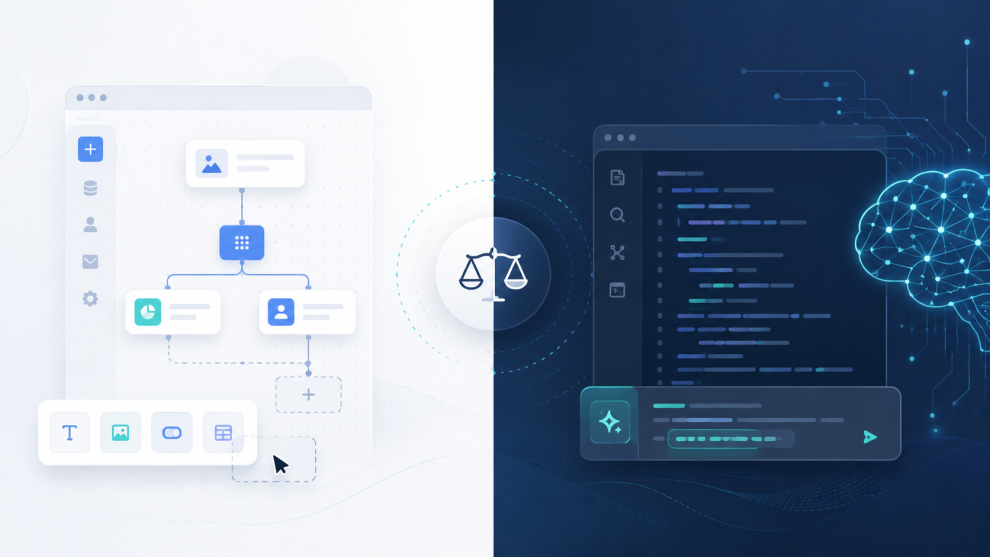
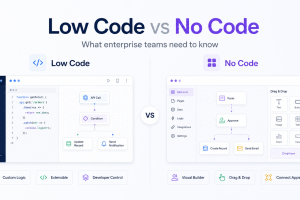
A low-code platform changes the delivery model through visual composition, reusable components, workflow engines, connectors, deployment services, and governance. An AI coding assistant changes how engineers work inside the existing model. It generates, explains, tests, and refactors source code, while the organization still owns the architecture, toolchain, runtime, and controls.
That distinction matters because enterprise bottlenecks extend beyond code production into integration, security reviews, environments, testing, releases, and maintenance. The 2025 Stack Overflow Developer Survey found that 84% of respondents use or plan to use AI development tools, yet 46% distrust their accuracy and 66% cite outputs that are almost right as their biggest frustration. Faster code creation can increase verification work when teams lack strong controls.
What problem does each approach actually solve?
Low-code platforms solve for repeatability and controlled application assembly. They work best when teams need many applications built from common patterns such as forms, approvals, case management, dashboards, portals, field workflows, and enterprise integrations. The platform turns those patterns into governed building blocks and gives business and technical teams a shared visual model of process logic.
AI coding assistants solve for developer throughput and cognitive load. They can draft API handlers, generate tests, explain unfamiliar services, migrate syntax, and accelerate repetitive implementation. Advanced agents can work across files, run commands, and propose pull requests. Their output still enters the repositories, pipelines, security gates, and runtime environments the organization already operates.
The technical difference is abstraction. Low-code abstracts parts of the application stack into metadata, models, and platform services. AI assistants create or modify code within a chosen stack. One standardizes how applications are constructed. The other accelerates the people constructing them.
This is why license comparisons alone mislead procurement teams. The real cost model includes platform fees, developer capacity, integration effort, security assurance, observability, vendor dependency, maintenance, and the cost of changing direction later. Gartner projected the low-code development technologies market to reach $58.2 billion by 2029, with agentic AI, citizen development, and operational efficiency driving adoption. That forecast suggests convergence, not replacement.
Where do architecture, governance, and ownership diverge?
With low-code, architecture partly resides in the platform. The vendor may provide identity integration, access controls, connectors, workflow orchestration, audit logs, deployment promotion, monitoring, and scaling. This reduces repeated decisions but can create concentration risk when business logic, data models, or UI behavior depend on proprietary services.
With AI-assisted coding, architecture remains the enterprise’s responsibility. The assistant may recommend patterns, but it does not automatically enforce service boundaries, data residency rules, threat models, accessibility standards, or production support requirements. Teams need approved model access, prompt and code handling policies, secure context retrieval, dependency controls, automated testing, code review, software composition analysis, and traceability for generated changes.
Code ownership also differs. AI assistants generally produce source code that stays in enterprise repositories, although model terms and data controls require review. Low-code platforms vary. Some expose code or standards-based artifacts, while others store behavior as platform-specific metadata. Exit planning must examine exportability, API access, data portability, extension mechanisms, and rebuild effort.
Google Cloud’s 2025 DORA research reinforces this operating-model view. Based on nearly 5,000 technology professionals, it found that AI amplifies existing team conditions. It also reported a positive relationship with delivery throughput and product performance, but a negative relationship with delivery stability when teams lack automated testing, mature version control, fast feedback, and loosely coupled architecture. The question is not whether AI writes usable code. The question is whether the surrounding system can absorb more change safely.
Which approach fits each enterprise delivery pattern?
Technology leaders can classify the portfolio before choosing tools:
- Low-code fits standardized, process-heavy applications. It is usually the stronger option when the business needs many similar workflows, rapid changes to rules, visible process ownership, and controlled participation from non-developers. Examples include claims intake, employee onboarding, service requests, operational dashboards, and regulated approval flows. The platform should still pass architecture review for integration limits, performance, data classification, disaster recovery, and long-term portability. Low-code removes repeated implementation work, but it does not remove the need for platform engineering.
- AI coding assistants fit differentiated software built on established engineering foundations. They create more value when teams already have reliable CI/CD, test automation, secure repositories, reusable services, observability, and clear coding standards. In that environment, assistants can accelerate code search, scaffolding, test creation, documentation, refactoring, and legacy modernization without forcing the organization into a new application runtime. They are less effective when developers must compensate for fragmented architecture, weak documentation, slow environments, or tightly coupled systems.
- A hybrid model fits portfolios with both commodity workflows and differentiated capabilities. A customer service application, for example, might use low-code for case routing, forms, approvals, and operational dashboards while custom services handle pricing, fraud detection, personalization, or high-volume transaction processing. Engineers can use AI assistants to build and maintain those services, generate tests, and create integration adapters. The low-code layer supplies governance and workflow visibility, while the custom layer preserves control over the capabilities that create competitive advantage.
This portfolio view prevents a common failure pattern: selecting one tool category as an enterprise standard and forcing every workload into it. Standardization should reduce unnecessary variation, not eliminate technical judgment.
Why are leading teams combining both approaches?
Low-code vendors are adding natural-language generation, AI-assisted workflow design, test generation, and agent builders. Coding assistants are expanding from autocomplete into planning, multi-file changes, code review, and autonomous task execution. The boundary is becoming less visible at the user interface, but the underlying accountability remains different.
The strongest enterprise pattern uses low-code as a governed product platform and AI assistants as an engineering acceleration layer. Platform teams define approved components, data access patterns, deployment controls, observability requirements, and extension points. Product teams assemble standard capabilities and write custom code only where differentiation or technical constraints justify it. AI tools help engineers create those extensions faster, but automated controls verify the output.
GitHub’s 2025 Octoverse data shows how quickly AI has entered mainstream development. It reported more than 1.1 million public repositories using an LLM SDK and found that 80% of new GitHub developers used Copilot in their first week. That scale makes governance an immediate operating concern rather than a future policy project.
Enterprises that need outside support may evaluate consulting companies active in AI-assisted delivery, platform modernization, and digital product engineering, including Thoughtworks, Slalom, and GeekyAnts. Their value should be assessed through architecture depth, platform neutrality, security practices, modernization experience, and the ability to measure delivery outcomes, not through tool partnerships alone.
How should technology leaders make the decision?
The decision should start with the application portfolio, not a vendor demonstration. Leaders need to identify standardized workloads, differentiating capabilities, delivery bottlenecks, and the risks the organization can realistically govern.
A practical evaluation should compare both approaches against the same production scenario. The test should include identity, data integration, exception handling, automated tests, accessibility, observability, deployment promotion, security scanning, change management, and a requirement change introduced late in the exercise. Teams should measure lead time, defect escape, review effort, platform dependency, and estimated maintenance cost. A prototype that only proves screen generation will not expose enterprise delivery friction.
The likely answer will not be low-code or AI coding assistants across the entire estate. It will be a deliberate boundary between platform-managed capabilities and engineer-owned code. A focused assessment can help leaders map that boundary, identify a measurable pilot, and avoid adding another tool that accelerates local activity while leaving the wider delivery system unchanged.


Add Comment