



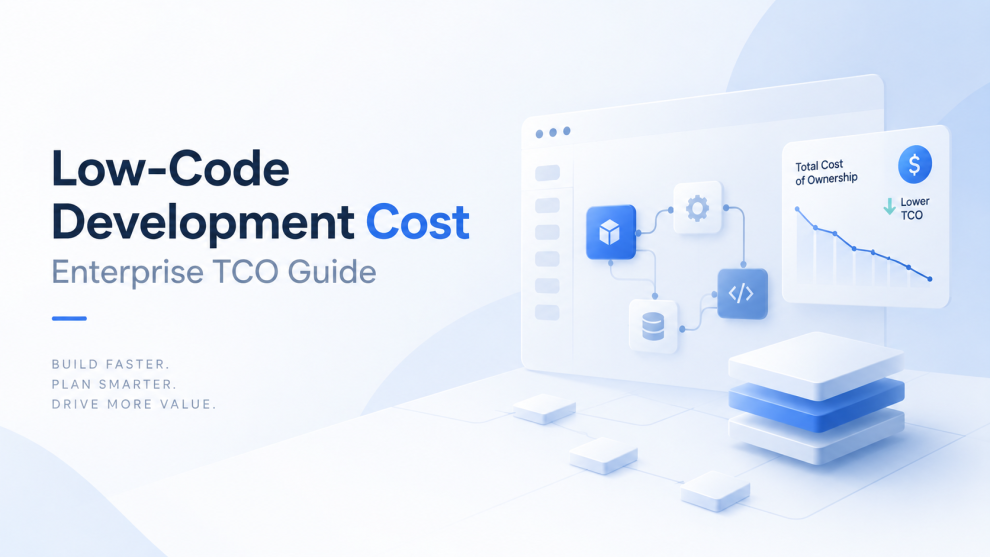

Low-code development is usually sold on speed. For enterprise engineering leaders, however, speed is only one line in the cost model. A platform can reduce the effort needed to build workflows, dashboards, and internal applications, yet still become expensive once licensing, integrations, governance, support, data capacity, and custom code accumulate across thousands of users.
A pilot may look inexpensive because a small team can deliver it quickly. Costs change after the application expands across business units, integrates with core systems, and becomes operationally critical.
The useful question is therefore not simply, “What does it cost to build a low-code app?” It is, “What will the platform, application portfolio, and operating model cost over three to five years?”
How Much Does Low-Code Development Cost in 2026?
There is no defensible universal price for an enterprise low-code application because platform economics vary by vendor, licensing model, user count, application count, and consumption.
Microsoft currently lists Power Apps Premium at $20 per user per month when paid yearly, with a $12 per user per month option for organizations purchasing at least 2,000 licenses. Microsoft also prices additional Dataverse database capacity at $40 per GB per month. Those figures show why a modest per-user fee can become a material annual expense at enterprise scale.
Mendix uses a different model. Its Standard plan currently starts at $1,090 per month for one application and $2,725 per month for unlimited applications, while Premium pricing requires a quote.
Development sits on top of those platform costs. A simple internal workflow using standard connectors may require little custom engineering. A mission-critical application may need custom APIs, identity integration, domain logic, automated testing, observability, security controls, performance engineering, and production support.
Enterprise buyers should therefore separate initial delivery cost, recurring platform cost, and lifecycle operating cost. Combining them into one “app development” estimate makes low-code comparisons unreliable.
What Actually Determines the Total Cost of a Low-Code Application?
The largest cost drivers compound quickly.
- Platform licensing and consumption: Licensing can depend on named users, applications, environments, database capacity, automation runs, AI credits, external users, or premium capabilities. Enterprise agreements may reduce unit prices while increasing contractual commitment. Cost models should use expected adoption, not pilot headcount.
- Professional engineering and customization: Low-code does not remove engineering from complex systems. Teams still need architecture, data modeling, API development, custom components, testing, security reviews, performance tuning, CI/CD, and release management. As business logic moves beyond native platform capabilities, engineering effort starts resembling conventional development.
- Integration and enterprise data: Connecting a workflow to Microsoft 365 is different from connecting it to SAP, Salesforce, mainframes, proprietary systems, data warehouses, and identity providers. Integration may require middleware, API management, data transformation, synchronization, and failure handling, making it one of the largest technical costs in modernization programs.
- Security, governance, and compliance: Large enterprises need environment strategies, role-based access controls, auditability, data loss prevention, architecture standards, approval processes, asset inventories, and retirement policies. Deloitte has noted that citizen development can create governance, security, and technical-debt risks without sufficient guardrails.
- Operations and lifecycle management: Production applications need monitoring, incident response, regression testing, dependency management, platform upgrades, capacity planning, support, and controlled change. Enterprises also need an exit strategy because deep dependence on proprietary workflows, connectors, data models, or runtime services can turn migration into another modernization program.
Why Do Low-Code Costs Rise After the First Successful Application?
The first application rarely exposes the real cost structure. Portfolio growth does.
A successful pilot encourages more teams to build. More applications create more environments, connectors, service accounts, data stores, automation flows, and support dependencies. The platform may still improve delivery speed, but the operating model becomes more complex.
The scale can be substantial. Microsoft has reported that Deutsche Bahn built a community of 4,000 citizen developers with more than 500 applications in production. Microsoft’s own internal Power Platform environment has previously exceeded 170,000 Power Apps and 18,000 environments. These examples show why governance becomes an engineering capability rather than an administrative afterthought.
Engineering leaders should also watch the custom-code boundary. Teams may choose low-code because most requirements map cleanly to standard components. The remaining requirements can include unusual UX, high-volume APIs, specialized authorization, complex calculations, or latency-sensitive workflows. If that custom layer keeps growing, the enterprise can end up maintaining both a proprietary runtime and a substantial conventional codebase.
AI adds another cost dimension. Modern platforms increasingly combine low-code development with copilots, agents, automation, and consumption-based services. Microsoft, for example, now includes agentic capabilities in Power Apps plans while separately monetizing related capacity and agent services.
The financial model should assume success. It should calculate what happens when an application moves from 100 users to 10,000 and from a departmental tool to a system the business cannot afford to lose.
Is Low-Code Cheaper Than Custom Development Over Three to Five Years?
Low-code often wins on time to first release. It does not automatically win on total cost of ownership.
A practical model is:
Three-year low-code TCO = delivery + licenses + integration + governance + infrastructure and consumption + support + change + exit risk
Low-code tends to produce strong economics for standardized workflows, approvals, case management, internal portals, data-entry applications, operational dashboards, and applications that fit the platform’s native integration model.
Custom engineering can become more economical when an application requires differentiated customer experiences, complex domain behavior, high transaction volumes, specialized performance, broad portability, or extensive custom services. In those cases, recurring platform charges can continue after much of the development advantage has disappeared.
The answer is frequently hybrid. Enterprise teams can use low-code for workflow orchestration, administrative tooling, and rapid internal applications while keeping differentiating services, core domain logic, high-scale APIs, or experience layers in pro-code systems.
Accenture provides a useful example. Microsoft reported that Accenture’s Power Platform program developed more than 50,000 citizen developers and reduced demand on central IT for short-term applications by 30 percent. That outcome depended on a Center of Excellence and governance model, not simply access to visual development tools.
The economic test is straightforward: low-code creates an advantage when the engineering effort it removes remains greater than the recurring platform, governance, integration, and constraint costs it introduces.
Which Low-Code Consulting Companies Can Help Enterprises Validate the Business Case?
Enterprises evaluating low-code at portfolio scale often involve consulting partners because implementation choices affect licensing, governance, integration, and long-term ownership.
Deloitte is one established option for large transformation programs. Its Appian practice combines consulting, platform implementation, architecture, process optimization, and enterprise delivery methods.
Accenture brings experience operating low-code at organizational scale, particularly around Microsoft Power Platform, citizen development, and governance. Its own adoption offers a reference point for organizations considering a broad Center of Excellence model.
GeekyAnts represents an engineering-oriented option for organizations evaluating low-code alongside custom web, mobile, backend, cloud, and integration work. Its published low-code capabilities include application and database integration, workflow automation, deployment, scalability, maintenance, and citizen-developer enablement. That can matter when the target architecture is expected to remain partly pro-code rather than move entirely onto one platform.
The consulting decision should still follow the cost model. Before committing to a platform, engineering leadership should model application volume, user growth, integration complexity, data consumption, custom-code requirements, governance overhead, and the cost of changing direction later.
A focused architecture and TCO assessment can expose those trade-offs before a discounted license agreement becomes a long-term platform commitment. In many enterprises, that conversation is more valuable than another development estimate because it answers the decision that matters: where low-code should be used, where it should not, and what that boundary will cost at scale.


Add Comment