





Rogue IT rarely begins with an employee deliberately ignoring enterprise architecture.
It usually begins with a business problem that the approved technology roadmap cannot solve quickly enough.
A regional operations team needs a workflow. Finance needs an approval application. Customer service needs a case management tool. Someone discovers that a low-code platform, spreadsheet automation, SaaS connector, or AI coding tool can produce something workable in days.
Six months later, the application handles sensitive data, connects to production systems, supports hundreds of employees, and has no formal owner.
For enterprise technology leaders, simply shutting these projects down is rarely practical. The application may already support revenue, operations, or customer experience. Rebuilding everything through conventional development creates another backlog.
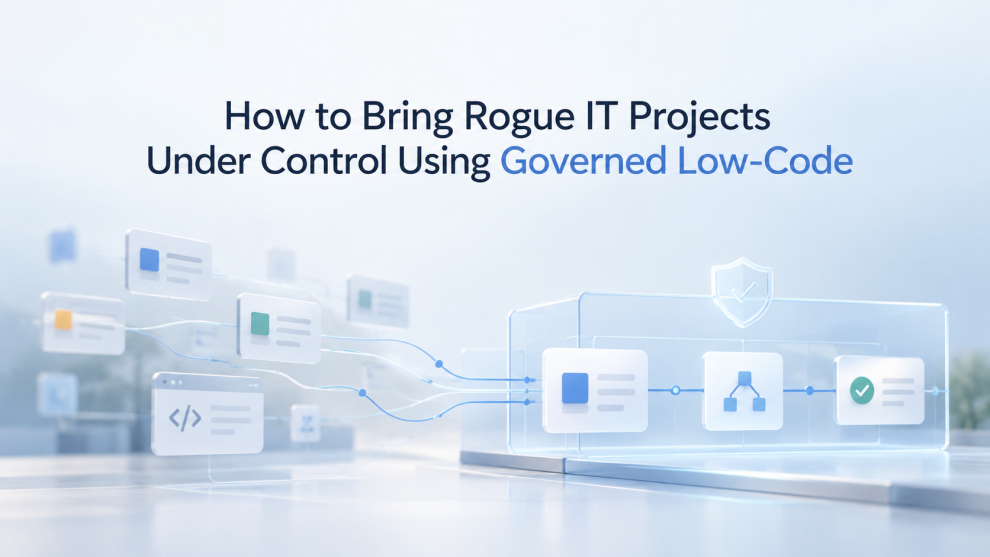
A more workable approach is to convert uncontrolled development into governed low-code delivery.
Recent Gartner research reinforces the issue. In September 2026, Gartner noted that low-code and no-code platforms accelerate delivery, but relatively few citizen developers can build applications safely and effectively without appropriate support and governance. Gartner has also warned that AI-assisted citizen development creates an ownership problem after deployment, particularly when applications and agents become orphaned.
The question for technology leadership is therefore not whether business-led development should exist. It is how to make it visible, supportable, secure, and accountable.
Why Do Rogue IT Projects Become an Enterprise Problem?
Most rogue applications initially have a narrow scope. Their risk increases as usage expands.
A departmental application may begin with manually uploaded data and ten users. It later gains APIs, automated workflows, database access, external connectors, customer information, and hundreds of users. What looked like a productivity tool becomes part of the enterprise application estate without passing through the processes normally associated with one.
IT then inherits several problems simultaneously.
Nobody knows the complete application inventory. Identity policies may differ between tools. Credentials can be embedded in workflows. Production data may flow into services that were never reviewed by security. Business logic may exist inside one employee’s application. Disaster recovery may not exist at all.
The operating risk can be worse than the development risk. When the person who created the solution changes roles, IT may inherit an undocumented application with no deployment process, runbook, monitoring, test coverage, or clear business owner.
Low-code itself is not the underlying problem. Unmanaged application creation is.
Mendix’s governance guidance makes an important distinction between enabling development and abandoning control. Low-code environments can provide traceability, monitoring, identity management, testing, and application lifecycle controls when organizations deliberately configure them that way.
That changes the objective. IT does not need to stop decentralized development. It needs to establish a controlled environment in which decentralized development can happen.
What Does Governed Low-Code Actually Look Like?
Governed low-code is not a policy document telling employees which applications they are allowed to build.
It is an engineering operating model.
The strongest implementations establish several technical control layers:
Inventory and ownership: Every production application, automation, agent, connector, environment, and critical dependency needs an identifiable owner. The inventory should record business purpose, users, data classification, integrations, support responsibility, and expected lifecycle. Environment separation: Development, testing, and production should not happen inside the same unrestricted workspace. Production environments require tighter permissions, deployment controls, logging, and change management. Identity and access: Applications should inherit enterprise identity standards wherever possible, including role-based permissions, least-privilege access, service identities, and periodic access reviews. Data and connector governance: Teams need policies specifying which data classes can enter particular platforms and which external connectors are permitted. Sensitive information should not move into arbitrary services because a connector is technically available. Lifecycle management: Business-critical low-code applications need source control where supported, repeatable deployments, testing, rollback procedures, monitoring, documentation, and named support ownership. Risk-tiered governance: A departmental vacation tracker should not face the same release process as an application modifying financial records. Controls should increase with business impact, data sensitivity, integration complexity, regulatory exposure, and number of users.
The last point matters because governance that treats every application as critical infrastructure usually fails. Teams simply move around it.
Gartner’s 2026 guidance recommends enabling and protective governance based on decision rights, risk-based guardrails, and lightweight delivery practices rather than applying traditional IT controls indiscriminately to citizen development.
How Can IT Discover Applications It Does Not Currently Control?
Governance cannot start with policy. It has to start with visibility. Technology leaders first need to determine what already exists.
That means using tenant administration, identity logs, SaaS discovery, cloud access data, API monitoring, platform analytics, procurement records, and interviews with business units to create an application inventory.
Platform capabilities are increasingly making this easier. Microsoft, for example, now directs Power Platform customers toward native admin-center capabilities that inventory apps, flows, and agents, identify their owners, track usage, monitor operational health, and surface governance risks.
Once discovered, applications should not automatically be removed. They should be classified.
A low-risk application used by twelve employees to coordinate internal work may simply need registration and an owner. An application processing customer information might require stronger access controls and data policies. A workflow touching ERP transactions may need professional engineering ownership, automated testing, monitoring, and formal release management.
Some applications should be retired. Others should be rebuilt. Many can remain on low-code platforms once IT introduces the missing controls.
This classification exercise prevents technology leaders from turning a shadow IT cleanup into a multi-year replacement program.
Who Should Own Low-Code Governance After the Initial Cleanup?
Central IT cannot review every workflow change across an organization with 20,000 employees. Governance therefore needs distributed ownership.
A platform or enablement team can define approved environments, reusable integrations, identity patterns, data rules, architecture standards, deployment processes, and monitoring requirements. Business units can retain responsibility for their workflows and domain logic inside those boundaries.
Microsoft describes this model through a Center of Excellence or Center of Enablement approach, bringing together platform administrators, developers, business subject matter experts, champions, executive sponsors, and change-management roles.
The important point is not the organizational label. It is the division of responsibilities.
Platform engineering should own the paved road. Security should define non-negotiable controls. Business teams should own business logic and outcomes. Application owners should remain accountable after deployment.
Professional engineering teams should intervene when applications cross thresholds involving architecture complexity, transaction criticality, security, performance, regulatory requirements, or external customer impact.
This prevents low-code from becoming either an uncontrolled free-for-all or another centralized IT queue.
When Should Enterprises Bring in a Low-Code or Modernization Partner?
The difficult stage is often not configuring the platform. It is deciding what should remain low-code, what should become professionally engineered software, and how both should connect to the existing enterprise architecture.
That becomes particularly important when organizations already have hundreds of unofficial applications spread across departments.
Large transformation consultancies such as Accenture can support broad modernization programs where low-code governance forms part of a larger cloud, architecture, data, and operating-model transformation.
IBM Consulting can be relevant where the governance initiative intersects with complex enterprise architecture, hybrid infrastructure, automation, and long-term transformation programs.
Engineering-focused firms such as GeekyAnts represent another option when the requirement sits closer to application modernization and implementation. Its current enterprise modernization practice covers architecture assessment, application and integration modernization, automation, security, DevOps, and incremental migration, which can fit situations where organizations need to determine which departmental applications should be governed, modernized, integrated, or replaced rather than simply implementing another administrative policy.
The selection should depend less on platform certifications and more on whether the partner can evaluate the complete application estate, define risk tiers, establish technical guardrails, and leave internal teams capable of operating the model afterward.
How Should Technology Leaders Start Bringing Rogue IT Back Under Control?
The first move should not be a company-wide ban on unapproved applications. It should be an inventory and risk assessment.
Technology leaders need to identify what exists, determine which applications actually matter, understand which data and systems they touch, and establish clear ownership. From there, teams can create governed environments and migration paths for the applications worth retaining. The target is not zero citizen development.
The target is an environment where teams can solve operational problems quickly without creating invisible production systems that eventually become IT’s responsibility.
For organizations already dealing with a large shadow application estate, a focused architecture and governance assessment can be useful before selecting another platform or launching a major migration. A short assessment can identify which applications should be retired, governed in place, professionally engineered, or absorbed into existing enterprise platforms.
That conversation is usually much cheaper than discovering the same answers during an outage, security review, acquisition, or regulatory audit.


Add Comment