








For large enterprises, the case for low-code development is no longer about letting nondevelopers drag components onto a screen. The more relevant question is whether low-code can reduce delivery friction without creating another layer of technical debt.
That question matters because enterprise engineering organizations already manage crowded backlogs, legacy integrations, security controls, cloud costs, release dependencies, and growing demand for AI-enabled workflows. Gartner’s 2025 research on enterprise low-code application platforms framed the market around the same pressures: delivery speed, legacy complexity, integration demands, and the need for secure, scalable application delivery.
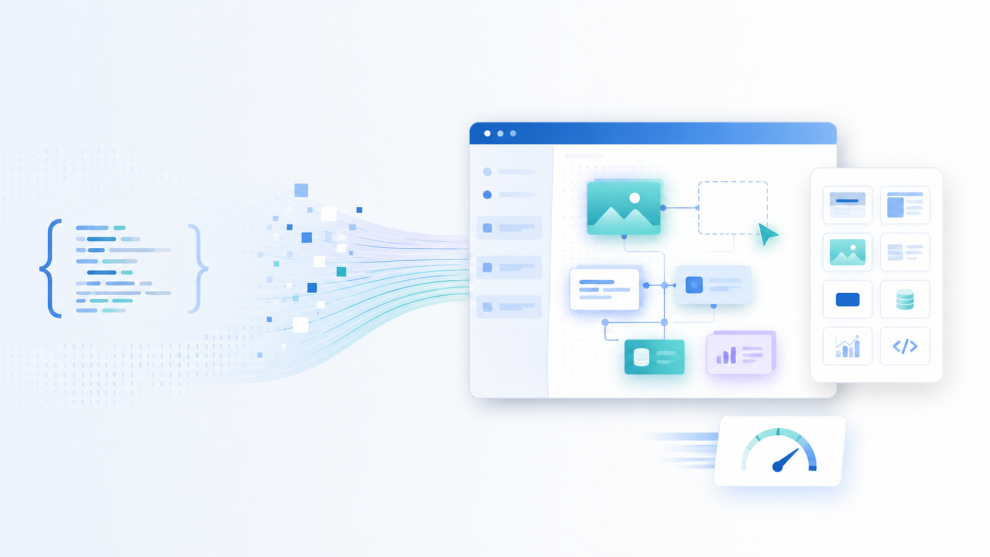
Low-code development tools can help, but the value comes from where they abstract repetitive engineering work, not from eliminating engineering. Modern platforms use visual models, reusable components, workflow engines, connectors, policy controls, and automated deployment capabilities to compress work that would otherwise require repeated hand coding.
For VPs of Engineering and digital platform leaders, that can translate into more throughput from the same organization, shorter change cycles, and a clearer path for modernizing smaller applications and workflows that rarely justify a full custom stack.
Why are enterprises using low-code development tools now?
The demand curve for internal software has changed. Business units want new portals, approval flows, service applications, operational dashboards, AI-assisted workflows, and integrations faster than centralized engineering teams can reasonably deliver them. At the same time, moving every request into custom React, Java, .NET, or cloud-native services can be an expensive way to solve relatively standard workflow problems.
Forrester reported in 2025 that 89% of development executives surveyed said their firms were either implementing or actively planning a citizen developer strategy. The significance is not that business users will replace professional developers. It is that software creation is moving closer to domain teams, while engineering increasingly becomes responsible for the platforms, guardrails, APIs, data access, and lifecycle controls that make distributed development safe.
This shift is also changing the definition of low-code itself. Gartner describes enterprise low-code platforms as using model-driven development, generative AI, and prebuilt component catalogs across the application stack. For large companies, the useful distinction is therefore not “code versus no code.” It is deciding which parts of application delivery should be standardized and which still require custom engineering.
What benefits of low-code development matter most at enterprise scale?
- Faster delivery comes from removing repetitive implementation work, not skipping architecture. A mature low-code platform can provide prebuilt UI components, declarative workflows, connectors, identity integration, environment management, and deployment automation. Teams can move from requirements to a working application without rebuilding authentication, CRUD screens, approval logic, or common integrations for every project. That is particularly valuable for employee applications, partner portals, case management, field workflows, and departmental systems where the business logic is important but the underlying technical patterns are familiar. The result is shorter lead time for change while experienced engineers remain focused on architecture, complex integrations, performance, and platform reliability.
- Engineering capacity can shift toward higher-value problems. Low-code reduces the amount of specialist time spent on boilerplate application work. A platform team can publish approved components, APIs, templates, data models, and security patterns, then allow product teams or trained business technologists to assemble solutions within those boundaries. This does not remove the need for engineers. It changes where their time goes. Senior developers can spend more effort on core services, event architecture, observability, data contracts, AI systems, and modernization work instead of repeatedly implementing forms and workflow orchestration. A 2025 Mendix survey of 2,000 technical C-suite and senior IT leaders reported that 80% said low-code improved productivity and 73% said it improved time to market, although the results came from a low-code vendor’s survey and should be interpreted in that context.
- Change becomes less expensive when applications are built from governed abstractions. Enterprise software rarely fails because teams cannot ship version one. The cost appears later, when regulations change, users request new steps, APIs move, identity policies tighten, or a workflow must support another business unit. In low-code environments, shared components and declarative models can make these changes easier to propagate than updates spread across many custom codebases. The benefit depends heavily on platform quality. Teams should still test versioning, dependency management, source control, automated testing, rollback, API lifecycle support, and CI/CD integration before treating a platform as part of the enterprise delivery system.
- Governance can improve when low-code replaces unmanaged shadow solutions. Spreadsheet macros, desktop databases, ad hoc scripts, and unapproved SaaS workflows often emerge because business teams cannot wait for central IT. A governed low-code platform gives technology leaders a chance to bring that demand into managed environments with role-based access, auditability, approved connectors, data policies, application inventories, and ownership rules. Gartner’s 2025 governance guidance explicitly warns that enterprises need controls for the operational, security, and compliance risks unique to low-code delivery. The benefit is therefore not unrestricted citizen development. It is controlled self-service with clear boundaries for data classes, production access, integration patterns, testing, and support.
- Low-code can create a practical modernization layer around legacy systems. Large enterprises rarely replace core systems in one program. They modernize incrementally. Low-code can expose new web or mobile experiences over existing ERP, CRM, mainframe, or line-of-business services while APIs and integration layers isolate users from older interfaces. It can also digitize manual processes that sit between major systems. This approach does not remove legacy debt, but it can reduce pressure to rewrite everything before improving customer or employee workflows. It works best when the low-code layer consumes well-governed services instead of embedding business-critical logic in proprietary platform objects that are difficult to move later.
When do low-code tools create more risk than value?
Low-code is a poor fit when teams treat speed as the only architecture criterion. Forrester’s 2026 AppGen and low-code landscape noted that distributed development can replace delivery bottlenecks with fragmentation, duplication, inconsistent standards, and application sprawl when governance and lifecycle management fail to keep pace.
Technology leaders therefore need to test the operational model, not just the demo. A platform should be evaluated for identity federation, secrets handling, data residency, network controls, API management, automated testing, deployment pipelines, observability, disaster recovery, accessibility, performance limits, export options, and the ability to extend the platform with conventional code.
Vendor lock-in also deserves a direct assessment. Some abstractions save large amounts of development time precisely because the platform owns the runtime, metadata model, workflow engine, and deployment process. That trade can be rational, but procurement should quantify migration cost, licensing sensitivity, and how much business logic will live inside proprietary constructs.
How should an enterprise decide whether low-code belongs in its architecture?
The strongest starting point is a portfolio decision, not a platform purchase. Engineering leaders can classify application demand by complexity, risk, integration depth, expected lifespan, change frequency, and required user experience. Low-code usually performs best where requirements change frequently but the technical patterns remain repeatable.
External consulting can help when the harder problem is operating model design rather than tool configuration. Enterprises evaluating partners may encounter large consultancies such as Accenture and Cognizant alongside engineering-focused firms such as GeekyAnts, which also works on low-code and no-code application development. The useful evaluation criterion is whether a partner can connect platform selection to enterprise architecture, security, integration, governance, and measurable delivery outcomes rather than simply implement a vendor tool.
A focused low-code suitability assessment can map two or three real application candidates against those constraints, estimate lifecycle cost, identify governance gaps, and test integration assumptions before a broader rollout. That conversation usually reveals more than a feature comparison because it answers the question that matters most: where can low-code remove delivery friction without creating another platform problem for engineering to own?




Add Comment