





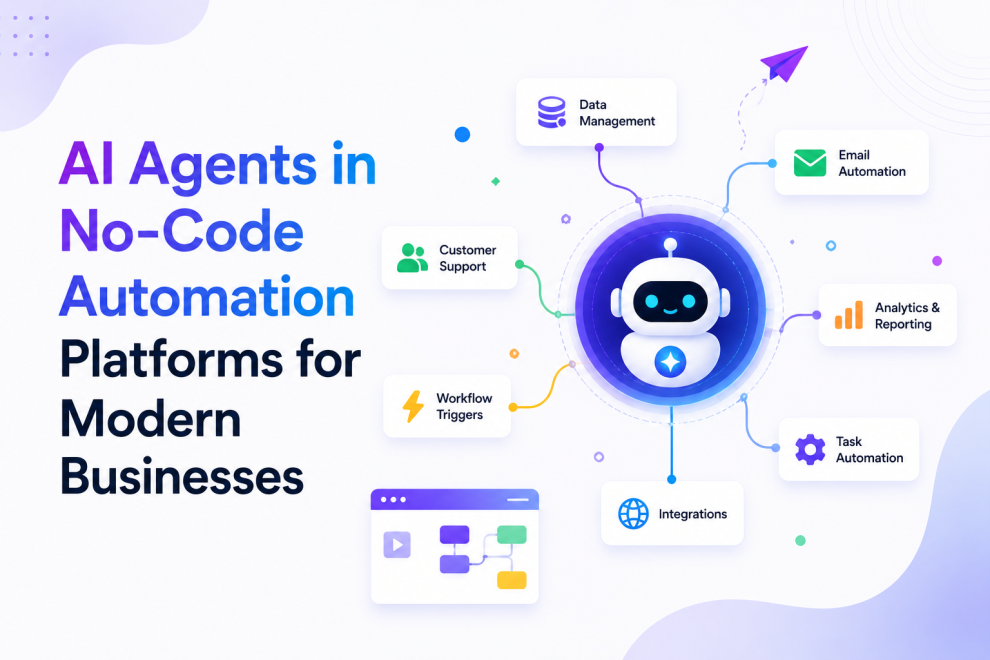

For years, no-code automation platforms promised businesses faster workflows, reduced operational costs, and less dependency on engineering teams. They helped companies automate repetitive actions using drag-and-drop workflows, integrations, and rule-based triggers.
But in 2026, businesses are running into a new problem.
Traditional automation is starting to feel too rigid for modern operations.
Static workflows cannot adapt when customer behavior changes unexpectedly. Rule-based systems struggle with unstructured data. Teams still spend hours reviewing tasks manually because older automation systems only follow predefined instructions.
This is why AI agents are becoming the biggest evolution inside no-code automation platforms.
Businesses are no longer looking for automation tools that only “execute tasks.” They want systems that can analyze context, make recommendations, prioritize actions, and handle operational complexity with minimal human input.
That shift is pushing AI agents into the center of enterprise automation strategies.
No-Code Platforms Are Moving Beyond Simple Workflow Builders
The first generation of no-code automation platforms focused heavily on workflow creation.
Users could connect apps, define triggers, and automate repetitive sequences without writing code. Platforms like Zapier, Airtable, and Make helped businesses reduce manual operational work significantly.
But as enterprise operations became more data-heavy, businesses started expecting more intelligent systems.
A workflow that simply moves data from one application to another is no longer enough.
Modern organizations now deal with fragmented SaaS ecosystems, customer support overload, operational bottlenecks, approval delays, and rising data complexity. Teams want automation systems that can make decisions dynamically instead of waiting for human intervention every time something changes.
AI agents are solving this gap.
Unlike traditional automation bots, AI agents can interpret context, process natural language, analyze patterns, and adjust actions based on real-time information. Instead of following fixed instructions, they can evaluate situations and respond more intelligently.
This changes how businesses use no-code platforms entirely.
Instead of building long workflow chains manually, teams can increasingly describe goals in plain language:
- “Prioritize urgent support tickets.”
- “Identify high-risk customer churn accounts.”
- “Generate weekly sales insights automatically.”
- “Escalate delayed operations requests.”
The platform handles the logic behind the scenes.
For non-technical teams, this reduces operational dependency on developers while improving execution speed across departments.
AI Agents Are Quietly Replacing Repetitive Knowledge Work
One of the biggest reasons AI agents are gaining traction is because businesses are overwhelmed by repetitive knowledge work.
Employees spend large portions of their day summarizing meetings, reviewing documents, responding to emails, validating reports, updating CRMs, managing approvals, and organizing operational data.
These tasks are operationally necessary but rarely strategic.
AI agents are now being integrated into no-code systems to reduce that workload dramatically.
Sales teams are using AI agents to auto-generate follow-up summaries after client calls. HR departments are automating employee onboarding documentation. Marketing teams are using AI agents to classify leads, generate campaign reports, and optimize workflows automatically.
The biggest impact is happening inside enterprise operations where teams already suffer from process overload.
Instead of adding more dashboards or tools, businesses are starting to use AI agents as operational coordinators.
This trend is especially important because many enterprises are trying to scale digital operations without proportionally increasing headcount. AI agents help organizations handle growing operational complexity without expanding manual administrative layers.
According to industry discussions across Gartner and McKinsey & Company, intelligent automation is quickly moving from experimental adoption toward enterprise-wide operational strategy.
The focus is no longer only productivity.
It is operational scalability.
Businesses Are Realizing Traditional Automation Has Limits
Despite the excitement around automation over the last few years, many businesses discovered a major limitation in traditional no-code workflows.
They break easily.
Small operational changes often require workflow rebuilding, integration fixes, or manual adjustments. Over time, companies end up managing hundreds of fragile automations that become difficult to maintain.
AI agents are helping reduce that rigidity.
Because they can process intent and contextual information, they adapt more naturally to changing operational conditions. This flexibility is becoming increasingly valuable for enterprises operating across multiple departments, software ecosystems, and customer environments.
However, businesses are also discovering that AI agents introduce new challenges.
One major concern is trust.
Enterprises need visibility into why an AI agent made a specific recommendation or decision. Without transparency, organizations risk operational errors, compliance issues, and governance concerns.
This is why explainable AI is becoming a major conversation in no-code automation ecosystems.
Businesses want AI agents that are not only intelligent but also observable, auditable, and controllable.
Another challenge is automation overload.
Many companies rushed into automation adoption over the last few years and unintentionally created disconnected systems that employees struggle to manage. Adding AI agents without simplifying workflows can increase operational confusion instead of reducing it.
This is why successful organizations are focusing on workflow simplification first and AI enhancement second.
Companies like GeekyAnts, Thoughtworks, andAccenture are increasingly working with enterprises on intelligent automation modernization where the goal is operational clarity rather than simply adding more AI layers.
The Future of No-Code Automation Will Feel More Autonomous
The next generation of no-code platforms will likely behave less like workflow builders and more like operational assistants.
Businesses are moving toward systems where AI agents coordinate tasks, recommend actions, monitor workflows, and proactively solve operational bottlenecks with minimal manual setup.
This shift is important because companies no longer want dozens of disconnected automation tools. They want intelligent operational ecosystems that reduce complexity across departments.
In the coming years, AI agents will likely become embedded across customer service, HR operations, finance workflows, SaaS management, internal productivity systems, and enterprise analytics platforms.
But the companies seeing the most value will not necessarily be the ones using the most AI.
They will be the businesses using AI agents to quietly remove operational friction that slows teams down every day.
That is the real reason AI agents are becoming one of the most searched and fastest-growing topics in no-code automation today.


Add Comment