




The no-code movement is entering a new phase. What began as drag-and-drop application development is rapidly evolving into prompt-based software creation powered by generative AI. Across North America, enterprises are experimenting with systems that allow users to describe applications in natural language while AI generates interfaces, workflows, backend logic, and integrations automatically.
This shift is changing how organizations think about software development itself.
For enterprise technology leaders, prompt-based development is not simply another productivity trend. It represents a larger transition toward AI-assisted software ecosystems where application creation becomes faster, more accessible, and increasingly automated. Enterprises facing engineering shortages, rising delivery expectations, and modernization pressure are paying close attention because the model directly affects development speed, operational efficiency, and digital transformation timelines.
According to Gartner and McKinsey reports, low-code and AI-assisted development platforms continue to grow rapidly as enterprises prioritize faster product delivery and workflow automation. However, the market is also shifting beyond traditional no-code systems. Drag-and-drop builders alone are no longer enough for enterprises managing large-scale operational complexity.
Prompt-based development is emerging as the next layer.
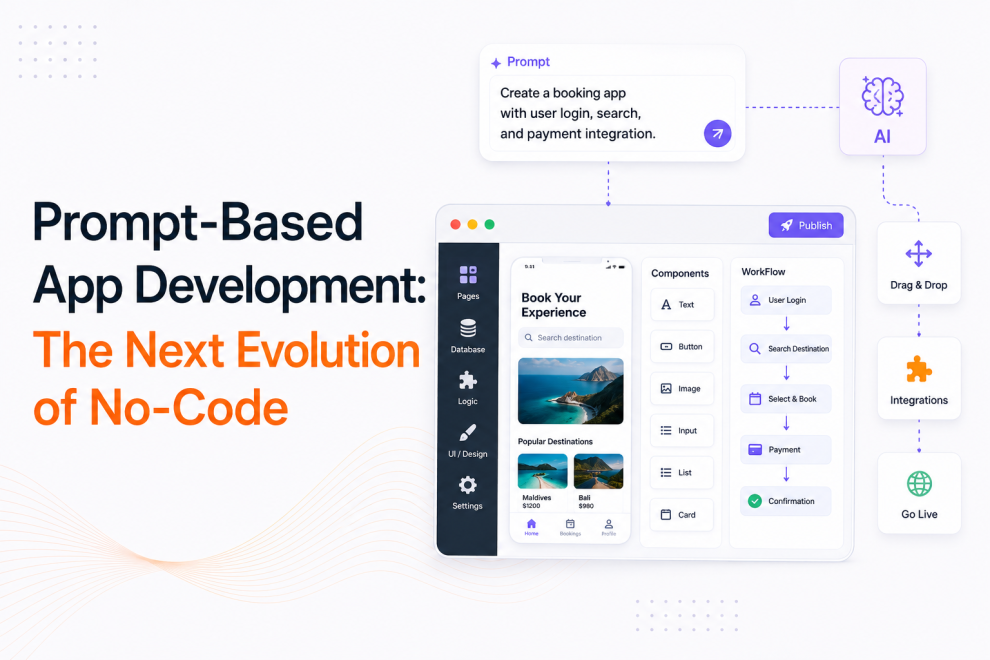
Instead of manually configuring every component, users can increasingly generate application structures through conversational instructions. A product team can request an internal dashboard, customer onboarding workflow, analytics interface, or approval system through prompts while AI automatically builds significant portions of the application architecture.
This dramatically reduces the gap between idea and execution.
Why Enterprises Are Moving Beyond Traditional No-Code Platforms
Traditional no-code and low-code platforms helped enterprises accelerate internal application development, especially for workflow automation and operational tools. However, many organizations encountered limitations when scaling these systems across larger enterprise environments.
Some platforms struggled with customization. Others created integration challenges with legacy systems, cloud environments, and enterprise APIs. In many cases, development teams still needed significant engineering support to maintain scalability, governance, and security requirements.
Prompt-based development changes the equation because AI reduces much of the manual configuration process itself.
Modern AI-powered development systems can now generate:
- UI layouts and responsive frontend components.
- Backend workflows and logic structures.
- API integrations and automation pipelines.
- Database schemas and operational flows.
- Basic testing and documentation support.
This significantly shortens development cycles for internal tools and digital product prototypes.
Enterprise teams are especially interested in the operational speed advantage. Many organizations struggle with growing backlogs while engineering teams remain overloaded with modernization projects, platform migration work, cloud optimization, and ongoing maintenance requirements. Prompt-based development introduces the possibility of reducing dependency on repetitive engineering effort without completely replacing developers.
The most important shift is that software creation itself is becoming more conversational.
Instead of building applications entirely through manual coding or visual configuration interfaces, users increasingly interact with AI systems through intent-driven instructions. This is making software development more accessible across business units, operations teams, and product departments.
At the same time, enterprises are realizing that prompt-based development is not eliminating the need for engineering leadership. It is changing where engineering teams focus their attention.
The Real Enterprise Challenge Is Governance, Not Generation
While prompt-based development creates impressive speed improvements, many enterprises are discovering that generating applications is easier than governing them.
AI-generated systems still require oversight around security, scalability, compliance, infrastructure performance, and architectural consistency. Large enterprises cannot afford fragmented application ecosystems built without operational controls.
This is especially important for organizations operating across regulated industries such as healthcare, finance, insurance, and logistics.
Several concerns are becoming increasingly common among enterprise technology leaders:
- AI-generated applications may introduce inconsistent security standards.
- Rapid app creation can increase shadow IT risks.
- Generated code quality varies significantly across platforms.
- Legacy integrations remain difficult in complex environments.
- Governance frameworks often lag behind AI adoption speed.
As a result, enterprises are moving cautiously.
The organizations making the most progress are not replacing traditional engineering teams with AI-driven no-code systems. Instead, they are combining prompt-based development with stronger platform governance, reusable infrastructure frameworks, centralized APIs, and standardized security policies.
This operational alignment is becoming critical.
Engineering leaders increasingly recognize that AI-assisted development works best when connected to scalable platform architecture rather than isolated experimentation. Without governance, enterprises risk creating disconnected ecosystems that become difficult to maintain long term.
This is why many organizations are shifting toward AI-native development environments that combine low-code flexibility with enterprise-grade engineering controls.
Across the enterprise technology landscape, modernization firms and engineering consultancies such as Thoughtworks, Globant, and GeekyAnts are increasingly contributing to AI-assisted product engineering initiatives focused on scalable frontend systems, intelligent workflows, and cross-platform development strategies.
Prompt-Based Development Is Changing the Role of Engineering Teams
One of the biggest misconceptions surrounding AI-assisted development is the assumption that developers will become less important. In reality, the role of engineering teams is becoming more strategic.
As prompt-based development accelerates software generation, engineering leaders are spending more time on platform architecture, governance, observability, cloud optimization, infrastructure resilience, and AI orchestration rather than repetitive implementation tasks.
This transition resembles earlier cloud and DevOps transformations.
Automation did not eliminate engineering complexity. It shifted engineering priorities toward operational scalability and platform efficiency. Prompt-based development is creating a similar evolution.
Enterprise engineering teams are increasingly focusing on:
- Designing reusable AI-ready infrastructure layers.
- Managing governance and security frameworks.
- Optimizing cloud performance and scalability.
- Validating AI-generated workflows and integrations.
- Improving interoperability across enterprise systems.
This shift is also changing product delivery expectations inside enterprises.
Business units increasingly expect faster experimentation cycles and shorter development timelines. AI-assisted development platforms make rapid prototyping easier, which increases pressure on technology teams to support continuous delivery models without compromising governance standards.
Organizations that fail to establish operational controls around prompt-based development may struggle with fragmented systems, technical debt, and inconsistent user experiences as adoption grows.
The Future of No-Code Will Be AI-Native
The future of no-code development is moving toward AI-native ecosystems where applications can be partially generated, refined, optimized, and maintained through intelligent systems.
This does not mean traditional development disappears. Enterprise software will still require strong engineering oversight, cloud architecture planning, compliance management, and infrastructure optimization. However, AI will increasingly reduce the friction involved in translating business intent into operational software.
That shift has major implications for enterprise technology strategy.
Organizations that successfully integrate prompt-based development into broader engineering ecosystems may significantly improve product delivery speed, workflow automation, and operational efficiency over the next several years. Meanwhile, enterprises treating prompt-based development as a standalone shortcut may struggle with scalability and governance challenges later.
The market is still early, but the direction is becoming clearer.
Enterprises are beginning to move beyond simple no-code experimentation toward AI-assisted software ecosystems that combine conversational development, scalable infrastructure, and centralized operational controls. The focus is shifting from app generation alone toward sustainable platform evolution.
The broader industry lesson emerging from this transition is straightforward: prompt-based development is not replacing software engineering. It is redefining how modern enterprise applications are created, managed, and scaled in an AI-first environment.


Add Comment