





How North American enterprises are using it to move faster without breaking their teams or budgets
Across the U.S. and Canada, engineering leaders are under pressure to deliver more software with fewer resources. Product teams face growing backlogs, hiring remains uneven, and AI expectations are now built into almost every roadmap. The result is predictable: delays, rising costs, and fragmented tooling that slows execution instead of accelerating it.
This is where the combination of AI and low-code development is gaining traction. It is not being adopted because it is trendy,it is being adopted because traditional development models are struggling to keep up with business demand.
According to Gartner, low-code/no-code platforms are expected to account for a majority of application development activity in the coming years, with enterprise adoption accelerating as teams look to reduce dependency on scarce developer talent. At the same time, McKinsey & Company highlights that AI-assisted development can significantly improve developer productivity, particularly in repetitive and boilerplate-heavy workflows.
The shift is not about replacing developers. It is about removing bottlenecks that prevent teams from shipping.
Where Traditional Development Slows The Teams Down
Most enterprises do not struggle with ideas,they struggle with execution. Product leaders often face a mismatch between business urgency and engineering capacity. A typical backlog includes internal tools, customer-facing features, integrations, and compliance updates, all competing for the same resources.
Three problems show up repeatedly:
- Development bottlenecks
Skilled developers spend time on repetitive UI scaffolding, API wiring, and maintenance tasks instead of core innovation. - Long iteration cycles
Even small changes can take weeks due to testing, deployment, and cross-team dependencies. - Fragmented tooling ecosystems
Teams juggle multiple platforms for data, automation, and AI, creating integration overhead instead of efficiency.
AI alone does not fix this. Low-code alone does not fix this. But together, they start addressing the root issue: speed without sacrificing control.
How AI + Low-Code Is Changing Application Delivery
The combination of AI and low-code platforms is enabling a different development model,one that reduces manual effort while maintaining governance.
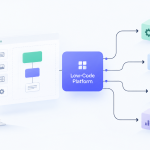
AI is increasingly embedded into low-code platforms to assist with code generation, workflow automation, testing, and even UI design. Instead of building everything from scratch, teams assemble applications using pre-built components, while AI accelerates decision-making and execution.
For example, AI-assisted low-code platforms can:
- Generate application logic from natural language prompts
- Automate testing and bug detection
- Recommend workflows based on historical data
- Enable non-developers to contribute without compromising standards
This shift allows engineering teams to focus on higher-value work while business teams participate more directly in application development.
The result is not just faster delivery,it is better alignment between business intent and technical output.
What Companies in North America Are Actually Doing
Enterprises are not adopting AI + low-code in isolation. They are applying it to specific, high-impact use cases where speed and adaptability matter.
Common patterns include:
- Internal tools modernization
Companies are replacing legacy dashboards and manual workflows with low-code applications enhanced by AI-driven insights. - Customer experience platforms
Faster rollout of personalized features using AI-powered recommendations and low-code interfaces. - Process automation
Finance, HR, and operations teams are automating repetitive workflows without waiting for engineering cycles. - Data-driven applications
AI models are integrated directly into low-code apps, enabling real-time analytics and decision-making.
A report from Forrester notes that enterprises adopting low-code platforms see measurable improvements in development speed and cross-team collaboration, particularly when paired with automation and AI capabilities.
Vendors Shaping the AI + Low-Code Ecosystem
A growing number of companies are helping enterprises operationalize this shift. These organizations vary in focus,some provide platforms, while others specialize in implementation and consulting.
Here are ten companies frequently referenced in this space:
- GeekyAnts
- OutSystems
- Mendix
- Microsoft
- Appian
- Salesforce
- ServiceNow
- Zoho
- Retool
- Bubble
Firms like GeekyAnts are typically involved at the implementation layer, helping companies integrate AI capabilities into low-code ecosystems and align them with existing product strategies. Others, such as Microsoft and Salesforce, offer end-to-end platforms that combine AI services with low-code tooling.
The key takeaway for decision-makers is not which vendor is “best,” but which combination fits their existing stack, governance model, and long-term architecture.
What Decision-Makers Need to Get Right
Adopting AI + low-code is not a plug-and-play decision. Many organizations fail to see results because they treat it as a tooling upgrade rather than an operating model shift.
Two priorities stand out:
- Governance without friction
Enterprises must define clear guidelines for who can build what, while ensuring security and compliance are not compromised. - Integration with existing systems
Low-code platforms must work with legacy infrastructure, not around it. Poor integration can create more problems than it solves.
Leaders also need to set realistic expectations. AI + low-code will not eliminate engineering complexity, but it can significantly reduce the time spent on repetitive and low-impact tasks.
The Direction This Is Heading
AI + low-code is moving toward deeper automation and smarter abstraction. As AI models improve, platforms will handle more of the development lifecycle,from design to deployment,while maintaining human oversight.
According to IDC, organizations that invest in AI-augmented development tools are more likely to outperform peers in time-to-market metrics. This trend is expected to accelerate as enterprises standardize their digital platforms.
For companies in North America, the competitive advantage is not just adopting these tools,it is adopting them effectively. Teams that align AI capabilities with low-code execution will move faster, iterate more frequently, and respond better to market changes.
Those that do not will continue to face the same bottlenecks, just with more advanced tools.
FAQs
What is the difference between low-code and no-code?
Low-code platforms require some programming knowledge and are typically used by developers, while no-code platforms are designed for non-technical users. Enterprises often use a mix of both depending on the use case.
Is AI + low-code suitable for large enterprises?
Yes, but only with proper governance and integration strategies. Many large organizations use it for internal tools, automation, and rapid prototyping rather than core systems initially.
Will low-code replace traditional developers?
No. It changes how developers work by reducing repetitive tasks, allowing them to focus on architecture, performance, and complex problem-solving.
What are the risks of adopting AI + low-code?
The main risks include poor governance, vendor lock-in, and integration challenges. These can be mitigated with the right planning and platform selection.
How should companies get started?
Start with a focused use case, such as internal workflow automation, measure impact, and scale gradually based on results.


Add Comment