





The Development Backlog Is the Real Cost. No-Code Is How Smart Teams Are Fixing It.
Most engineering leaders do not think of their backlog as a cost center. They should. Every approved project sitting unbuilt is a delayed business outcome. Every internal request rerouted through a six-month development queue is a department finding a workaround — or a vendor. For large enterprises managing dozens of concurrent digital priorities, the true cost of traditional development pipelines does not show up in the dev budget. It shows up in missed deadlines, shadow IT sprawl, and business units building their own solutions without IT visibility.
According to Gartner, 72% of IT leaders report being blocked from strategic work due to project backlogs. That is not a resourcing problem. It is a structural one — and no-code and low-code development is how a growing number of enterprises are addressing it without adding headcount or extending timelines.
The case for no-code is not about replacing engineers. It is about redistributing where application development happens, and recovering the budget being quietly consumed by low-complexity builds that do not need a senior developer’s attention.
What No-Code Actually Saves — and Where
The cost advantages of no-code are real and measurable, but they are not uniform. Understanding where savings actually accumulate matters more than citing headline numbers.
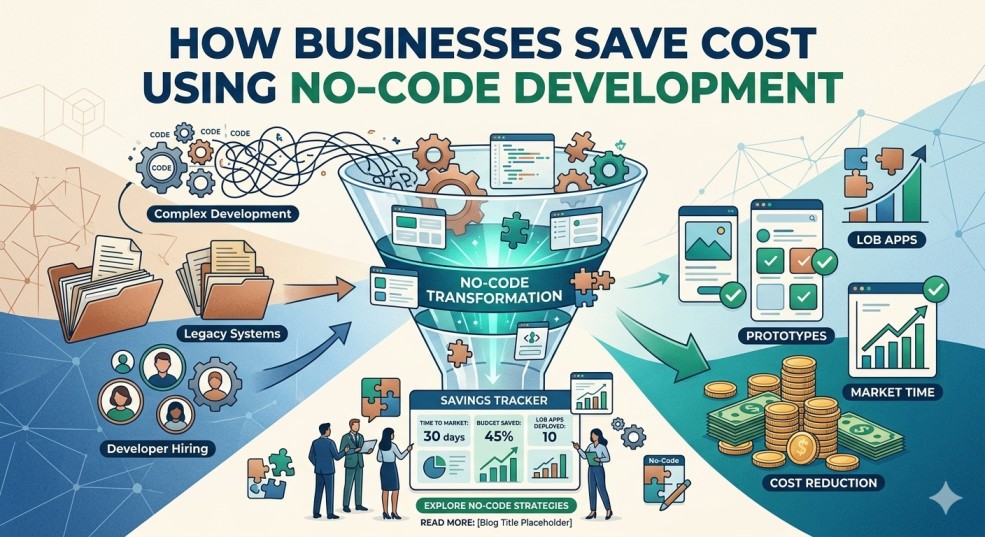
Organizations save an estimated 70% on development costs using no-code platforms. Decerto’s analysis shows that applications traditionally costing $300,000 are being delivered for $75,000 through no-code — a 4x cost reduction. Those savings compound across a portfolio. An enterprise running 15 to 20 internal tool builds per year does not just save on each project — it frees its senior engineering capacity for the work that genuinely requires it.
Labor cost reduction is the most direct lever. Citizen developers — business users empowered to build their own workflow applications — cost 40 to 60% less than professional developers for equivalent output on low-complexity builds. The productivity gain extends beyond headcount. Companies using low-code platforms reduce app development time by up to 90%, enabling faster responses to business changes and quicker time-to-market.
Maintenance overhead is the cost that surprises leaders who focus only on build costs. Microsoft Power Platform delivered a 206% ROI in a Forrester Total Economic Impact study, with organizations saving over one million cumulative hours by year three — largely through reduced maintenance burden on professional development teams.
The savings profile typically breaks down across four areas:
- Build cost reduction — drag-and-drop platforms remove the labor required for low-complexity internal applications, approval workflows, data collection tools, and process automation.
- Maintenance and update costs — platform vendors handle infrastructure updates and security patches, removing the ongoing overhead that accumulates on custom-built tools.
- Opportunity cost recovery — engineering capacity freed from low-value builds gets redirected to differentiated product work that actually advances competitive position.
- Shadow IT containment — governed citizen development reduces the untracked tools proliferating across departments, which carry their own security and integration cost downstream.
Sixty percent of organizations report annual savings between $100,000 and $200,000 from no-code platform implementation — and that figure reflects conservative deployments. Enterprises running mature citizen development programs at scale report materially higher returns.
What Enterprise Adoption Actually Looks Like
The no-code market has moved well past early-adopter territory. Gartner predicts 70% of new applications developed by enterprises will use low-code or no-code technologies by 2025 — up from less than 25% in 2020. Meanwhile, 75% of large enterprises are expected to be using at least four low-code development tools. The multi-platform reality is important: no single no-code tool serves every enterprise use case. The practical architecture is a governed portfolio of platforms matched to specific use cases.
The 2025 Gartner Magic Quadrant highlights Appian, OutSystems, and Mendix as strong enterprise players, noting their ecosystem depth and enterprise reach, while also acknowledging increasing demand for platforms that are simpler, faster, and better suited for departmental use cases. OutSystems handles mission-critical, complex enterprise applications. Mendix bridges IT and business users through model-driven development. Kissflow targets workflow automation and process management for operational teams in HR, finance, and procurement — functions where the development backlog piles up fastest. Microsoft Power Apps serves organizations already embedded in the Microsoft ecosystem, extending citizen development capabilities to teams that already live in Teams and Office 365.
The governance question is the one that tends to pause adoption at the VP level, and it deserves a direct answer: no-code adoption without governance creates a new version of the shadow IT problem it was meant to solve. Governed low-code is the path that preserves the productivity gains of decentralized development while eliminating the security and compliance risk of untracked tooling. Enterprise platforms built for this environment include role-based permissions, audit trails, versioning, and compliance management as standard features — not add-ons.
How Leading Firms Are Deploying This
The organizations extracting the most value from no-code are treating it as a delivery model decision, not a platform decision. The platform comes second.
GeekyAnts, which has completed more than 550 engagements across industries including fintech, healthcare, and enterprise services, uses no-code and low-code tooling as part of a broader strategy to accelerate delivery cycles without compromising engineering discipline. Their position — speed without rigor is just faster failure — reflects what separates successful no-code deployments from those that generate technical debt. Simform, with over 900 client engagements, integrates no-code as a deliberate layer in its delivery model, using platforms like OutSystems and Microsoft Power Apps to reduce time-to-market for internal tooling while reserving custom development for differentiated product features.
Enterprise platforms like Kissflow power workflows at Fortune 500 companies including Pepsi and Motorola. Mendix and OutSystems are used for mission-critical applications at global enterprises. BairesDev applies a platform-selection framework at the start of engagements — mapping use case complexity against platform capability before any build begins. Netguru uses the same discipline, starting with a discovery phase that explicitly identifies which parts of a client’s digital roadmap are candidates for no-code delivery versus custom engineering.
What these firms share is a refusal to treat no-code as a blanket answer or a cost-cutting shortcut. The savings are real, but they materialize only when the deployment is structured- right platform, right use case, right governance model.
For VP-level leaders managing large engineering portfolios, the question is not whether no-code belongs in the delivery model. It already does, whether or not it has been formally acknowledged. The more useful question is: which parts of the current backlog are consuming custom engineering capacity that no-code could free — and what would that capacity do if it were redirected?
FAQs
Does no-code development create vendor lock-in, and how should enterprise leaders evaluate that risk?
Yes, it is a real risk and one worth structuring around from the start. Some platforms like OutSystems and Mendix are designed for enterprise portability, with containerized, cloud-native architectures. Others lock data and logic into proprietary formats that make migration expensive. The evaluation criteria that matter: does the platform allow code export or API-level data access? What does the migration path look like if the vendor changes pricing or discontinues the product? A platform governance policy that addresses lock-in risk before deployment is far cheaper than managing it after.
Is no-code appropriate for customer-facing applications, or just internal tools?
Both, but with different platform selection implications. Internal workflow tools, approval processes, and operational dashboards are the lowest-risk starting point — they have clear ROI, limited compliance exposure, and predictable user bases. Customer-facing applications built on no-code platforms require more scrutiny: performance under load, security architecture, and the ability to customize the user experience beyond what the platform’s templates allow. Platforms like OutSystems and Mendix handle customer-facing enterprise applications at scale. General-purpose no-code tools designed for SMBs typically do not.
How does no-code fit with existing compliance requirements — HIPAA, PCI-DSS, SOC 2?
Enterprise-grade no-code platforms are built to meet these requirements, but the responsibility for compliance implementation sits with the organization, not the vendor. The platform provides the infrastructure — encryption at rest and in transit, role-based access controls, audit logs, and data residency options. The enterprise configures it correctly and governs who builds what. For regulated industries, the selection criteria for a no-code platform should include the vendor’s compliance certifications and their contractual commitments around data handling before any deployment.
What is a realistic timeline for seeing cost savings from no-code adoption?
Ricoh achieved a 253% ROI from low-code adoption with full payback in just seven months — but that reflects a deliberate enterprise-scale rollout with clear use-case targeting. More conservative deployments — a single department, a handful of workflow automation projects — typically show measurable savings within one to two quarters. The speed of return is directly proportional to how precisely the initial use cases are scoped. Organizations that start with the highest-volume, lowest-complexity builds in their backlog see the fastest payback.



Add Comment