






Enterprise employees no longer need to wait for an engineering team to build every application they need.
Low-code platforms, workflow tools, generative AI assistants, and AI coding environments now allow operations, finance, HR, customer service, and other business teams to create applications themselves. For CIOs and engineering leaders, that can remove hundreds of small requests from already crowded development backlogs.
The difficult part starts when those applications move beyond experimentation.
A departmental workflow can begin with a form and eventually connect to customer data, enterprise APIs, production databases, identity systems, or AI models. What started as productivity automation has effectively become enterprise software, often without passing through the controls applied to professionally developed applications.
That makes citizen development less of a tooling question and more of a governance question.
Gartner’s September 2026 research on governing low-code citizen development at scale makes the same distinction: low-code platforms can accelerate delivery, but organizations still need structures that help citizen developers build safely and effectively.
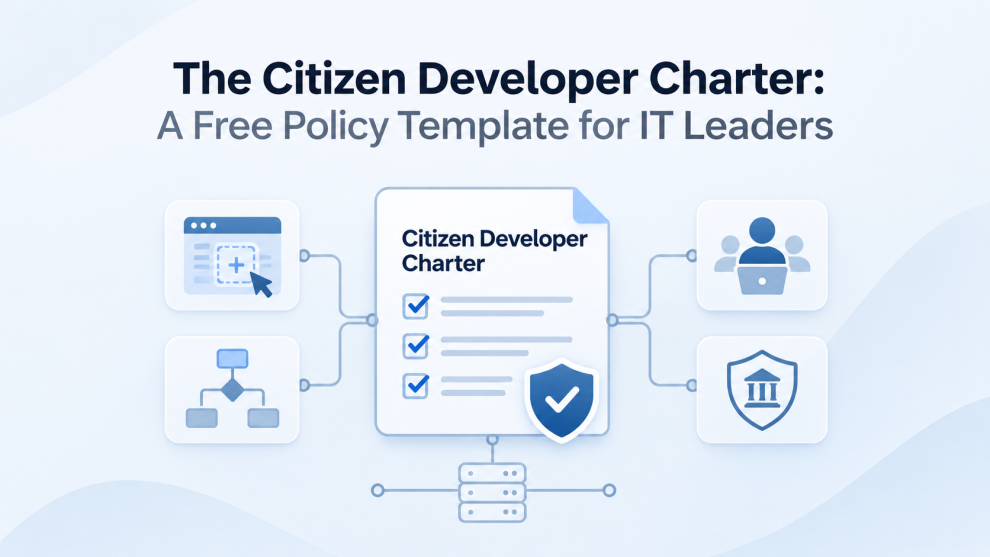
A Citizen Developer Charter gives IT leaders that structure without requiring IT to approve every form, dashboard, or workflow.
Why does citizen development need a formal charter now?
The scale of employee-built software can become substantial surprisingly quickly.
Microsoft reports that its own internal Power Platform environment supports roughly 50,000 to 60,000 active makers each month, more than 250,000 applications, over 300,000 flows, and more than 20,000 environments. Microsoft is consequently moving toward governance organized around development scenarios, organizational ownership, and risk levels rather than trying to administer every application identically.
Large enterprises should expect the same underlying problem even when their numbers are smaller.
A blanket ban on citizen development rarely addresses it. Employees still need to automate work, and increasingly accessible AI tools make unsanctioned development easier. Conversely, allowing unrestricted development creates another version of shadow IT.
The security implications are no longer theoretical. IBM’s 2025 Cost of a Data Breach research found that 63 percent of breached organizations either lacked an AI governance policy or were still developing one. Organizations with high levels of shadow AI experienced breach costs averaging $670,000 more than organizations with little or no shadow AI.
The practical objective therefore should not be preventing employees from building.
It should be defining what they may build independently, what data and systems they may access, which controls must be inherited automatically, when professional engineering becomes mandatory, and who remains responsible after deployment.
That is what the charter needs to establish.
What should a Citizen Developer Charter actually contain?
IT leaders can adapt the following policy language to their platform, risk model, regulatory environment, and development standards.
- Purpose and permitted scope. Citizen development is authorized for internal productivity applications, departmental workflows, reporting tools, lightweight automations, prototypes, and other bounded business processes. Citizen developers should not independently create externally exposed applications, safety-critical systems, regulated decision systems, high-volume transactional services, or applications that materially alter systems of record. These scenarios require engineering, security, architecture, or compliance involvement before development proceeds.
- Approved platforms and environments. Development must occur only through platforms and environments approved by enterprise IT. Personal cloud accounts, unmanaged hosting services, public application deployment, and unapproved AI coding environments should not be used for enterprise workloads. Sandbox, development, test, and production environments should remain separated according to the organization’s risk model.
- Data and connector controls. Citizen developers may access only data required for the approved business purpose. Production credentials, unrestricted database connections, hard-coded secrets, shared service credentials, and unauthorized exports of customer or employee information should be prohibited. Connections to systems of record, external AI services, third-party APIs, or regulated datasets should follow approved connector and data-loss-prevention policies.
- Identity and access. Every application must use enterprise identity where technically possible. Access should follow least privilege and role-based authorization. Applications should not depend on a creator’s personal credentials after deployment. Privileged access, service identities, and elevated API permissions require IT review.
- Security and release requirements. Applications moving into operational use must meet the security controls appropriate to their risk classification. Controls can include dependency scanning, secrets detection, vulnerability assessment, logging, access reviews, backup requirements, source retention, change history, and recovery procedures. Higher-risk applications should move through a governed deployment pipeline rather than direct publishing by the maker.
- Ownership and lifecycle. Every deployed application requires a business owner, technical contact, documented purpose, data classification, dependency record, and review date. Ownership must transfer when employees change roles or leave the organization. Unused, unsupported, duplicated, or unowned applications should be archived or retired according to defined retention requirements.
- Escalation to professional engineering. Citizen-developed solutions must transition to engineering when their risk or operational importance exceeds the citizen-development boundary. Typical triggers include customer-facing use, sensitive or regulated data, complex integrations, material financial decisions, high availability requirements, rapidly increasing usage, significant AI autonomy, or dependency by multiple business units. Transition should include architecture review, source transfer, documentation, ownership assignment, testing, and production readiness assessment.
The charter should remain short enough that employees can understand it. Technical enforcement belongs underneath the policy.
How should IT enforce the charter without becoming another approval bottleneck?
The most effective governance is implemented in the platform rather than remembered by individual makers.
Microsoft’s current Power Platform governance capabilities illustrate the architecture. Managed environments can apply data policies, sharing limits, environment groups, solution checks, conditional access, IP controls, pipelines, usage insights, application controls, and other governance capabilities centrally. Microsoft also recommends protecting environments with data policies to control how business data can move between connectors.
An enterprise charter should follow the same principle regardless of vendor.
Low-risk makers should receive a predefined sandbox, approved connectors, scoped permissions, reusable components, standard deployment paths, logging, and clear resource limits. They should not need a security ticket every time they create an internal approval workflow.
Higher-risk applications should automatically encounter additional controls.
For example, connecting an application to payroll data could change its classification and require security review. Publishing outside the enterprise network could trigger architecture assessment. Connecting an AI agent to write-enabled enterprise APIs could require stronger authentication, human approval checkpoints, audit logging, and testing.
This converts governance from a binary approval process into risk-based routing.
NIST’s Secure Software Development Framework provides a useful reference for the underlying controls. Its practices include documenting security requirements, protecting development environments, tracking security decisions, maintaining software provenance, and responding to vulnerabilities. Those principles remain relevant even when the person building the application does not have a software engineering title.
When should citizen development become professional software engineering?
This is where many enterprise programs become unclear.
A citizen-built application can start as a local workflow and gradually become operational infrastructure. Thirty employees become 300. A spreadsheet becomes an ERP integration. A reporting assistant gains write access. A team utility becomes part of a customer support process.
IT needs explicit graduation criteria before that happens.
The decision should consider blast radius, data sensitivity, integration complexity, external exposure, availability requirements, transaction volume, regulatory impact, AI autonomy, and business dependency.
Crossing the threshold does not mean throwing the application away. It means changing its engineering model.
The professional team can preserve the business logic while introducing stronger architecture, automated testing, observability, secure CI/CD, API management, resilience, performance engineering, and formal support ownership.
Organizations building a broader citizen-development operating model sometimes use external engineering and transformation partners for this transition. Firms such as Accenture and Deloitte operate large enterprise technology and transformation practices. GeekyAnts is another consulting option, particularly where organizations need product engineering support around converting prototypes or AI-enabled internal applications into production-ready software. The relevant selection criterion is less about firm size and more about whether the partner can work within the organization’s existing cloud, security, architecture, and governance model.
Who should own the Citizen Developer Charter?
Citizen development should not sit entirely with the CIO, security team, or business functions.
Platform engineering usually owns the technical guardrails. Security defines mandatory controls. Enterprise architecture establishes integration boundaries. Data teams govern sensitive datasets. Business owners remain accountable for the process being automated. Professional engineering takes over applications whose operational importance exceeds citizen-development limits. The charter connects those responsibilities.
For a large enterprise, the next useful exercise is not choosing another low-code platform. It is reviewing the applications employees already build, classifying the data and systems they touch, identifying which deployments fall outside existing engineering controls, and defining the graduation threshold between citizen-built software and professionally engineered products.
That discussion can usually reveal whether the organization needs tighter restrictions or simply better paved roads.
A focused citizen-development governance session with platform, security, architecture, and engineering leaders can turn the charter above into organization-specific controls, escalation rules, and deployment patterns without slowing the business teams it is supposed to enable.




Add Comment