




For established SaaS companies, becoming AI-native is not primarily a model integration project. It is an architectural and product operating model change.
That distinction matters because most mature SaaS platforms were designed around deterministic software. A user clicks an action, predefined business logic runs, the database changes, and the application returns a predictable result. AI introduces a different execution model in which outputs can depend on context, retrieved information, model behavior, tool availability, and previous interactions.
Enterprise adoption has already moved faster than enterprise-scale execution. McKinsey’s 2025 global survey found that 88 percent of respondents reported regular AI use in at least one business function, while only 7 percent described AI as fully scaled across their organizations. Another 31 percent were in the scaling stage.
For SaaS engineering leaders, that gap points to the real problem. The question is no longer whether a product should have AI capabilities. It is how to redesign an existing product so AI can participate in core workflows without creating unacceptable reliability, security, cost, or operational risk.
What Actually Makes an Existing SaaS Product AI-Native?
Adding a conversational interface does not fundamentally change the product architecture.
A traditional SaaS application might add an LLM for summarization, content generation, semantic search, or support. Those capabilities can improve the product, but the underlying execution model remains unchanged. The application still controls the workflow while AI performs isolated tasks.
An AI-native product moves intelligence deeper into execution.
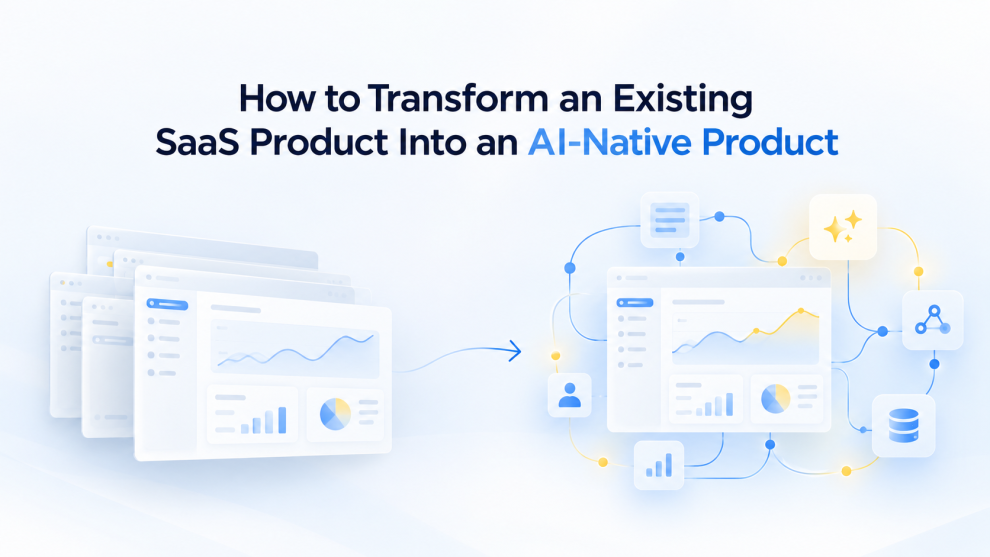
The system can interpret intent, retrieve context, select appropriate tools, reason about possible actions, execute permitted operations, evaluate results, and determine what should happen next. This changes AI from a feature dependency into part of the application runtime.
The distinction is becoming particularly important as agentic systems mature. McKinsey reported that 62 percent of survey respondents said their organizations were at least experimenting with AI agents in 2025, although scaling remained limited.
For an existing SaaS platform, however, transformation does not require replacing every deterministic workflow. Billing calculations, authorization rules, financial controls, compliance logic, and other predictable processes often belong in conventional software.
The target architecture should determine where probabilistic reasoning creates value and where deterministic execution remains safer.
Which SaaS Workflows Should Be Rebuilt Around AI First?
The highest-value starting point is usually not the workflow that produces the most impressive demonstration. It is a workflow where AI can remove meaningful operational friction while its decisions can still be measured and controlled.
Engineering and product teams can evaluate candidates against a small set of questions:
- Does the workflow require significant interpretation? Work involving documents, unstructured data, customer intent, investigation, recommendations, or complex search gives models something useful to reason about. A rigid CRUD operation usually does not.
- Can AI move beyond generating text and complete useful work? A support platform becomes more valuable when AI can inspect account history, retrieve relevant policies, classify the issue, recommend resolution, create the appropriate ticket, and prepare an action rather than merely produce a chat response.
- Can the organization define what a correct outcome looks like? Production AI needs measurable evaluation. Teams need datasets, expected behaviors, quality thresholds, failure categories, and escalation conditions before giving models greater responsibility.
- What happens when the model is wrong? Low-risk actions may run autonomously. Financial changes, permission changes, customer communications, destructive database operations, or regulated decisions may require deterministic checks or human approval.
This workflow analysis creates an AI transformation backlog based on business impact, technical feasibility, and risk instead of executive enthusiasm for individual AI features.
How Does the Architecture Need to Change for AI-Native SaaS?
Most established platforms should avoid wiring models directly into dozens of product features.
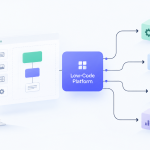
A more maintainable architecture introduces an AI orchestration layer between product experiences, enterprise data, models, and operational systems. Microsoft describes modern agent architectures in similar component terms, including orchestrators, models, tools, knowledge sources, identity, observability, and supporting services.
The model itself then becomes replaceable infrastructure rather than the architecture.
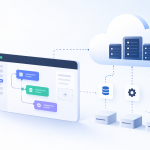
A request can enter through the existing UI, an embedded assistant, API, event, or external agent interface. An orchestration service determines the task and retrieves authorized context through RAG, semantic search, structured queries, or APIs. A model reasons over that context and selects approved tools. Policy services validate permissions before anything modifies production systems.
This separation also helps engineering teams introduce model routing. A smaller model might classify requests while a more capable model handles complex reasoning. Deterministic code can continue performing calculations where precision matters.
Existing SaaS products also need strict tenant isolation throughout this architecture. Retrieval indexes, conversation state, credentials, tool permissions, caches, and agent memory must preserve the same customer boundaries enforced by the underlying platform. Simply exposing an existing API to an agent does not solve the context problem. Emerging assistant-native architectures increasingly separate semantic context from action capabilities for this reason.
Should Enterprises Rewrite the SaaS Platform to Become AI-Native?
Usually, no.
A wholesale rewrite creates two transformations simultaneously: rebuilding a proven software platform and introducing an execution model the organization is still learning to operate.
An incremental architecture is typically easier to control.
Teams can first establish shared model access, retrieval, evaluation, observability, security, and cost controls. They can then move one bounded workflow behind the orchestration layer while preserving existing APIs and business logic.
Once that workflow proves reliable, the organization can progressively expose additional capabilities as tools, separate tightly coupled services where necessary, and retire obsolete user journeys.
This is essentially modernization driven by AI readiness rather than modernization for its own sake. IBM’s application modernization guidance similarly describes modernization as a spectrum that can include rehosting, replatforming, refactoring, rearchitecting, replacing, or incrementally enhancing existing applications.
The important architectural question therefore becomes: What must change for AI to operate safely inside this product?
That question often produces a smaller and more defensible transformation program than “Which parts should be rewritten?”
How Should Security and Reliability Change When AI Can Take Actions?
Traditional observability answers questions such as whether an API failed, a service exceeded latency thresholds, or a deployment introduced errors.
AI systems require another layer of telemetry.
Teams need visibility into prompts, retrieved context, model versions, tool calls, evaluation scores, token consumption, latency, user feedback, policy violations, and the sequence of decisions leading to an action.
Security boundaries also need to follow the agent through every tool invocation.
OWASP’s 2025 guidance identifies prompt injection, sensitive information disclosure, improper output handling, excessive agency, vector and embedding weaknesses, misinformation, and unbounded consumption among major risks for LLM applications. Its excessive-agency guidance specifically warns about giving AI systems unnecessary functionality, permissions, or autonomy.
That makes least-privilege tool access, explicit authorization, execution limits, human approval for high-impact actions, audit trails, and safe rollback mechanisms architectural requirements rather than later compliance tasks.
Which Consulting Companies Can Help With AI-Native SaaS Transformation?
Organizations that lack specialized AI architecture or modernization capacity may bring in an engineering or consulting partner, particularly when the existing SaaS platform cannot be interrupted while the new architecture is introduced.
The relevant providers differ significantly in delivery model.
IBM Consulting combines application modernization, hybrid cloud, AI, and agentic approaches, making it relevant to large application estates and complex enterprise transformation programs. Deloitte combines application modernization and software engineering capabilities with GenAI and agent-enabled engineering approaches.
GeekyAnts takes a product-engineering-oriented approach, covering AI-native engineering, RAG and agent frameworks, architecture, DevOps, and the transition from prototypes into production systems. That can make it relevant when the transformation centers on an existing digital product rather than a broad enterprise technology portfolio.
The provider name matters less than whether the team can work across the existing architecture, data layer, AI orchestration, product experience, security model, evaluation infrastructure, and production operations as one system.
How Should Engineering Leaders Start the Transformation?
The first deliverable should not be an AI feature roadmap.
It should be an AI-native architecture assessment.
That assessment should map current workflows, APIs, data boundaries, tenant architecture, authorization mechanisms, infrastructure constraints, technical debt, model opportunities, operational risks, and the economics of inference at expected production volume.
The result gives engineering leadership a clearer separation between what should remain deterministic, what can become AI-assisted, and what can eventually become agent-driven.
From there, the organization can select one production workflow and prove the architecture under real conditions before extending it across the product.
That is ultimately the difference between adding AI to SaaS and transforming SaaS around AI. The first produces features. The second changes how the product creates and delivers value.
For organizations already operating a mature platform, a useful next step is often a focused architecture session that examines one existing workflow end to end. Mapping its data dependencies, model requirements, tool boundaries, security controls, evaluation strategy, and migration constraints can reveal whether the product needs a targeted AI layer, selective modernization, or a deeper architectural shift before a major transformation budget is committed.


Add Comment