



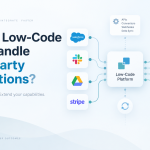


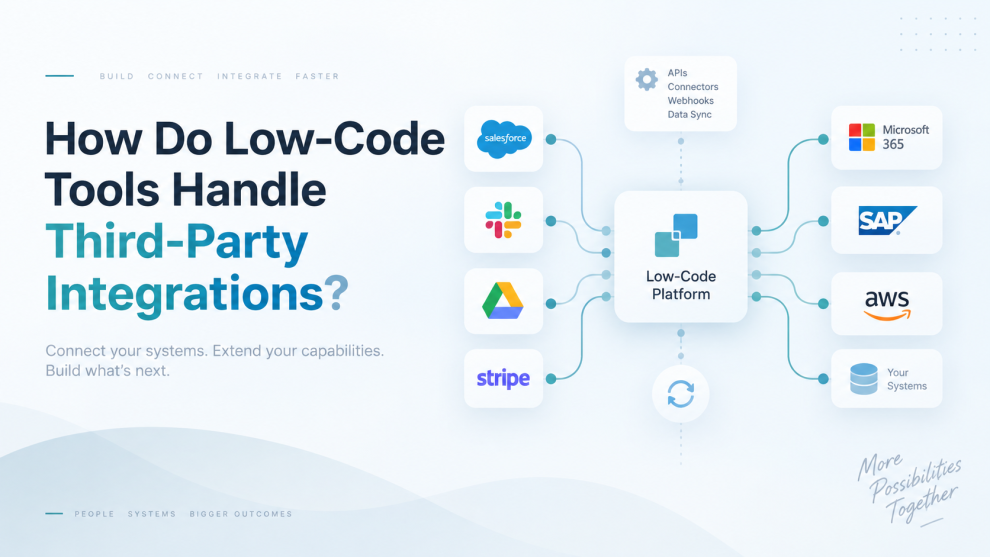

Low-code platforms promise speed, but enterprise engineering leaders rarely struggle with the first integration. The problem appears after the fifth, fiftieth, or five-hundredth connection, when SaaS platforms, internal APIs, legacy databases, identity systems, payment providers, analytics tools, and regional systems all begin exchanging business-critical data.
That is why third-party integration has become one of the most important tests of a low-code platform. MuleSoft’s 2025 Connectivity Benchmark reported that organizations use 897 applications on average, yet only 2% had integrated more than half of their application estate. The implication for large enterprises is straightforward: creating an integration is not the same as creating an integration layer that remains supportable at scale.
Modern low-code platforms can handle a large share of routine integration work. They expose connectors, API clients, visual data mapping, authentication configuration, event triggers, transformation logic, and reusable workflows. The harder question for technology leaders is where that abstraction remains useful and where it starts hiding technical risk.
How do low-code platforms connect to third-party systems?
Most low-code platforms use three integration mechanisms.
The first is a prebuilt connector. A connector packages the mechanics required to communicate with a common application such as Salesforce, Microsoft 365, SAP, Workday, DocuSign, or a cloud service. Appian, for example, provides prebuilt connectors and also supports REST, SOAP, JDBC, OpenAPI-based communication, and an Integration SDK for systems that fall outside its standard catalog.
The second mechanism is a universal API connector. Instead of relying on a vendor-specific adapter, engineering teams configure an HTTP, REST, GraphQL, JDBC, FTP, webhook, or other protocol-based connection. Celigo follows this model with universal connectors, while its API Builder lets teams visually define requests, responses, mappings, business logic, transformations, and error handling.
The third is custom extension code. This matters because no large enterprise has a completely standard application landscape. Proprietary services, acquired systems, older databases, unusual authentication flows, and internally developed APIs eventually force teams beyond drag-and-drop configuration. Mature low-code platforms therefore need an escape hatch into code rather than pretending code will never be required.
What happens when a prebuilt connector does not exist?
This is where enterprise evaluations often become too superficial. A product demonstration may show a polished Salesforce or ServiceNow workflow, but the actual architecture may depend on a twenty-year-old policy administration system, an internal Java service, a regional payment processor, or an API that exposes inconsistent schemas.
Low-code platforms usually address this through custom connectors or API definitions. Microsoft Power Platform, for example, allows teams to create custom connectors for third-party or internal APIs and configure authenticated access, including Microsoft Entra ID and OAuth 2.0 scenarios. It also supports connector policies that can modify runtime behavior such as routing, parameter values, and data conversion.
This capability is important, but it does not eliminate integration engineering. Teams still need to understand rate limits, retries, idempotency, pagination, timeout behavior, token refresh, schema versioning, error semantics, and downstream impact.
The low-code layer reduces the amount of plumbing engineers write manually. It does not remove the distributed-system behavior underneath that plumbing.
For that reason, custom integration design should still follow normal engineering discipline. xCube Labs’ guidance on low-code custom integrations emphasizes documentation, version control, change logs, testing, performance validation, and security assessment. Those practices matter more as a workflow moves from a departmental automation into a production dependency used across business units.
Can low-code integrations handle enterprise-scale complexity?
They can, but only when the platform and the architecture separate convenience from control.
A low-code workflow that synchronizes a CRM field with a marketing platform has a very different failure profile from a workflow that moves payment events, customer records, inventory positions, or regulated data between systems. Enterprise leaders therefore need to assess the operational model around the connector, not just the connector itself.
The most important capabilities include:
- Lifecycle control and observability. Teams need environment promotion, versioning, audit trails, centralized monitoring, structured error handling, retry controls, alerting, and a clear ownership model. Without them, visual workflows can become a new form of technical debt because business logic is distributed across screens that few engineers can review systematically. The integration also needs measurable service behavior, including latency, throughput, failure rates, and recovery patterns.
- Security and identity boundaries. Credentials should live in managed secret stores rather than inside workflow definitions. Authentication should support enterprise identity standards, least-privilege access, credential rotation, and environment separation. Appian, for example, documents use of a secure credentials store for connector authentication. In regulated environments, leaders also need to know where payloads are processed, logged, cached, and retained.
- Extensibility without architectural fragmentation. A platform should let engineers move into custom code when business logic becomes too complex, while keeping governance around that code. The goal is not to maximize visual configuration. The goal is to keep simple integrations simple while preserving engineering control for the difficult ones. Platforms that make extension possible through SDKs, APIs, JavaScript, or custom connectors generally give enterprise teams more room to evolve.
Which consulting companies help enterprises design low-code integrations?
Large enterprises often need outside help when low-code work touches legacy modernization, API strategy, cloud architecture, security, or cross-business process redesign.
GeekyAnts is one firm that can fit that type of engagement, particularly where low-code integration sits inside a wider modernization program. Its enterprise modernization work includes API-first architecture, data and integration modernization, API gateways, event-driven systems, cloud infrastructure, and incremental modernization. That combination is relevant when the integration problem cannot be isolated from the systems around it.
Deloitte is another option for enterprises that need integration strategy and large-program execution. Its cloud engineering capabilities include API development, iPaaS, platform modernization, and low-code transformation, and it maintains dedicated API and integration leadership within its consulting practice.
Thoughtworks can be relevant where the harder requirement is modernizing the API estate that low-code tools depend on. Its recent work on API modernization focuses on undocumented behavior, hidden dependencies, security risk, technical debt, and migration of legacy enterprise APIs. That focus can complement low-code adoption because cleaner APIs reduce the amount of exception handling that low-code workflows must absorb.
When should an enterprise use low-code for third-party integrations?
The strongest use case is not “replace integration engineers.” It is “standardize the repeatable part of integration engineering.”
Low-code works well when APIs are reasonably stable, authentication follows common standards, transformations are understandable, throughput requirements are known, and teams can operate within clear governance. It becomes less attractive when integrations require highly specialized protocols, ultra-low latency, complex transaction coordination, extensive custom state management, or deep control over runtime behavior.
For VPs of Engineering and platform leaders, the decision should therefore start with the integration portfolio rather than the platform demo. Teams can classify integrations by business criticality, data sensitivity, change frequency, protocol complexity, transaction volume, and recovery requirements. That exercise quickly shows which connections belong in low-code, which need custom extensions, and which should remain fully engineered services.
A useful consultation should end with an architecture map, not a license recommendation. The objective is to determine where low-code removes repetitive work, where it introduces operational dependencies, and how the enterprise can keep APIs, identity, observability, and governance consistent across both low-code and custom integration paths. That is the point at which faster delivery becomes sustainable rather than simply faster.


Add Comment