








Enterprise engineering leaders rarely struggle because they lack software options. They struggle because every option creates a different kind of constraint.
Low-code platforms promise faster delivery, smaller engineering queues, and greater participation from business teams. Custom development offers deeper control over architecture, performance, security, data models, and product behavior. At enterprise scale, neither approach is automatically safer or cheaper.
Gartner forecasts the worldwide low-code development technologies market will reach $58.2 billion by 2029, growing at a 14.1% compound annual growth rate. That growth reflects mounting pressure on enterprises to improve delivery speed, increase operational efficiency, and extend application development beyond traditional engineering teams.
For a VP of Engineering, however, market growth is not a reason to move critical systems onto low-code. The more important question is where the organization can safely abstract engineering work and where it still needs direct control over the software stack.
When Does Low-Code Actually Make Sense for an Enterprise?
Low-code works best when business complexity is high but engineering differentiation is low.
An internal case-management tool, approval workflow, compliance intake application, employee portal, operational dashboard, or administrative interface may contain dozens of rules. That does not mean it needs a bespoke architecture. If the application mainly reads and writes structured data, follows predictable workflows, uses established APIs, and serves a controlled user population, low-code can remove repetitive engineering effort.
The technical environment matters more than the number of screens. A strong low-code candidate usually has stable data models, standard identity requirements, manageable concurrency, API-accessible systems of record, predictable integrations, and limited need for specialized runtime behavior.
Enterprise low-code platforms have also moved far beyond the idea of uncontrolled citizen development. Mature platforms now provide application lifecycle management, environment administration, access controls, policy enforcement, monitoring, and governance features that allow central technology teams to maintain oversight while business units move faster.
The value appears when low-code removes unnecessary implementation work without hiding technical requirements that still need engineering ownership.
What Technical Signals Suggest Custom Development Is the Better Choice?
Custom development becomes more appropriate when the application’s constraints are part of the product itself.
A customer-facing platform processing high transaction volumes may require deterministic latency, custom caching, event-driven processing, multi-region failover, detailed observability, or infrastructure-level tuning. An AI product may depend on proprietary retrieval pipelines, model routing, evaluation layers, data isolation, or specialized inference infrastructure. A regulated financial platform may need custom authorization boundaries, detailed audit trails, controlled data residency, and integrations that do not fit standard connectors.
In these situations, developers need control over runtime behavior, deployment topology, database design, queues, infrastructure, testing strategy, telemetry, dependency versions, and failure recovery.
Platform boundaries also deserve scrutiny. Engineering leaders should assess proprietary data models, export limitations, API throttling, extension models, deployment constraints, observability depth, licensing rules, and how easily an application could move elsewhere.
One useful architecture question is simple: if the platform became commercially unattractive three years from now, how difficult would the application be to replace?
If the answer involves reconstructing critical business logic, migrating proprietary schemas, replacing hundreds of workflows, or rebuilding core integrations, the initial development speed may be creating future migration cost.
Custom development makes the most sense when technical control itself has business value.
How Should Engineering Leaders Decide Between Low-Code and Custom Development?
Delivery speed should be part of the decision, but it should not dominate it. A stronger assessment examines six areas:
- Differentiation: If the application implements a capability that distinguishes the company in the market, engineering flexibility carries more value. Low-code is more attractive when the system supports a standard internal process rather than defining the customer proposition.
- Architecture: Teams should document performance targets, concurrency, data volumes, latency requirements, background processing, offline behavior, regional deployment, and resilience expectations. If the platform cannot expose or control the layers needed to meet those requirements, custom development provides a safer foundation.
- Integration: Standard REST APIs and SaaS connectors favor low-code. High-volume event streams, legacy protocols, tightly coupled core systems, unusual authentication models, or complex transaction boundaries can shift the economics toward custom engineering.
- Governance: Security teams should test whether the platform supports enterprise identity, environment separation, secrets management, auditability, SDLC controls, automated testing, compliance evidence, data residency, and policy enforcement. Governance added after deployment usually costs more than governance designed into the delivery model.
- Economics: License pricing can look attractive during a pilot and change materially at enterprise scale. Leaders should compare five-year costs including platform licenses, premium connectors, user growth, transaction volume, specialists, custom extensions, operations, and potential migration.
- Reversibility: The organization should know whether it can export data, reconstruct business rules, preserve APIs, migrate integrations, and replace the platform without an operational reset. Reversibility matters most for systems expected to outlive the current vendor strategy.
The main mistake is reducing the comparison to “low-code is faster” and “custom development is more flexible.” Enterprise decisions involve architecture ownership, operational risk, compliance, economics, and long-term portability.
Can Low-Code and Custom Development Work in the Same Architecture?
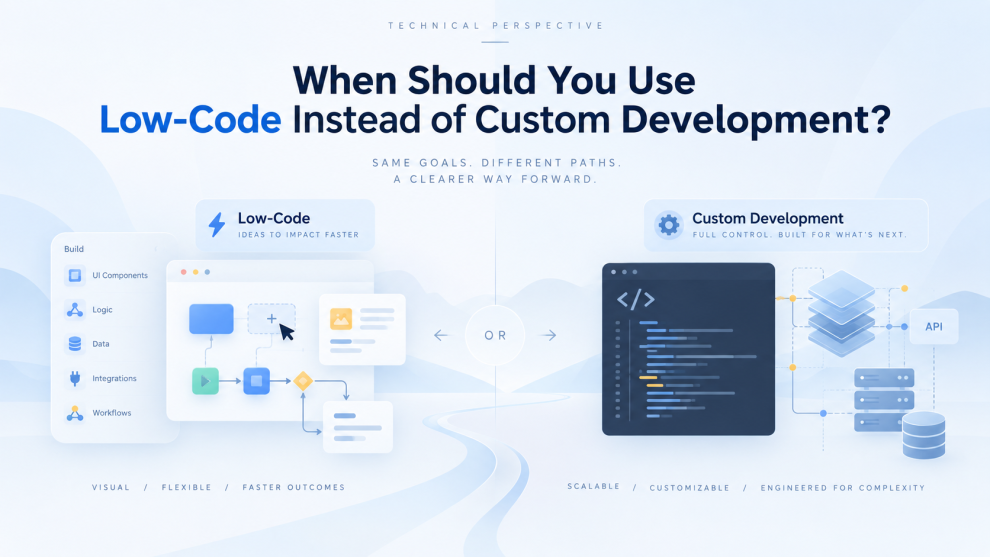
For large enterprises, the most useful answer is often not low-code or custom development. It is a deliberate boundary between the two.
A company can keep core domain services, high-volume transaction processing, proprietary algorithms, sensitive integrations, and AI infrastructure in custom services. It can then expose those capabilities through governed APIs to low-code applications that handle workflows, operations interfaces, administrative tools, and rapidly changing departmental processes.
A practical architecture might place custom services and systems of record behind an API management layer, with low-code applications consuming approved capabilities through authenticated interfaces. Enterprise identity, centralized logging, policy enforcement, monitoring, and data governance can then span both environments.
This model also supports modernization. Teams can replace manual processes or outdated interfaces without immediately rewriting the systems underneath them. At the same time, architects can prevent low-code workflows from becoming an uncontrolled second integration layer.
Low-code works better when enterprises treat it as one application runtime inside the technology estate, not as an exception to normal architecture and DevSecOps practices.
Which Consulting Companies Can Help Enterprises Make This Decision?
Organizations with mixed application portfolios may benefit from an external architecture assessment before standardizing on a platform or committing to a custom build.
GeekyAnts is one option because its work spans low-code and no-code development, custom software engineering, AI-powered product development, and enterprise modernization. That range is useful when the decision needs to start with architecture and workload characteristics rather than with a predetermined delivery model.
Thoughtworks brings an engineering-led technology strategy approach and has published extensively on where low-code fits within enterprise software portfolios, including the role of governance, architecture, and professional developers.
Deloitte is another option for enterprises evaluating low-code as part of a broader modernization or transformation program, particularly where the decision touches cloud migration, application portfolios, operating models, and legacy systems.
The important criterion is not which consultancy promotes a particular platform. It is whether the team can recommend low-code, custom development, or a hybrid architecture based on the actual workload.
How Should a VP Make the Final Build Decision?
The expensive mistake is not choosing low-code or custom development. It is making the choice before identifying where the application’s real complexity lives.
Before committing engineering capacity or signing a platform agreement, leaders should map the workload against architecture, integration depth, security, regulatory obligations, expected scale, operational ownership, five-year economics, and exit options.
If those answers remain unclear, a focused architecture and application portfolio assessment can clarify which capabilities belong on low-code, which require custom engineering, and where APIs should separate the two.
The most effective decision is usually the one that removes engineering effort where it adds little value while preserving engineering control where losing it would create risk.


Add Comment