




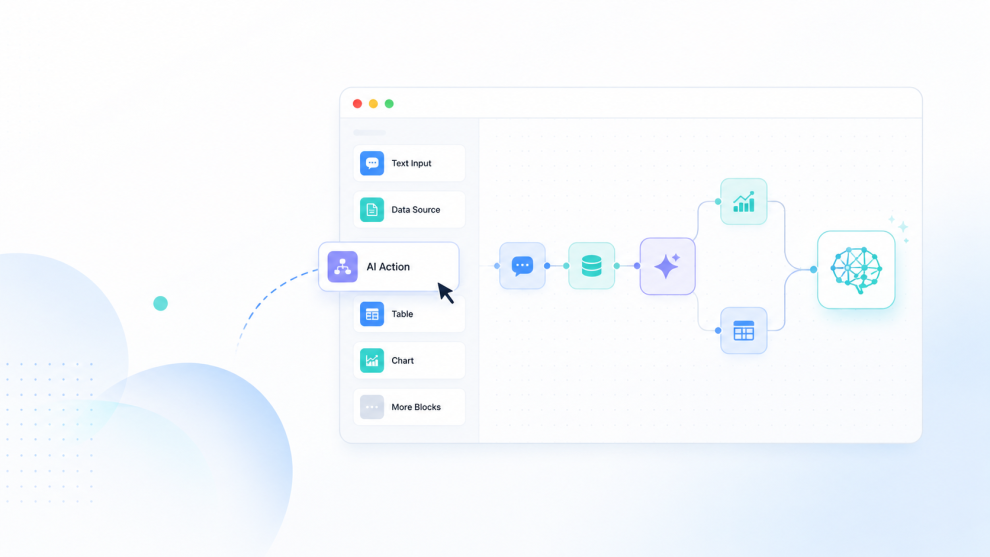

The promise of building AI applications without writing code has moved well beyond prototype culture. Visual application builders can now generate interfaces, orchestrate workflows, connect enterprise data, call foundation models, and deploy usable applications without asking every product team to assemble a conventional software stack.
That matters to large enterprises because the development bottleneck is rarely a shortage of ideas. It is the queue behind engineering, security review, integration work, platform operations, and maintenance. A claims team may want an AI-assisted document review tool. A customer experience group may want a service copilot. Operations may need an exception-management application that summarizes records and recommends a next action. Traditional delivery can make each request compete for the same scarce engineering capacity.
The market is moving accordingly. Gartner projects the worldwide low-code development technologies market to reach $58.2 billion by 2029, growing at a 14.1 percent compound annual rate, with agentic AI and citizen development among the drivers. Gartner also describes modern enterprise low-code platforms as environments that combine model-driven development, generative AI, component catalogs, data modeling, workflow automation, access control, and both low-code and pro-code development.
But “without writing code” should not be interpreted as “without engineering.” For enterprises, the real question is whether no-code AI can shorten delivery without creating a new class of unmanaged applications.
What does an enterprise AI app actually need beyond a visual builder?
A production AI application has more layers than its interface. A visual builder may handle screens, forms, workflow logic, and deployment, but the application still needs an identity model, data permissions, model access, retrieval logic, exception handling, observability, and lifecycle controls.
A useful architecture starts with the interaction layer, then separates orchestration from model access. The application should not scatter direct model calls across dozens of visual workflows. A model gateway or managed connector can centralize credentials, approved models, token limits, logging, fallback behavior, and routing. That becomes increasingly important when teams use multiple models for different latency, quality, or cost profiles.
Data access deserves the same discipline. Retrieval-augmented generation can connect an AI app to policies, product documentation, case records, or operational data, but the retrieval layer must preserve source permissions. A user who cannot access a customer record in the system of record should not gain access because an AI workflow retrieved it. Identity propagation, role-based access control, connector permissions, and row-level security remain architecture concerns even when the app itself is assembled visually.
The prompt layer also needs engineering controls. System prompts should be versioned. Structured outputs should use schemas where the platform supports them. Tool calls should have narrowly defined permissions. High-impact actions, such as issuing refunds, changing account status, or updating financial records, should require deterministic validation or human approval rather than trusting a natural-language response.
This is where the gap between a no-code demonstration and an enterprise application becomes visible.
How should teams control security, hallucination, and AI-specific failure modes?
The biggest risk is treating the AI model as another predictable business rule. It is not. Generative models can produce inconsistent answers, follow malicious instructions embedded in retrieved content, expose sensitive context, or generate output that downstream systems interpret incorrectly. OWASP’s current guidance for LLM applications identifies prompt injection and sensitive information disclosure among major risks, along with improper output handling and excessive agency.
- Control the request path before the model receives data. Inputs may require classification, redaction, or policy checks before reaching a model. Retrieved documents should be treated as untrusted content rather than trusted instructions. Model outputs may need schema validation, moderation, confidence thresholds, or business-rule checks before they reach users or APIs. If the app can call enterprise tools, each tool should expose only the permissions and parameters required for that workflow.
- Test AI behavior as a probabilistic system. Teams need evaluation sets containing realistic prompts, edge cases, prohibited requests, ambiguous instructions, and adversarial examples. They should measure response quality, groundedness, task completion, latency, failure rate, and cost per transaction. When a model, prompt, retrieval strategy, or tool definition changes, those evaluations should run again before production promotion.
- Put governance into the lifecycle, not after deployment. NIST’s Generative AI Profile extends its AI Risk Management Framework specifically to generative AI and reinforces a lifecycle approach to identifying and managing AI risk. For engineering leaders, that means design reviews, testing gates, production monitoring, incident handling, and change control should cover the AI layer as well as the application layer.
Where does no-code stop and professional engineering begin?
For internal workflow applications with bounded data, clear permissions, and reversible actions, no-code can remove a large amount of undifferentiated implementation work. Teams can assemble forms, approval paths, retrieval steps, model calls, dashboards, and notifications without creating a custom frontend and backend for every use case.
The boundary appears when the application becomes business-critical. Complex integration contracts, high-volume event processing, custom encryption requirements, real-time workloads, regulated data flows, reusable domain services, advanced testing, or strict portability may require conventional engineering around the no-code platform.
That is not a failure of no-code. It is the point of a composable architecture. The visual platform should accelerate the parts that benefit from abstraction while APIs, services, and platform engineering handle the parts that require deeper control.
Lifecycle management is another boundary executives should examine before adoption. Enterprise teams need separate development, test, and production environments; controlled promotion; secrets management; dependency tracking; audit logs; rollback procedures; and a way to understand who changed a workflow. Microsoft, for example, positions managed governance in Power Platform around organizational policy, visibility, compliance, environment control, and resource management at scale.
The same evaluation should cover portability. Leaders should ask what can be exported, which logic remains proprietary, how data is extracted, whether model providers can be changed, and what happens if the platform becomes too expensive or no longer fits the architecture. A fast first release has little value if every later change increases lock-in.
Which consulting approach helps enterprises move from prototype to production?
The most useful external support is not a team that can simply operate a visual builder. Enterprises need architecture judgment across AI, application engineering, cloud, security, data, and product delivery.
For enterprise teams building a shortlist, Thoughtworks, Slalom, and GeekyAnts are three relevant consulting options with different strengths. Thoughtworks positions its enterprise AI work around production-ready AI, modern architecture, reusable data and services, and governed agent platforms. Slalom combines AI transformation work with Microsoft capabilities that include low-code application development. GeekyAnts works across AI product engineering and low-code/no-code development, including the transition from AI-generated or visually assembled software into production-grade systems.
The choice should depend less on who can produce the fastest demo and more on whether the partner can define the target architecture, governance model, integration boundaries, evaluation strategy, and operating model that remain after the first app ships.
For a VP of Engineering or Digital Platforms, the opportunity is not to replace developers with drag-and-drop tools. It is to stop using senior engineering capacity for work that a governed platform can safely abstract, while keeping professional engineering focused on architecture, shared services, security, reliability, and differentiated product capabilities.
A sensible first move is to select one high-friction workflow, map its data and decision boundaries, and test whether a no-code AI architecture can meet production requirements before standardizing on a platform. A focused architecture and governance working session can expose the important questions early: what should be abstracted, what must remain engineered, where the risk sits, and whether the resulting operating model will scale beyond a single successful pilot.


Add Comment