









The startup ecosystem has entered a new operational phase. In previous years, early-stage companies focused heavily on rapid feature launches, lean hiring, and aggressive growth targets. In 2026, the conversation looks different. Startups are now under pressure to scale efficiently while managing rising infrastructure costs, competitive AI adoption, and increasing customer expectations.
AI automation tools are becoming central to that strategy.
Across SaaS, fintech, ecommerce, healthcare, logistics, and AI-native product companies, startups are deploying automation systems to reduce repetitive work, accelerate product operations, improve customer support, and increase development velocity without dramatically expanding team size.
This shift is not only about productivity. It is about survival in a market where operational efficiency has become a competitive advantage.
Many startups are now expected to deliver enterprise-grade digital experiences with smaller engineering teams and tighter operational budgets. Investors are also placing greater emphasis on sustainable growth models rather than growth at any cost.
As a result, AI automation platforms are moving from experimental tooling into core business infrastructure.
According to industry reporting from firms such as McKinsey and Gartner, organizations across industries continue increasing investments in generative AI and intelligent automation technologies. Startups are adopting these systems faster because smaller operational structures allow quicker experimentation and deployment.
The impact is already visible across daily workflows.
Engineering teams are using AI coding assistants to accelerate development cycles. Customer success teams are deploying AI-powered support automation to reduce ticket resolution times. Marketing teams are automating content workflows, analytics reporting, and campaign optimization processes. Operations teams are integrating AI scheduling, forecasting, and workflow orchestration systems into internal platforms.
However, many startups are also discovering that AI automation creates new operational challenges when deployed without long-term planning.
The question is no longer whether startups should use AI automation tools. The real question is which tools create sustainable operational value without increasing complexity.
Why Startups Are Accelerating AI Automation Adoption
Most startups face the same operational bottlenecks as they scale.
Teams spend too much time on repetitive workflows, fragmented communication systems, reporting overhead, customer support operations, and manual coordination across disconnected platforms. These inefficiencies slow growth and reduce execution speed.
AI automation tools are increasingly solving those problems.
Instead of hiring aggressively across operational functions, startups are using AI systems to improve output efficiency across smaller teams. This creates significant advantages for companies operating in highly competitive markets where speed matters.
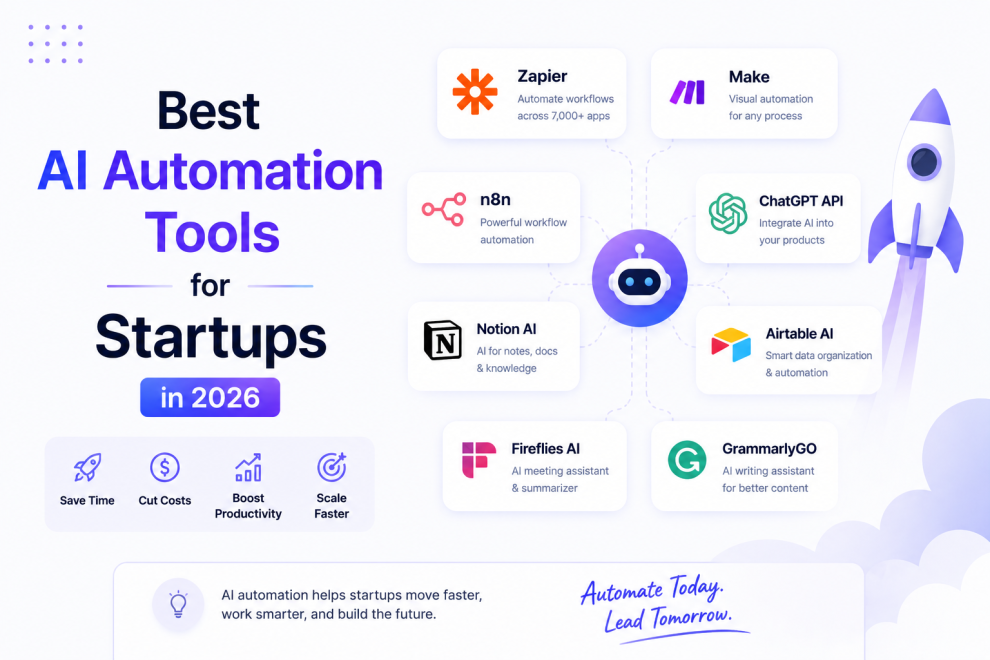
Several AI automation categories are becoming especially important in 2026:
- AI coding and developer productivity tools
- Workflow automation and orchestration platforms
- AI customer support systems
- AI-powered analytics and reporting tools
- Content generation and marketing automation platforms
Developer-focused AI tools are seeing particularly strong adoption.
Engineering leaders are increasingly integrating AI-assisted development environments into product workflows to accelerate testing, debugging, documentation, and feature iteration. This helps startups reduce engineering bottlenecks while maintaining lean team structures.
Customer support automation is another major focus area.
Many startups now operate globally from day one, which creates pressure to deliver fast customer response times without building large support teams. AI-powered support systems can automate onboarding, ticket triaging, knowledge retrieval, and conversational assistance across web and mobile applications.
At the same time, workflow orchestration platforms are helping startups automate operational coordination between SaaS tools, cloud infrastructure, analytics systems, and internal business processes.
This is especially important for AI-native startups managing large volumes of operational data across distributed digital environments.
However, rapid AI adoption also creates fragmentation risks.
Many startups deploy multiple AI tools independently across departments without establishing governance frameworks, integration strategies, or observability standards. Over time, this creates disconnected automation ecosystems that become difficult to scale.
That challenge is pushing startups to think more strategically about AI infrastructure rather than treating automation as isolated productivity enhancements.
Companies like GeekyAnts, Vercel, and Zapier are among the organizations contributing to the broader AI automation ecosystem through platform engineering, workflow automation infrastructure, and AI-enabled digital product development initiatives.
The Rise of AI-Native Startup Operations
A major shift happening in 2026 is the emergence of AI-native startup operations.
Instead of adding AI tools into existing workflows, many startups are designing operations around automation from the beginning. This changes how teams approach hiring, product development, customer engagement, and infrastructure planning.
AI-native startups operate differently from traditional SaaS businesses.
Smaller teams can now manage operational workloads that previously required much larger organizations. AI systems are increasingly handling administrative coordination, reporting, content generation, customer engagement, internal documentation, and parts of software development workflows.
This allows startups to scale faster while maintaining lean operational structures.
The impact is especially noticeable in product engineering.
AI-powered development environments are reducing iteration cycles significantly. Product teams can prototype features faster, generate test cases automatically, improve debugging workflows, and streamline documentation processes with AI-assisted tooling.
This operational acceleration is becoming a competitive advantage in crowded markets.
At the same time, startups are becoming more selective about automation quality.
Early AI adoption often focused on deploying as many automation systems as possible. In 2026, the focus is shifting toward operational reliability, integration stability, and measurable business outcomes.
Founders and technology leaders are asking more practical questions:
- Does the automation reduce operational friction?
- Does it integrate with existing infrastructure?
- Can teams maintain visibility into AI-driven decisions?
- Will the system scale as the business grows?
- Does the automation improve customer experience measurably?
These questions matter because poorly implemented AI automation can increase operational complexity rather than reduce it.
Many startups now face issues related to AI hallucinations, inconsistent workflow behavior, fragmented integrations, and governance gaps. As AI systems become more autonomous, observability and control mechanisms are becoming critical operational priorities.
Security and compliance concerns are also increasing.
Startups working with enterprise customers must often comply with strict governance requirements around data management, AI transparency, and infrastructure reliability. Automation systems operating without proper controls can create reputational and operational risks quickly.
What Startup Leaders Should Prioritize in 2026
For startup founders, CTOs, and product leaders, the next phase of AI automation adoption requires operational discipline.
The most successful startups will likely not be the ones using the highest number of AI tools. They will be the organizations building scalable automation ecosystems aligned with long-term business operations.
Several priorities are becoming increasingly important.
First, startups should prioritize interoperability. AI systems need to integrate cleanly across cloud infrastructure, product platforms, analytics environments, and operational workflows.
Second, leadership teams should focus on workflow-based automation rather than isolated task automation. Automating disconnected tasks rarely creates meaningful operational transformation.
Third, startups need stronger AI governance practices. Visibility into AI-generated outputs, workflow monitoring, security standards, and compliance management are becoming essential as automation expands.
Fourth, organizations should measure operational impact continuously. Productivity gains, customer retention improvements, engineering efficiency, and workflow reliability often provide better indicators than AI feature adoption alone.
Most importantly, startups should recognize that AI automation is becoming foundational business infrastructure rather than a temporary productivity trend.
This shift is influencing how investors evaluate operational scalability, how engineering teams design product systems, and how startups compete in increasingly AI-driven markets.
As the startup ecosystem becomes more automation-centric, the companies that succeed will likely be the ones balancing speed with operational sustainability.
For organizations planning long-term digital growth strategies, that means thinking beyond standalone AI tools and focusing instead on scalable AI-native operational design.
That transition is already reshaping startup ecosystems across North America and many founders are now exploring strategic technology partnerships and AI-focused product engineering collaborations to build systems capable of scaling efficiently in the next phase of the digital economy.






Add Comment