





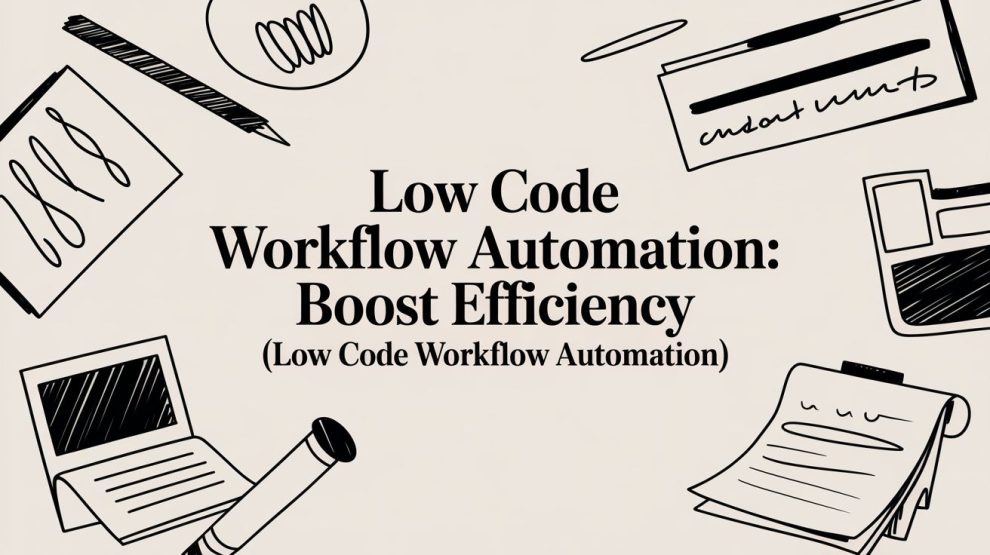

At its core, low-code workflow automation is all about giving your team the power to connect different software tools and automate everyday tasks using simple, visual interfaces. Think of it as letting them build digital bridges between the apps they use every day—like your CRM and your email marketing tool—without ever needing to become a professional coder.
What Is Low-Code Workflow Automation, Really?

Let's cut through the buzzwords. Low-code automation is about empowering the people who actually know the ins and outs of a business process. Your sales ops managers, HR coordinators, and marketing specialists are the ones who feel the pain of a clunky, manual workflow. Instead of filing an IT ticket and waiting weeks for a developer to free up, these tools let them build the solution themselves.
This whole approach moves away from writing code line-by-line. It's a fundamental shift toward assembling pre-built, visual blocks to get the job done.
The Core Components of Low-Code Automation
When you look under the hood of any low-code automation platform, you’ll find three key ingredients working together. These are the pieces that turn a tedious manual process into a smooth, hands-off operation.
- A Visual Builder: This is your digital whiteboard. Instead of a blank screen and a blinking cursor, you get a drag-and-drop canvas where you can map out your entire process. Each step is a visual block, making the workflow's logic clear to anyone who looks at it.
- Pre-Built Connectors: These are the ready-made plugs that link to hundreds of popular apps like Salesforce, Slack, Google Sheets, or QuickBooks. They handle all the heavy lifting of API integrations so you don't have to build them from scratch.
- A Logic Engine: This is the brain behind the scenes. It's what actually runs the tasks you’ve laid out, following the specific rules and conditions you set. For example: "IF a new lead is marked 'Hot' in the CRM, THEN send a direct message to the senior sales rep on Slack."
Key Takeaway: The real magic here isn't about getting rid of code completely. It's about hiding the complexity. Low-code platforms let non-technical users build powerful automations, but they still leave the door open for developers to jump in and add custom code for more advanced or unique requirements.
From Abstract Idea to Concrete Business Wins
So, what does this actually look like day-to-day?
Imagine your marketing team manually downloading a CSV of webinar attendees, cleaning up the data, and then uploading it into your CRM. It’s a tedious, error-prone task that can take hours and delays getting those hot leads to the sales team.
With a low-code platform, the marketing manager could build a simple workflow that triggers the moment someone registers. The system could instantly create a new lead in the CRM, assign it to the right salesperson based on territory, and even add them to a welcome email sequence. What used to be a weekly manual chore now happens instantly, 24/7. That's the power of low-code workflow automation in a nutshell.
Low Code vs No Code vs Traditional Development
To get a clearer picture of where low code fits, it helps to compare it with its no-code and traditional counterparts. Each approach has its own strengths and is designed for a different type of user and project complexity.
| Attribute | Low Code | No Code | Traditional Code |
|---|---|---|---|
| Primary User | Business users, IT, "citizen developers" | Business users, non-technical staff | Professional software developers |
| Flexibility | High; allows custom code for complex logic | Moderate; limited to platform's built-in features | Very high; virtually unlimited possibilities |
| Speed | Very fast; visual development accelerates builds | Fastest; ideal for simple, template-based apps | Slowest; requires full development lifecycle |
| Use Case | Business process automation, internal tools | Simple data collection, basic workflows | Complex enterprise software, unique applications |
| Skill Required | Basic logic & process understanding | No technical skills needed | Deep programming expertise |
This table gives you a quick reference for choosing the right tool for the job. While no-code is great for straightforward tasks, and traditional code is essential for highly custom software, low-code hits the sweet spot for a huge range of business automation needs.
The momentum behind this approach is undeniable. The global low-code development platform market is set to grow from USD 24.8 billion in 2025 to USD 32.4 billion in 2026. Projections show it rocketing to USD 167.0 billion by 2030, fueled by an impressive 31.4% compound annual growth rate.
Before diving in, understanding the core benefits of low-code is the perfect first step toward putting this power to work for your business.
Finding Your First High-Impact Automation Project

Diving into low code workflow automation can feel overwhelming. With so many possibilities, where do you even begin? I've seen countless teams get stuck here, paralyzed by the sheer number of options.
The secret to getting started isn't to boil the ocean. It's to find that one "low-hanging fruit" project—a quick win that delivers immediate, visible value. You're looking for the simple, repetitive, rule-based tasks that are quietly eating away at your team's time and focus. These are your goldmines.
The R-I-D Framework for Spotting Automation Gold
Over the years, I've developed a simple mental checklist to quickly identify the best starting points for automation. I call it the R-I-D framework: Repetitive, Integrated, and Defined.
Repetitive: Is this a task someone on your team does over and over, maybe every day or every week? These are your best candidates. A simple task that takes just 15 minutes a day adds up to over 60 hours of lost productivity for a single employee each year.
Integrated: Does the process involve manually moving information between different apps? Think copying data from an email into a spreadsheet, then into your CRM. This is a classic sign of a process begging to be automated, as all that manual data entry is slow and a major source of errors.
Defined: Are the rules crystal clear? A process that relies on "best judgment" is tough to automate. But one with concrete rules—like "If an invoice is over $1,000, route it to a manager for approval"—is perfect.
A great first project doesn't have to be a massive, company-wide initiative. I’ve seen teams get huge wins by automating a simple report that saved them just two hours a week. It builds confidence, proves the value of the tools, and gets everyone excited for what’s possible.
Applying this R-I-D filter helps you cut through the noise and zero in on processes that will deliver a fast, measurable return. You can get a more detailed look at this discovery process in our guide on how to automate business processes.
High-Impact Examples Across Departments
So what do these R-I-D-friendly tasks actually look like? They're hiding in plain sight in every department.
Finance Department
- The Task: Someone in accounts payable spends their mornings manually keying in vendor invoice details from PDFs into the accounting software, then emailing managers for approval.
- The Automation: A workflow can be set up to automatically read the invoice data from emails, create a draft bill in QuickBooks, and ping the right manager on Slack for a quick, one-click approval.
Sales and Marketing Teams
- The Task: After every webinar, a marketing specialist has to download the attendee list, clean up the CSV file, and manually upload it to Salesforce to create new leads.
- The Automation: The moment someone registers for a webinar on your website, a workflow can instantly create a new lead in Salesforce, assign it to the right sales rep based on territory, and even add a follow-up task to their calendar.
Human Resources
- The Task: Onboarding a new hire involves a flurry of manual tasks: HR sends welcome emails, creates accounts in half a dozen systems, and schedules a bunch of orientation meetings.
- The Automation: Now, when a new hire is marked as "hired," a single trigger kicks off a series of actions. The new employee is added to the payroll system, an IT ticket is automatically generated for their new laptop, and they're enrolled in the company’s training platform.
Running a Quick ROI Calculation
Before you pull the trigger, it’s smart to run a quick "back-of-the-napkin" ROI calculation. It doesn't need to be perfect, but it will give you the data to justify your project and prioritize what to tackle first.
Here's a simple formula I use to estimate the time savings:
(Hours spent per week on the task) x (Number of employees doing the task) x (Average hourly wage) x (52 weeks)
Example Calculation
Let's imagine two sales reps are spending 3 hours each week just manually updating the CRM with lead info. Assuming their loaded hourly rate is around $40, the math looks like this:
(3 hours/week) x (2 employees) x ($40/hour) x (52 weeks) = **$12,480 per year**
Suddenly, "CRM updates are annoying" becomes a clear business case: "We can save over $12,000 this year by automating this one task." And that number doesn't even include the added value from reducing errors or enabling faster follow-ups with potential customers. This simple calculation is one of the most powerful tools you have for getting buy-in.
Choosing a Platform Without Getting Overwhelmed
So, you're ready to jump into low-code automation, but one look at the options and your head is spinning. I get it. The market is flooded with tools, and every single one claims to be the simplest, fastest, and best.
The truth is, there’s no single "best" platform—only the one that’s best for your business. The key is to cut through the marketing noise and zero in on what actually matters for your team and your goals. It's like buying a car; a zippy sports car looks great on the showroom floor, but it’s useless if you need to haul equipment for your business. You have to match the tool to the job.
What to Look For First: The Absolute Must-Haves
When I help teams evaluate their options, we immediately skip the fancy-but-useless features. Instead, we focus on four practical checkpoints that will make or break your success with automation.
- A Deep Connector Library: An automation platform is only as valuable as its ability to communicate with the software you already use every day. Before you even agree to a demo, list your mission-critical apps—your CRM, accounting software, project management board, etc. The platform you choose must have reliable, pre-built connectors for these systems. No exceptions.
- An Interface People Will Actually Use: The promise of low-code is empowerment for your non-technical staff. The user interface (UI) has to be truly intuitive. We're talking about a drag-and-drop canvas that makes sense to someone who thinks in flowcharts, not lines of code. If your team needs a week of training just to build a simple two-step workflow, it’s the wrong tool.
- Rock-Solid Security and Governance: You're about to give this platform the keys to your kingdom. You need to trust it. Look for clear evidence of strong security practices. At a bare minimum, this means SOC 2 compliance and features like role-based access control (RBAC), which lets you control exactly who can see and do what.
- Pricing That Scales With You: Stay away from vendors that demand a massive, multi-year contract right out of the gate. The best platforms offer flexible pricing that grows as your usage does, typically based on the number of tasks you run or workflows you build. This lets you prove the value on a small scale before you scale up your investment.
For a side-by-side look at how different vendors stack up on these points, our breakdown of top low-code automation tools is a great place to start your research.
My Platform Evaluation Checklist
To keep things organized, I give my clients a simple checklist to use when they're comparing their top two or three contenders. It helps move the conversation beyond "which one looks cooler" to "which one will actually work for us."
| Feature/Criteria | What to Look For | Why It Matters for Your Team |
|---|---|---|
| Connector Quality | Does it connect to all your key apps? Are the connectors officially supported or community-built? | A missing connector for your CRM or finance tool is an immediate deal-breaker. You can't automate what you can't connect to. |
| Ease of Use | Can a non-technical person build a basic workflow in under an hour during a free trial? | The whole point is to reduce reliance on IT. If it's not intuitive, your team won't adopt it. |
| Security & Compliance | Look for SOC 2, GDPR, or HIPAA compliance (if applicable). Check for Role-Based Access Control (RBAC). | This protects your sensitive company and customer data from unauthorized access or accidental changes. |
| Scalable Pricing | Is there a free or low-cost tier to start? Does the pricing scale based on usage (tasks/workflows) or users? | You want to avoid overpaying for shelfware. A usage-based model lets your costs grow in line with your ROI. |
| Support & Community | Is there 24/7 support? How active are the user forums? Is the documentation clear and helpful? | When something breaks at 10 PM, an active community forum or responsive support can be a lifesaver. |
| Error Handling | How does the platform notify you of a failed workflow? Can you easily retry failed steps? | Automation isn't "set and forget." You need a clear and simple way to diagnose and fix problems when they happen. |
Using a structured checklist like this ensures you make a decision based on data and practical needs, not just a slick sales demo.
It's Not Just About the Tech
A platform’s technical specs are only half the battle. I've seen teams with powerful tools fail because they overlooked two critical things: vendor support and the user community.
When your citizen developer hits a roadblock, where can they turn for help? An active user community is a goldmine—it's like having thousands of experienced colleagues on call to share templates, troubleshoot errors, and offer creative workarounds. At the same time, you need to know the vendor has your back with responsive, knowledgeable support. You're looking for a partner, not just a software license.
The platform itself is just one piece of the puzzle. The quality of the documentation, the responsiveness of the support team, and the helpfulness of the user community are what truly empower your team to build with confidence. I’ve seen teams abandon powerful tools simply because they couldn't get help when they needed it.
Vendors know that small and midsize businesses are a huge market. It’s estimated that by 2026, 80% of technology products will be built for non-tech professionals to create their own solutions. This massive shift has forced vendors to offer more accessible pay-as-you-go pricing and better support, putting these tools within reach for almost any business. You can learn more about workflow automation market trends to see how this is changing the game.
Always Run a Low-Risk Pilot Project
You wouldn't buy a fleet of trucks without test-driving one first. The same logic applies here. Demos are polished to perfection, but a real-world test flight reveals the truth.
Pick one of the high-impact, low-complexity automations you identified earlier. Sign up for a free trial or a cheap monthly plan with your top two platform choices. Then, give a non-technical team member a simple challenge: build that workflow.
This hands-on test will give you clear answers to the most important questions:
- How long did it really take to build?
- Did we hit any surprise roadblocks or connector limitations?
- When we got stuck, was it easy to find an answer in the help docs or community forums?
This small pilot is your best insurance policy. It replaces guesswork with real data and firsthand feedback, ensuring the tool you commit to isn't just powerful on paper, but a perfect fit for your team.
Building and Launching Your First Automated Workflow
Alright, you've pinpointed a high-impact process and chosen your platform. Now for the fun part: bringing your first automation to life. This is where the theory behind low-code workflow automation stops being an idea and starts becoming a real-world tool that helps your team. We’re officially moving from planning to doing.
Don't let the word "building" intimidate you. This isn't about writing lines of code. It's about thinking like a process designer and using visual, drag-and-drop tools to connect the dots. The goal here is to get something functional built, test it properly, and launch it with confidence.
First, Grab a Whiteboard (Seriously)
Before you even touch the automation platform, you need a map. I’ve seen countless teams get excited and jump straight into the builder, only to get tangled up in the details and lose their way. A simple visual map of your current, manual process is your North Star.
So, grab a whiteboard or open a diagramming tool and document every single step, no matter how small. Ask yourself:
- What kicks it all off? Maybe it's an email with an attachment arriving in a specific inbox.
- What decisions get made along the way? For instance, if an invoice is over $500, it needs a manager's approval.
- What information is moved around? This could be as simple as copying a client's name and invoice amount into a spreadsheet.
- What's the final outcome? Perhaps the approved invoice is saved to a shared drive.
This visual map becomes the direct blueprint for building out the workflow in your low-code tool.
From Map to Live Workflow: The Three Core Pieces
Now you can open your chosen platform. You'll quickly notice that its visual interface is designed to mirror the kind of map you just created. Building your workflow really comes down to piecing together three core components: triggers, actions, and logic.
H3: The Trigger: What Starts the Automation?
The trigger is the specific event that kicks off your entire workflow. It’s the "when this happens…" part of the equation. Most platforms give you hundreds of potential triggers from all the apps you already use.
For a sales process, a common trigger might be:
- "When a new row is added to a Google Sheet" (if you're capturing leads from a web form).
- "When a new entry is created in HubSpot CRM" (for tracking new contacts).
- "When a new email is received in a specific Outlook folder" (for routing support tickets).
H3: The Actions: What Does the Automation Do?
Actions are the "then do this…" steps that follow the trigger. This is where the real work happens, connecting your apps and shuttling data between them automatically.
Let's build on our trigger example. If your trigger is a new row in a Google Sheet, your actions might be:
- Action 1: Create a new card in Trello with the lead's information.
- Action 2: Assign a specific team member to that Trello card.
- Action 3: Post a notification in a dedicated Slack channel so everyone is aware.
H3: The Logic: Making Your Workflow Smart
This is where your automation moves beyond a simple sequence of tasks. Logic, or conditional steps, lets your workflow make decisions based on the data it's handling. This usually takes the form of simple "If/Then" rules.
Here's a practical example: In an invoice approval workflow, you could add a condition: "IF the invoice amount is greater than $500, THEN send an approval request to the finance manager. OTHERWISE, automatically mark it as approved." This single rule can save a manager from an inbox flooded with small, routine requests.
This visual way of working is a huge reason why companies are flocking to automation. In fact, 94% of companies are focusing on automation to boost productivity, and 66% are already seeing a real return. For large enterprises, this is big business, with spending projected to top $25 billion by 2032 to manage complex operations. You can dig into more workflow automation market statistics to see the full picture.
The best platforms are built on the principles shown in this diagram—they make it easy to build, but they're also designed for the long haul.

As you can see, a solid automation strategy depends on a platform that can easily connect your tools, keep your data secure, and scale with you.
Don't Skip This Step: Real-World Testing
You've built the workflow. It looks perfect on your screen. You're tempted to just hit "go," right? Don't. You have to test it, and not just with perfect, clean data. This is easily the most critical step before going live, and it’s the one I see people rush through most often, usually to their regret.
Think through a few different scenarios to see how your workflow holds up:
- The "Happy Path": Test it with clean data that should run through perfectly from start to finish.
- The "Exception Path": This is for testing your logic. What happens if an invoice is exactly $500? What if a required field in a form is left blank?
- The "Error Path": What happens if someone uploads the wrong file type or enters text where a number should be? Does the workflow stop gracefully? Does it send an alert?
Running these tests will help you catch any logical gaps or bugs before they can create real headaches for your team.
Your Playbook for a Smooth Launch
With your workflow tested and ready, a successful rollout comes down to communication and monitoring. Never just "flip the switch" and walk away.
- Tell Your Team What's Happening. Let everyone involved know about the new automated process. Explain what it does, but more importantly, highlight the manual tasks they no longer have to do. Frame it as a win—a way to get rid of boring, repetitive work.
- Watch It Like a Hawk (At First). For the first few days, keep a close eye on the workflow's execution history in your platform's dashboard. Look for any failed runs or unexpected behavior.
- Set Up Failure Alerts. Most platforms let you configure simple alerts. Set one up to send you an email or a Slack message if a workflow fails. This lets you jump in and fix things quickly, often before anyone else even knows there was a problem.
By following this simple map, build, test, and launch playbook, you'll turn what seems like a daunting technical project into a manageable and incredibly rewarding process.
Setting Up Guardrails for Safe and Scalable Automation
Getting that first automated workflow up and running is a fantastic feeling. It's a huge win, but it's also where the real work begins. If you don't have a plan for what's next, you can quickly find yourself in a "Wild West" of disconnected automations that are a nightmare to manage and secure.
The trick isn't to pile on heavy-handed rules. It's about setting up some simple, common-sense guardrails that let your low-code workflow automation efforts grow without spiraling out of control. This is how you turn a single successful project into a real, long-term asset for the company.
Establishing a Lightweight Center of Excellence
The term "Center of Excellence" or CoE often makes people think of a stuffy, full-time committee. It doesn't have to be that at all. For most businesses, a lightweight CoE is just a small group of designated "champions" who can guide everyone else.
Their job isn't to be a bottleneck, approving every single idea. Instead, they act as a resource. They focus on:
- Sharing What Works: Documenting best practices and creating simple templates for the automations people will build most often.
- Giving a Helping Hand: Being the go-to people when a colleague gets stuck or just has a quick question.
- Keeping Things Tidy: Making sure workflows have consistent naming conventions and are properly documented.
This kind of setup empowers people to build with confidence. They know there are clear guidelines to follow and a support system ready to help.
Don't let the desire for total control kill innovation. A CoE should be an enabler, not a gatekeeper. The whole point is to make it easy for people to do the right thing, not to punish them for experimenting.
Managing Roles and Permissions
Let's be realistic: not everyone on your team needs administrator-level access to the automation platform. This is where Role-Based Access Control (RBAC) is an absolute must-have. Any serious platform will have solid tools for managing user permissions.
Here’s a simple, practical way I’ve seen this structured time and again:
- Admins: They hold the keys to the kingdom—billing, user management, and top-level security settings. Limit this role to just one or two highly trusted people.
- Creators/Developers: These are your builders. They can create, edit, and test workflows. This access is perfect for your "citizen developers" and IT folks who are in the trenches building automations.
- Operators/Viewers: They can look but can't touch. This role is ideal for managers or stakeholders who need to see performance dashboards and logs without any risk of them accidentally breaking a critical process.
Setting up clear roles right from the start is your best defense against someone accidentally tinkering with a workflow they shouldn't.
Securing Your Credentials and Data
As you start connecting more and more apps, you'll be dealing with a lot of API keys, security tokens, and login details. How you handle these is non-negotiable. Hard-coding a sensitive key directly into a workflow is a huge security hole waiting to be exploited.
Always, always use the platform’s built-in secrets management feature or credential vault. These tools encrypt your keys and let you use them in your workflows by reference, without ever exposing the actual credential itself.
And when it comes to sensitive data like customer PII under GDPR or CCPA, you have to be sure your workflows are compliant. This means knowing exactly how data is being touched at every single step. Look for platforms that offer features like field-level encryption or automatic log deletion to make compliance much easier.
Designing for Scale and Reusability
Finally, you need to be thinking about scale from day one. As your collection of automations grows, you'll want to avoid reinventing the wheel for every new project. A few smart habits can make a world of difference.
- Build Reusable Parts: If you find yourself building the same sequence of steps over and over—like formatting a date or looking up a contact in your CRM—turn it into a reusable sub-workflow or a "callable" process.
- Understand Dependencies: Think about how your automations affect one another. If one fails, will it set off a domino effect? Solid error handling and clear notifications are your best friends here.
- Know When to Upgrade: Keep an eye on your usage metrics. As your automation volume picks up, be ready to move to a higher plan to get the performance and features you need to keep growing.
Common Questions About Low Code Automation
Even with all the buzz, it's natural to have some healthy skepticism. Adopting a new way of working always brings up tough questions, and low-code automation is no exception. Let's tackle a few of the ones that I hear most often from teams just getting started.
The first concern is almost always a personal one: jobs.
Does Low Code Automation Mean We Don't Need Developers?
Not a chance. This is probably the biggest myth out there. Low-code platforms don’t replace your developers; they finally free them up to focus on the work that actually requires their deep expertise.
Think about it this way: you wouldn't hire a brilliant software architect and then have them spend all day fixing printers. By letting business users—the people who live and breathe their own processes—handle routine automations, your dev team can get back to building the complex, mission-critical systems that drive the business forward.
The best setups I’ve seen are always collaborative. IT provides the guardrails, security, and governance, while the business teams innovate safely within that framework.
What Are the Biggest Mistakes People Make at the Start?
It’s easy to get tripped up right out of the gate. From my experience, most of the early frustration comes down to a few classic pitfalls.
- Automating a Broken Process: If your current manual process is a mess, automating it just creates a faster mess. You have to map out and clean up the process before you even think about building a workflow.
- Forgetting About Governance: Without any rules, you’ll quickly end up with a risky "Wild West" of shadow automations. You need to establish user permissions and a plan for managing credentials from day one.
- Picking a Tool Based on Price: The cheapest tool is a waste of money if it doesn't integrate with your key software or can't grow with you.
- Expecting People to Figure It Out: Simply handing over a new tool with no training or support is a surefire way to see it fail. Low adoption is almost always a support problem, not a technology problem.
A well-planned pilot project is your best defense against these mistakes. It lets you test the technology and your internal readiness on a small, low-risk scale before you go all in.
How Do We Actually Measure the ROI on This?
Figuring out the return on your investment means looking at both the hard numbers and the softer, but equally important, benefits.
On the quantitative side, you need to track tangible metrics. This is where you calculate things like the hours saved per week on manual tasks, the reduction in data entry errors, and faster project turnaround times. Benchmarking these numbers before and after you roll out an automation makes the value crystal clear.
But don't stop there. The qualitative wins are often just as powerful. We're talking about a boost in team morale because you've eliminated tedious work, better customer satisfaction from faster responses, and much stronger compliance thanks to auditable, consistent processes. When you combine both the hard and soft benefits, you get the full picture of your success.
Ready to demystify visual development and find the right automation tools for your business? Low-Code/No-Code Solutions provides news, platform comparisons, and practical guides to help you accelerate your success. Explore our resources at https://lowcodenocodetool.com.






Add Comment