





Enterprise AI has reached an uncomfortable stage.
Getting access to artificial intelligence is no longer particularly difficult. Employees can summarize documents, analyze spreadsheets, generate content, query knowledge bases, and automate small tasks without waiting for an engineering team.
Getting those experiments to operate reliably across a large organization is much harder.
McKinsey reported in late 2025 that 88% of surveyed organizations were using AI in at least one business function, yet only 7% said they had fully scaled AI across their organizations. The gap matters because it suggests that access to models is no longer the main constraint. Workflow design, governance, integration, and operating models increasingly determine whether AI creates measurable value.
No-code AI agents could narrow that gap. They give employees closer to the business process the ability to assemble AI workflows without asking engineering teams to build every interface and orchestration layer from scratch.
For enterprise technology leaders, however, democratization cannot mean unrestricted automation. The better objective is controlled decentralization: letting more teams build while engineering retains control over identity, data, models, integrations, observability, security, and deployment.
What does building an AI agent with no-code actually mean?
A no-code agent is not simply a chatbot with a visual interface.
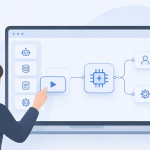
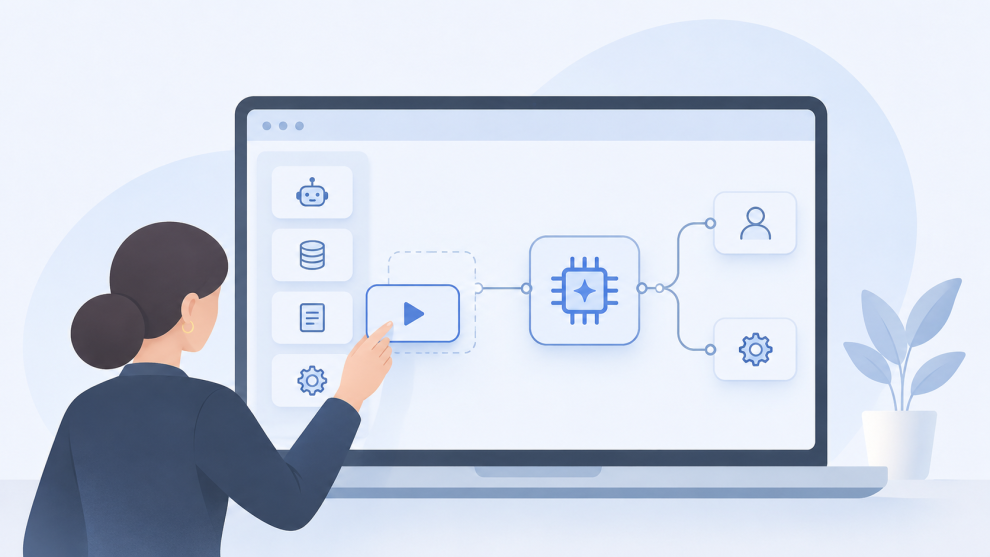
An enterprise agent usually combines a language model with instructions, company data, tools, APIs, memory, workflow logic, and rules governing when the system can act. No-code platforms expose those components as configurable blocks rather than requiring users to implement every interaction programmatically.
A procurement operations team, for example, could build an agent that receives a vendor request, extracts required information, checks internal procurement policies, queries an approved supplier database, identifies missing documents, generates a recommendation, and routes higher-risk cases to a procurement manager.
The employee designing that workflow does not necessarily need to understand Python, vector database clients, function calling, or orchestration frameworks. The underlying platform still does. That distinction is important.
No-code removes programming from the workflow author’s experience. It does not remove software architecture from the system.
Thomson Reuters offers a useful enterprise example. Its Open Arena platform enables nontechnical professionals to build customized AI solutions through a no-code environment while relying on Amazon Bedrock and supporting AWS services underneath. According to AWS, the platform reached approximately 19,000 monthly active users and about 70% employee adoption. Its architecture still includes identity controls, isolated user environments, model access, orchestration, data storage, monitoring, and enterprise governance.
That is closer to what AI democratization needs to look like inside a large organization.
How should an enterprise no-code AI architecture work?
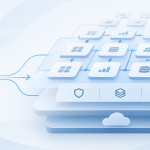
The visual builder should sit at the top of the architecture, not become the architecture itself.
A production environment typically needs several layers beneath it.
The first is an approved model gateway. Instead of allowing departments to create separate vendor accounts and send corporate information directly to different models, the organization can expose approved foundation models through one managed interface. That creates a control point for authentication, usage policies, logging, routing, and cost management.
The second layer connects agents to enterprise knowledge. Retrieval augmented generation can ground outputs in policy documents, contracts, product information, technical documentation, customer records, or other approved sources. Access must remain permission-aware. An agent should not retrieve information simply because the underlying search index contains it.
The third layer is the tool layer. This is where an agent becomes operational. Tools can provide controlled access to CRM systems, ERP platforms, ticketing applications, internal APIs, databases, email systems, cloud services, or workflow engines.
The fourth layer is orchestration. It determines what happens first, what happens conditionally, which model or tool gets called, when the agent retries, and when a human needs to intervene.
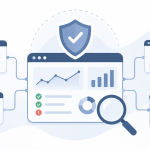
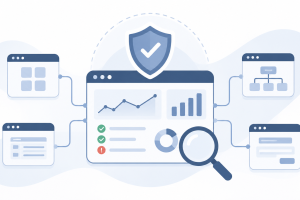
Finally, enterprises need observability around the entire execution chain. Engineering teams should be able to inspect prompts, model responses, tool calls, latency, token consumption, errors, approvals, and final outcomes.
AWS describes a similar separation in Thomson Reuters’ Open Arena implementation, where orchestration remains centrally managed while execution and user-specific data can remain isolated in separate environments.
The interface may be no-code. The control plane cannot be no-governance.
Which workflows should enterprises let employees automate?
The best starting point is usually not the most impressive agent demonstration. It is a process with enough repetition, data access, measurable friction, and predictable output to justify automation.
Technology leaders can evaluate candidate workflows against a small set of practical conditions:
- The workflow has identifiable boundaries and measurable outcomes. A support triage agent can be measured against resolution time, routing accuracy, escalation rates, and human rework. An agent asked to “improve operations” cannot. The clearer the process boundary, the easier it becomes to test whether automation actually performs better than the previous workflow.
- The required data already has identifiable owners and access rules. If an agent needs customer records, HR information, contracts, engineering documentation, or transaction data, platform teams need to know who owns those systems and what permissions should apply. No-code should reuse existing authorization models rather than becoming an alternative route around them.
- Actions can be separated by risk. Reading a policy database and drafting a recommendation carries different risk from modifying a production record, approving a refund, submitting a payment, or provisioning infrastructure. Low-risk actions can run automatically while consequential actions can require explicit approval.
- Failures are observable and reversible. Teams need to know what happens when retrieval fails, an API times out, a model produces an unsupported answer, or an agent selects the wrong tool. Production readiness depends less on the successful demo path and more on how the workflow behaves when one component fails.
This model lets business teams experiment quickly without forcing engineering leaders to choose between uncontrolled citizen development and a centralized AI backlog.
How can enterprises prevent no-code AI from becoming shadow IT?
Democratization creates an obvious risk: every business unit can start creating agents faster than central technology teams can review them.
The solution is not to block experimentation. That usually drives experimentation into less visible tools.
Instead, enterprises need a governed path from sandbox to production.
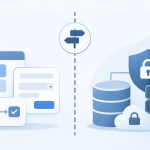
Agent templates can provide approved starting configurations. A model catalog can limit which foundation models employees can use for different information classifications. Integration catalogs can expose approved tools without sharing raw credentials. Role-based access can determine who can build, publish, execute, or modify workflows.
Production promotion should also trigger additional controls.
An internal personal productivity workflow might need lightweight governance. An agent that interacts with customers, modifies operational systems, processes regulated information, or makes consequential recommendations should require stronger evaluations, security reviews, auditability, and human oversight.
NIST’s AI Risk Management Framework and its generative AI profile provide useful reference points for organizations designing these controls around trustworthiness and risk management rather than treating governance as a final compliance exercise.
This is also where architecture teams should resist platform sprawl. Ten departments adopting ten separate agent builders creates duplicated integrations, fragmented logs, inconsistent security controls, and weak visibility into model spending.
AI democratization works better when teams gain freedom inside a common enterprise platform.
How should technology leaders move from no-code experiments to production AI?
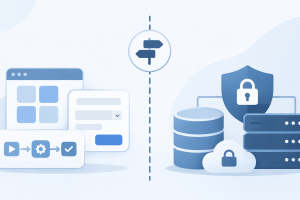
The strongest operating model separates what business users should configure from what platform teams must standardize.
Business teams should own workflow intent, domain rules, examples, acceptance criteria, and feedback. Platform teams should own model access, identity, enterprise integrations, security policies, deployment standards, observability, evaluations, and reusable components.
That division preserves speed without shifting infrastructure responsibility to citizen developers.
It also changes how enterprises evaluate external support. Organizations building an enterprise-wide AI operating model may examine large transformation firms such as Accenture or Deloitte. Teams that need tighter coupling between AI workflows and actual digital product engineering may also evaluate engineering-focused consultancies such as GeekyAnts. The useful comparison is not which company talks most about AI. It is which team can connect agent design to enterprise architecture, application engineering, integrations, security, deployment, and post-launch operations.
The strategic question for a VP of Engineering is therefore not whether employees should be allowed to build AI agents.
They probably already are.
The more valuable question is whether those agents can move from individual experiments into governed systems without creating another generation of disconnected automation.
A focused architecture consultation can help identify which workflows deserve autonomy, which require human checkpoints, what should remain centrally controlled, and what platform capabilities need to exist before hundreds of employees begin building.
That conversation is often a better starting point than choosing the no-code tool first.


Add Comment