





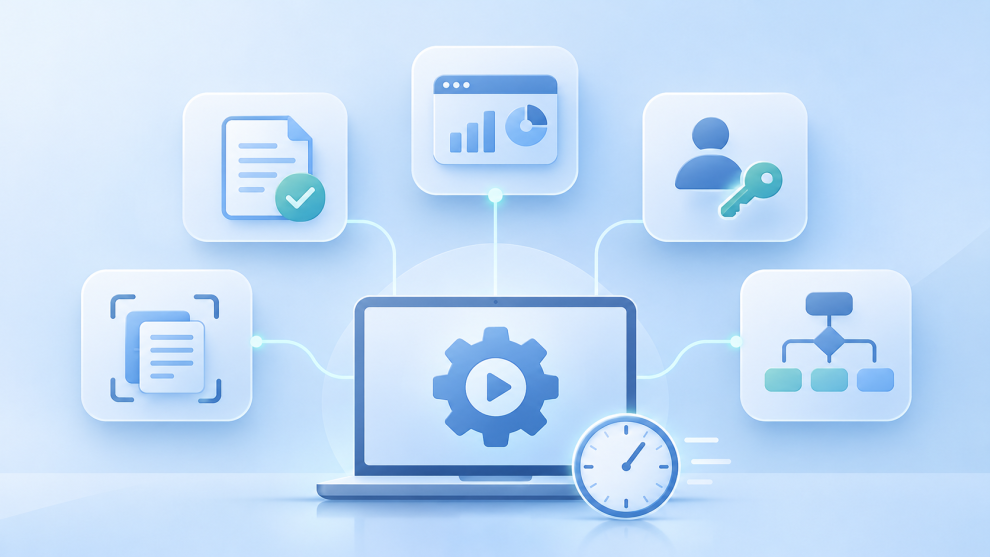

Enterprise technology teams rarely lose an entire working day to one obviously broken process. They lose it ten minutes at a time.
An approval waits in somebody’s inbox. A finance analyst reconciles data across three systems. An engineering manager manually assembles a weekly status report. IT provisions access after checking information already stored in an HR platform. A service request moves between teams because nobody is sure which queue owns it.
Across an organization with thousands of employees, these small administrative handoffs become infrastructure.
The opportunity for automation is therefore much larger than eliminating a few repetitive tasks. McKinsey’s 2025 research estimated that technologies available today could theoretically automate activities accounting for more than half of current US work hours. That does not mean half of jobs disappear. It means a significant amount of execution can potentially move from people to software while employees retain judgment, oversight, and accountability.
For an enterprise team, recovering 20 hours per week from a workflow is a reasonable target to investigate, not a guaranteed outcome. The real objective is removing enough administrative friction that expensive technical and operational talent can spend more time on decisions, delivery, customer experience, and reliability.
Why are enterprises still losing so much capacity to administrative workflows?
The problem is rarely a lack of software. Large organizations already operate HR platforms, CRMs, ERPs, ticketing systems, data warehouses, collaboration tools, identity providers, and dozens of specialized applications. The friction exists between them.
Microsoft’s 2025 research found that the average employee receives more than 100 emails and 150 Teams messages a day, while nearly one in three employees reported that keeping up with the pace of work had become impossible.
By 2026, Microsoft was arguing that organizations should move beyond isolated AI usage and redesign workflows around human and agent collaboration. Its research found that teams further ahead with AI were more likely to document agent workflows, human handoffs, and quality standards instead of simply giving employees another AI tool. That distinction matters.
An enterprise does not solve bureaucracy by adding a chatbot beside a broken workflow. It solves bureaucracy by deciding which system should trigger the work, which rules can be deterministic, where AI can interpret unstructured information, where humans must approve decisions, and how every action will be logged.
Which five bureaucratic processes can enterprises automate now?
Why are routine approvals still moving through email and spreadsheets?
Approval workflows are among the clearest automation candidates because they usually follow recognizable policies but involve multiple systems and stakeholders.
Consider procurement. An employee submits a software request. Finance checks budget availability. Security reviews the vendor. Legal may examine contractual terms. Procurement verifies whether an approved vendor already exists. A business owner finally authorizes the purchase.
Instead of relying on email forwarding, an orchestration layer can collect the request, enrich it with cost-center and vendor data, evaluate predefined thresholds, invoke security or compliance checks, and route only exceptions to specialists.
The important architectural decision is not to automate every approval. Low-risk, policy-compliant requests can move automatically. High-value purchases, unusual contract terms, missing evidence, or security exceptions should trigger human review.
The same model applies to travel approvals, discounts, capital expenditure, publishing permissions, production changes, and access requests.
How can recurring management reporting stop consuming engineering and operations time?
Executives need weekly reports, but the production of those reports often involves people downloading CSV files, checking dashboards, copying figures into spreadsheets, formatting slides, and writing explanations for anomalies.
Most of that pipeline can become event-driven. APIs can pull standardized data from operational platforms. Transformation jobs can normalize metrics. Rules can detect threshold changes. Generative AI can draft narrative summaries from governed data, while humans validate material explanations before distribution. This does more than save reporting time. It creates reproducibility.
A VP should be able to trace a reported KPI back to its source, calculation, timestamp, and exception history. Automation becomes substantially more useful when reporting shifts from “someone assembled these numbers” to a governed data product with a review layer.
Why does employee onboarding still require tickets across five departments?
Joining, changing roles, and leaving an organization create predictable identity events.
When HR confirms a new employee, the identity platform can create an account, assign role-based groups, request application access, configure collaboration environments, initiate device provisioning, and schedule mandatory training. The more important use case is deprovisioning.
When an employee leaves or changes roles, automated workflows can revoke obsolete privileges, rotate relevant credentials, transfer asset ownership, preserve required records, and produce an auditable completion trail.
For enterprises operating under financial, healthcare, privacy, or security controls, this is not simply an HR productivity improvement. It reduces the window during which excessive or outdated access remains active.
Can document-heavy finance and operations processes be automated safely?
Invoices, purchase orders, insurance documents, forms, customer correspondence, contracts, claims, and compliance evidence still create significant manual processing.
Traditional robotic process automation works well when formats and rules remain stable. Deloitte notes that RPA can automate structured steps such as collecting invoices, extracting known fields, entering them into an ERP, and flagging predefined errors. AI agents extend that model by interpreting context and handling more variable inputs. A stronger enterprise architecture combines both.
Deterministic automation should handle predictable validation and system updates. Document intelligence can extract information. AI can classify ambiguous content or recommend actions. Humans should receive low-confidence cases, policy exceptions, or transactions above defined risk thresholds.
That approach prevents a common mistake: using probabilistic AI for work that a simple rule can perform more reliably.
Why are internal requests still manually triaged between teams?
Enterprise service desks receive a mixture of IT incidents, HR questions, finance requests, access problems, security alerts, facilities issues, and product-support cases. Manual triage turns skilled employees into routers.
An automated intake layer can classify the request, identify the user and business context, retrieve relevant policies or knowledge, check entitlement, determine urgency, create the appropriate ticket, and route it to the correct resolver group.
For well-defined requests, the workflow may complete the action automatically. For ambiguous or high-impact cases, it should produce a structured summary for a human operator.
The measurable outcome is not simply fewer tickets. It is lower time-to-assignment, fewer transfers, faster resolution, and reduced interruption for specialist teams.
How can enterprises automate bureaucracy without creating another governance problem?
Automation becomes dangerous when teams optimize only for completion rate. Enterprise workflows also need identity controls, authorization boundaries, audit logs, observability, rollback mechanisms, data classification, exception queues, confidence thresholds, and clear human ownership.
That is especially important as organizations introduce agentic systems capable of taking actions across applications. Deloitte’s recent enterprise AI research found that 81 percent of surveyed leaders reported faster decision-making and execution from AI, while only 25 percent described their organizations as deeply transforming the business. It also found that accountability can remain unclear when autonomous systems make decisions.
Technology leaders therefore need to measure more than hours saved. They should examine error rates, exception rates, cycle time, failed actions, unauthorized attempts, human overrides, cost per transaction, and customer or employee outcomes.
The best workflow is not the one with the fewest humans. It is the one that uses human attention only where human judgment adds value.
Which consulting companies can help with enterprise workflow automation?
Organizations that need external support have several models available. Large transformation programs may bring firms such as Accenture or Deloitte into the conversation when the work spans operating-model redesign, major platform programs, governance, and organization-wide transformation.
Product and engineering-led initiatives may also involve firms such as GeekyAnts, particularly when the requirement is to connect automation with application engineering, AI integration, product workflows, and production implementation rather than treating automation as a standalone strategy exercise.
The right partner depends less on brand size than on whether the team can map the existing process at system level, integrate with the current technology estate, design appropriate human controls, and own the difficult transition from proof of concept to a maintained production workflow.
Where should technology leaders start?
A large automation program does not need to begin with an enterprise-wide mandate.
A more useful first step is to select one workflow that crosses several teams, quantify the manual touches inside it, identify the systems involved, measure current cycle time and exceptions, and determine which decisions genuinely require human judgment.
That exercise often reveals whether 20 hours per week is conservative, unrealistic, or only a fraction of the available capacity.
For VPs of Engineering, Digital Platforms, and Transformation, the most valuable consultation is therefore not a demonstration of another AI agent. It is a working session that maps one high-friction process, identifies where automation can safely take over execution, and estimates the operational impact before the organization commits to building it.


Add Comment