









Microservices solved one enterprise architecture problem by creating another. Breaking large applications into independently deployable services improves delivery velocity, resilience, and team autonomy. It also multiplies the number of machine identities, network connections, API calls, certificates, tokens, and authorization decisions that engineering teams must secure.
That becomes difficult when hundreds or thousands of workloads communicate across Kubernetes clusters, cloud accounts, regions, legacy environments, and third-party services. A firewall around the cluster is no longer enough.
NIST’s Zero Trust Architecture guidance explicitly rejects implicit trust based on network location. Access should instead depend on verified identity and explicit authorization before a resource is reached.
For enterprise engineering leaders, the practical question is therefore not whether internal services sit on a private network. It is whether every service can prove what it is, establish an encrypted connection, and demonstrate that it is authorized to perform the requested operation. That is the foundation of service-to-service Zero Trust.
Why Is Network-Level Trust No Longer Enough for Microservices?
Traditional application architectures often assumed that traffic inside the corporate network was relatively trustworthy. Microservices make that assumption increasingly dangerous.
Consider an enterprise platform where an API gateway calls an order service, which communicates with inventory, pricing, customer, payment, analytics, and notification services. The initial user may have authenticated correctly, but the resulting transaction can generate dozens of internal requests.
If those internal services trust requests simply because they originate from an approved subnet, namespace, Kubernetes cluster, or virtual private cloud, compromising one workload can give an attacker an opportunity to move laterally.
The threat is not theoretical. Verizon’s 2026 Data Breach Investigations Report found that credential abuse represented 20 percent of initial access vectors in North American breaches, while vulnerability exploitation represented 30 percent. Third-party involvement was identified in 43 percent of North American breaches in its dataset. Zero Trust changes the architectural assumption.
The payments service should not trust the order service because both run inside the same cluster. It should trust it only after validating a cryptographic workload identity and determining that the authenticated service has permission to perform the requested operation.
This means engineering teams need to treat workload identity with much of the same discipline traditionally applied to human identity.
How Should Services Authenticate Each Other in a Zero Trust Architecture?
Service-to-service authentication begins with establishing a unique identity for every workload.
Static API keys and shared secrets are weak foundations for this model. They are difficult to rotate, frequently copied between environments, and often provide limited information about which workload actually initiated a request.
Short-lived workload identities offer a stronger alternative.
A workload can receive an identity tied to properties such as service name, namespace, environment, cluster, or workload role. The identity can then be presented when establishing communication with another service.
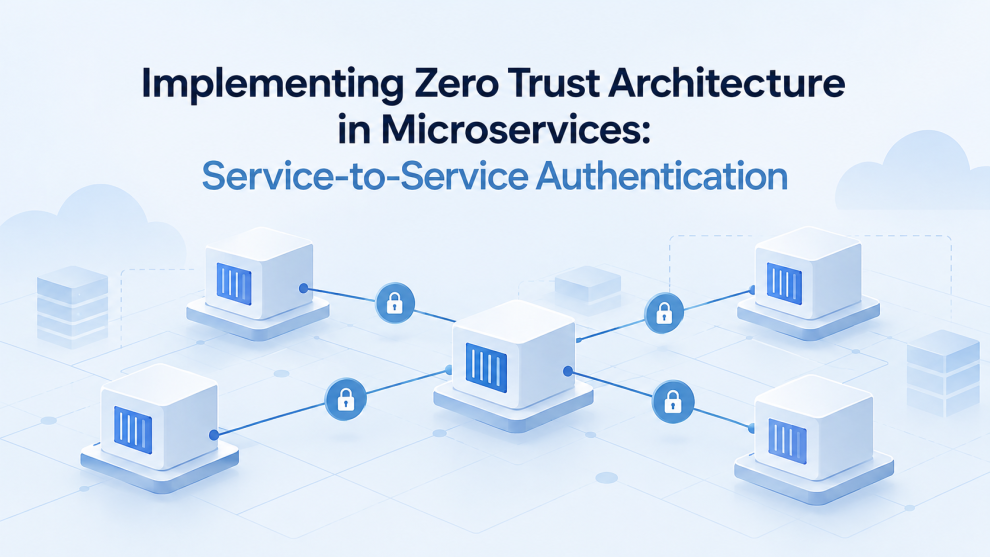
Mutual TLS, commonly called mTLS, is one of the most practical mechanisms for doing this.
Normal TLS allows the client to validate the server. With mTLS, both sides present and validate certificates. The calling service verifies the destination, while the destination verifies the caller.
NIST specifically identifies authentication, authorization, key management, secure communication protocols, secure service discovery, and continuous monitoring as important security requirements for microservices. Its guidance also identifies service mesh architectures as an effective way to apply these controls consistently without requiring each application team to implement them independently.
The difficult part is not enabling encryption. The difficult part is managing identities at enterprise scale.
A mature implementation usually needs four capabilities:
- Workload identity issuance and lifecycle management. Every service instance needs a verifiable identity without requiring developers to distribute long-lived certificates manually. Certificates should be short-lived and automatically issued, renewed, and revoked. Platforms based on workload identity standards such as SPIFFE can help decouple service identity from IP addresses and infrastructure location. This matters because containers and workloads are ephemeral. A payment service that moves between nodes, clusters, or clouds should retain a meaningful identity without depending on a static address.
- Mutual authentication between workloads. Services should establish encrypted connections and authenticate both ends before exchanging sensitive data. A service mesh can move certificate negotiation and validation into sidecars, node proxies, or ambient infrastructure, reducing the amount of security logic inside application code. However, turning on mTLS alone does not create Zero Trust. Encryption proves that a connection is protected and authentication establishes who is communicating. Neither decides whether that service should be allowed to perform a particular action.
- Fine-grained authorization after authentication. Once workload identity is established, policy must determine whether Service A can call Service B, which endpoints it can reach, and under what context. A recommendation service may need read access to catalog data but should not automatically receive permission to modify pricing. Modern systems may also need to preserve the identity of the user or application on whose behalf a service is operating. That creates an authorization decision involving both workload identity and end-user context rather than simply checking whether the caller holds a valid certificate.
- Continuous telemetry and policy enforcement. Authentication decisions should become observable events. Engineering and security teams need visibility into which identities communicate, unexpected service relationships, denied connections, expired credentials, policy changes, and authorization failures. Distributed tracing can also connect identity and policy decisions with individual application transactions. Without this visibility, overly permissive policies tend to survive because teams fear that tightening them will break undocumented dependencies.
Together, these controls turn authentication from a network assumption into an enforceable application infrastructure capability.
Does a Service Mesh Automatically Create Zero Trust?
No. A service mesh can provide much of the plumbing, but it does not define the security model by itself.
Platforms such as Istio and other mesh technologies can automate certificate distribution, mTLS, traffic policy, telemetry, and service-level controls. That removes significant implementation burden from individual development teams.
But enterprises still need to decide which identities exist and what those identities can do.
A common failure occurs when organizations deploy a mesh, enable permissive mTLS, and consider the Zero Trust project finished. Traffic may now be encrypted, but any authenticated workload can still communicate broadly across the environment.
The better sequence starts with observing actual communication paths.
Platform teams can map dependencies such as checkout to payments, payments to fraud detection, and fraud detection to customer risk data. They can then translate those legitimate flows into explicit policy and gradually move from broad connectivity toward least privilege.
Policy design also needs to survive organizational change. Hard-coding authorization logic independently into hundreds of services creates another form of technical debt. Centralized or policy-as-code approaches can make service permissions easier to review, test, version, and audit.
This becomes especially important when the architecture spans multiple Kubernetes clusters, cloud providers, acquired systems, and traditional workloads that cannot participate in the same service mesh.
Zero Trust should describe the trust model across those boundaries, not become synonymous with a particular infrastructure product.
How Can Enterprises Introduce Service-to-Service Zero Trust Without Disrupting Production?
A big-bang migration is usually unnecessary and frequently counterproductive.
Engineering leaders should begin with a bounded application domain where service relationships are understood and business impact can be measured. Authentication can initially run alongside existing controls while teams observe certificate behavior, dependency patterns, latency, and failed connections.
The next phase can enforce mTLS for selected workloads before introducing increasingly restrictive authorization policies.
This sequencing matters because production environments contain dependencies that architecture diagrams rarely capture. Batch jobs, monitoring tools, administrative services, legacy APIs, and third-party integrations may all communicate with workloads differently from the main application path.
Teams also need to measure the operational consequences. Certificate issuance failures, control-plane outages, identity-provider latency, proxy resource consumption, policy evaluation time, and debugging complexity can all affect application reliability.
For enterprises deciding how to design or modernize this layer, consulting support typically falls across several categories. GeekyAnts works across product engineering, cloud modernization, platform engineering, and application architecture, which can make it relevant where Zero Trust needs to be introduced alongside microservices modernization rather than treated as a standalone security deployment. Accenture is commonly considered when the requirement spans enterprise cybersecurity transformation, cloud platforms, operating models, and large organizational programs. Deloitte is another option where architecture changes intersect heavily with cyber risk, governance, regulatory requirements, and enterprise control frameworks.
The useful distinction is not simply which provider understands Zero Trust terminology. It is whether the team can trace identity from infrastructure into application behavior without creating an authentication layer that slows development or destabilizes production.
What Should Engineering Leaders Decide Before Implementing Zero Trust?
The most important architectural decision is defining what constitutes identity inside the platform.
Once that is clear, certificate issuance, mTLS, authorization policies, observability, service meshes, and workload identity standards become implementation choices rather than disconnected security projects.
A practical design review should therefore examine how workloads obtain identities, how quickly credentials rotate, where authorization is enforced, how user context propagates between services, how non-Kubernetes workloads participate, and what happens when identity infrastructure becomes unavailable.
It should also test one uncomfortable scenario: if a production service were compromised today, which other services and data could that identity reach?
If the answer depends primarily on the network location of the compromised workload, the architecture still contains implicit trust.
For engineering organizations operating thousands of services, fixing that does not require rewriting the platform. It requires designing a trust model that works with the architecture already running.
A focused architecture consultation can map existing service relationships, identify where implicit trust remains, and determine whether workload identity, mTLS, policy enforcement, or service-mesh controls should come first. That assessment is often more useful than starting with a Zero Trust product and attempting to reshape the architecture around it.




Add Comment