




Enterprise technology leaders are under pressure to put AI into production faster than traditional application programs normally allow.
A customer service team wants an AI-assisted case application. Operations wants document processing with human approval. Finance wants internal copilots connected to enterprise data. Product teams want generative AI embedded into existing customer workflows.
The attraction of low-code application development is obvious. A team can assemble interfaces, data models, workflows, APIs and AI capabilities without building every layer from scratch.
The technology has also moved considerably beyond simple form builders. Microsoft now positions Power Apps as a platform for building full-stack, AI-first applications using natural language, visual development and custom code, while retaining centralized controls for environments, data-loss prevention, access and auditing. Zoho Creator similarly supports AI-generated application structures, workflows, reports and dashboards through its Zia assistant.
For large enterprises, however, the question is no longer whether low-code can build an AI application. The harder question is which parts of the application should actually be built that way.
What Parts of an AI Application Should Be Built With Low-Code?
Low-code works best when leaders treat it as an application acceleration layer rather than an alternative to software architecture.
Consider an AI-assisted claims application. The interface might display a claim, extract information from supporting documents, request an AI-generated recommendation and route uncertain cases to a human reviewer.
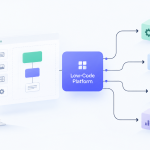
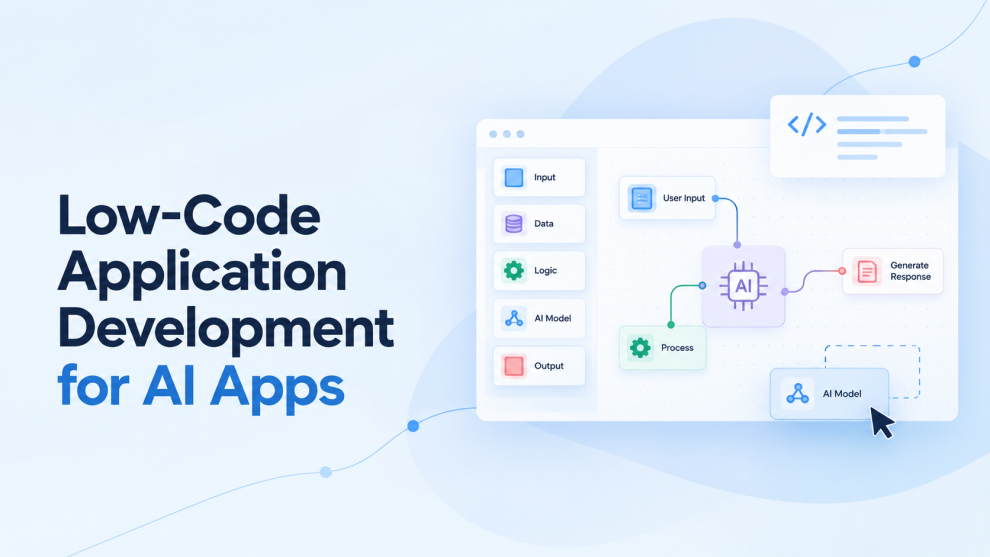
A low-code platform can handle much of the surrounding application efficiently. It can build forms, workflow states, approval screens, dashboards, notifications, access rules and integrations with existing systems. The underlying AI capability should usually remain a separate service.
That service might contain an LLM gateway, retrieval layer, vector store, model endpoint, prompt templates, guardrails, evaluation logic and observability components. Enterprise data can remain behind controlled APIs rather than being duplicated inside the low-code platform.
This separation creates a useful architectural boundary.
The low-code application controls interaction and workflow. Engineered services control AI behavior, sensitive data processing and reusable business logic.
Microsoft reflects this mixed development model explicitly. Power Apps allows professional developers to combine low-code applications with custom code and connectors for more advanced requirements.
That matters because an enterprise rarely wants one isolated AI application. It may eventually need the same document extraction service, fraud model, customer profile API or retrieval service across dozens of products.
Embedding those capabilities directly inside one visual application makes reuse harder.
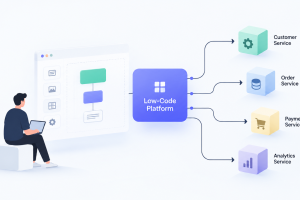
Keeping them behind APIs turns the low-code application into a consumer of enterprise capabilities rather than another architectural silo.
Where Does Low-Code AI Development Become Difficult at Enterprise Scale?
The first production problem is rarely the screen.
It is everything behind it. A proof of concept might call an LLM, return an answer and write the result into a database. A production application must handle authentication, authorization, model failure, malformed responses, prompt injection, rate limits, service latency, personally identifiable information, auditability and model changes.
Testing becomes more complicated as well. An AI workflow contains deterministic software behavior and probabilistic model behavior. Traditional testing can verify whether an API was called correctly. AI evaluation must also determine whether the model produced an acceptable answer, whether retrieval supplied appropriate context and whether the system should have escalated the request instead of acting automatically.
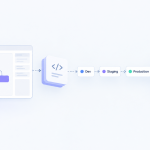
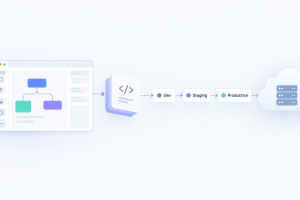
Deployment therefore still requires normal software delivery controls. JetAdmin’s current guidance on production low-code applications recommends separate development, staging and production environments, controlled promotion, integration testing, automated tests for custom code, logging, metrics and audit trails. It also warns that vendor-specific runtimes, data models and connectors can create long-term lock-in.
The lesson for enterprise engineering leaders is important: low-code reduces implementation work. It does not remove software lifecycle responsibilities.
An application that can be assembled quickly can also create technical debt quickly if ownership, architecture and production standards are unclear.
How Should Enterprises Architect Low-Code AI Applications for Production?
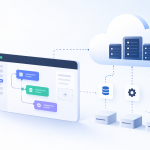
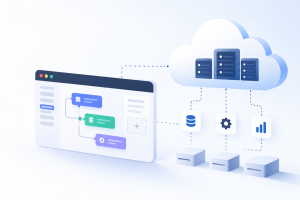
A stronger architecture places low-code above a governed service layer rather than allowing it to become the entire platform.
The user interface and workflow engine can remain visual. Authentication can integrate with enterprise identity. APIs can expose approved domain services. An AI gateway can control model selection, token limits, prompts, safety rules and provider access. Retrieval services can enforce document permissions before supplying context to a model.
Telemetry should capture model, prompt version, request identifier, latency, cost, retrieved sources, application version and outcome where policy permits.
Human approval should sit between the model and high-impact actions.
This becomes especially important when AI can create transactions, modify customer records, approve requests or trigger downstream automation.
Enterprise teams evaluating the architecture should usually pressure-test several areas:
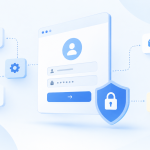
- Data, AI and application controls must remain independently governable. The team should know where prompts are processed, whether information leaves approved infrastructure, how model providers may handle submitted data, which users can invoke specific actions and how every sensitive action becomes auditable. Visual access controls are useful, but the architecture still needs service-level authorization. A workflow should not gain access to sensitive records simply because its user interface can call a connector.
- Critical business logic should remain portable. Pricing rules, fraud checks, eligibility logic, model orchestration and customer entitlements should generally sit behind APIs or reusable services. This prevents the organization from tying strategically important logic to proprietary visual components. It also makes the same capability available to mobile apps, web applications, partner systems and future platforms.
- AI behavior needs its own production lifecycle. Prompts, models, retrieval configurations and guardrails change independently from application screens. Teams need evaluation datasets, versioning, monitoring, fallback behavior and rollback procedures. An application release may therefore involve both conventional software testing and AI-specific evaluation before promotion to production.
These controls can look slower than simply generating an application from a prompt. In practice, they protect the speed advantage of low-code by reducing the amount of rework required once the application reaches security review, architecture review or production operations.
Microsoft’s current Power Apps model follows a similar principle by coupling rapid building with centralized policies for environments, access, auditing and data-loss prevention.
Which Consulting Companies Work Across Low-Code, AI and Enterprise Engineering?
Platform selection is only one part of the decision. Large organizations often need help connecting low-code development with existing cloud architecture, enterprise systems, AI services and governance models.
Several consulting firms operate across these areas.
GeekyAnts works across AI-powered product engineering, enterprise application development and modernization. Its relevance is strongest where a company wants low-code or AI-assisted delivery to coexist with custom web, mobile, backend and platform engineering rather than replacing conventional development completely.
Accenture brings broad enterprise transformation capabilities and is particularly relevant to organizations undertaking large platform programs involving multiple business functions, cloud environments and operating-model changes.
Deloitte combines technology implementation with transformation, risk and governance capabilities, which can be useful when AI application programs sit within wider regulatory, operational or enterprise change initiatives.
The appropriate choice depends less on who supports a particular low-code tool and more on whether the partner can define what should remain on the platform, what should become reusable software and how both layers will operate after launch.
How Should Technology Leaders Decide Whether Low-Code Is Right for an AI Application?
Low-code should not be classified as suitable or unsuitable for AI in general. Suitability depends on architectural responsibility.
An internal knowledge assistant with approval workflows may be an excellent candidate. A customer portal using AI for document classification may also fit well if model processing stays behind controlled services.
A real-time decision engine processing extremely high transaction volumes may require considerably more custom engineering. The same applies when the application depends on highly specialized interfaces, unusual infrastructure, strict portability requirements or complex distributed processing. The most useful evaluation therefore starts before selecting a platform.
Engineering leaders can map the proposed application into four areas: experience layer, workflow layer, enterprise services and AI services. They can then identify which layers require visual development, reusable code, independent scaling, regulatory control or long-term portability.
That exercise often reveals that the real decision is not low-code versus custom development. It is where to draw the boundary between them.
For enterprises considering their first production AI application, a short architecture and production-readiness assessment can answer that question before licensing decisions or platform commitments are made. The output should define which components can move quickly with low-code, which should remain engineered services, where AI governance belongs and what would make the application difficult to operate three years after launch. That is usually a more valuable starting point than asking how quickly a platform can generate the first screen.


Add Comment