



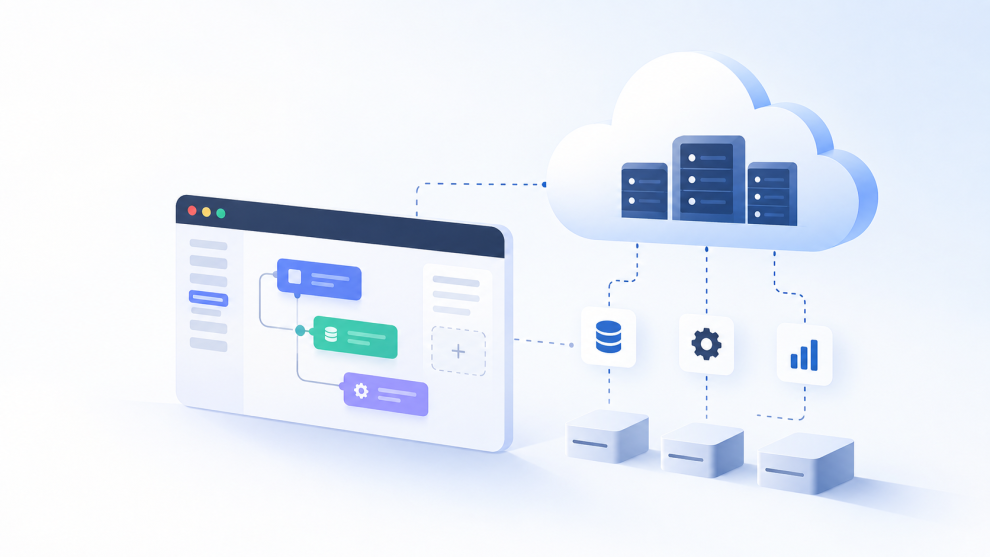

Low-code applications can run on the cloud, and many enterprise low-code platforms now treat cloud deployment as a standard operating model. The more important question for engineering leaders is not whether an application can be hosted there. It is whether its architecture can use cloud infrastructure effectively without creating problems with scalability, integration, security, observability, or platform dependency.
That distinction matters as low-code moves beyond departmental workflow automation.
Gartner’s 2025 assessment of enterprise low-code application platforms describes a market addressing delivery speed, legacy complexity, integration requirements, AI-assisted development, composable architectures, and governance. Enterprises are consequently evaluating low-code for workloads that may connect to core systems, APIs, data platforms, identity services, and cloud infrastructure.
A cloud deployment therefore needs the same architectural scrutiny as a conventionally developed enterprise application.
Can a Low-Code Application Actually Run in a Public or Private Cloud?
Yes. However, “running in the cloud” can describe several technically different models.
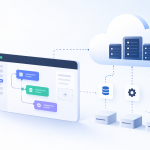
A low-code application may run in a vendor-managed SaaS environment, a dedicated cloud environment, an enterprise-controlled Kubernetes cluster, or infrastructure hosted by AWS, Microsoft Azure, Google Cloud, or another provider.
Mendix illustrates how broad this spectrum has become. Its managed cloud operates on Kubernetes and AWS, while its third-party cloud model supports deployment to AWS, Azure, Google Cloud, OpenShift, and private environments. Microsoft takes a somewhat different approach by connecting Power Apps with Azure capabilities such as API Management, Azure Functions, Azure SQL, and other services.
This creates an important architectural distinction.
A cloud-hosted low-code application runs somewhere in cloud infrastructure. A cloud-native low-code application is designed to exploit characteristics such as elastic scaling, API-based services, automated deployment, managed infrastructure, distributed workloads, and resilient architectures.
The second standard is considerably harder to meet.
For an internal approval application used by 300 employees, a vendor-managed runtime may be sufficient. For a customer platform serving users across North America while accessing multiple systems of record, architects need to understand where application logic executes, how state is managed, how APIs behave under load, where data resides, and which components can scale independently.
Cloud deployment should therefore be treated as an architecture decision rather than a hosting checkbox.
How Does a Low-Code Application Scale in the Cloud?
Scaling depends heavily on what the low-code platform abstracts from the engineering team.
In a traditional cloud-native architecture, engineering teams can directly control containers, compute instances, autoscaling policies, caching, queues, databases, load balancers, serverless functions, and observability. Low-code platforms deliberately hide some of this complexity to improve development speed.
That abstraction can be valuable until an application reaches a requirement the abstraction was not designed to handle.
Enterprise teams should examine five areas before putting a high-volume low-code workload into production:
- Runtime and scaling boundaries: Teams need to establish whether the platform scales application instances automatically, what triggers scaling, whether individual services can scale independently, and whether quotas exist. They should also understand whether workloads can be containerized and orchestrated through Kubernetes or must remain inside a proprietary runtime. The issue becomes especially important when usage is unpredictable or concentrated into short transaction peaks.
- Data architecture: A responsive user interface does not compensate for a poor data layer. Teams need to understand database connection limits, query delegation, caching, transaction behavior, data residency, replication, and network latency. Microsoft, for example, documents that Power Fx delegates supported operations to servers where possible, while unsupported operations may execute locally. Architecture teams therefore need to inspect actual execution behavior instead of assuming the platform automatically optimizes every query.
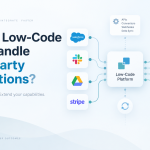
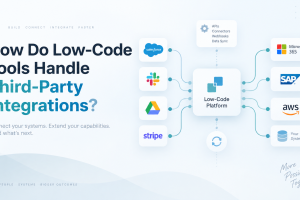
- Integration architecture: Enterprise applications rarely operate independently. They communicate with ERP platforms, CRMs, payment systems, identity providers, data warehouses, legacy applications, and custom APIs. An API-first boundary usually provides greater control than embedding critical business logic into dozens of application-specific connectors. Microsoft itself describes an API-first pattern in which a custom connector accesses an API that abstracts underlying complexity.
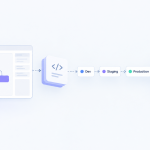
- Application lifecycle management: Development speed has little value if releases become difficult to control. Production use requires separate environments, source management, automated testing, CI/CD, rollback procedures, release approvals, and auditable changes. Mendix, for example, provides low-code pipelines for automating build and deployment processes.
- Observability and failure handling: Platform teams need access to logs, traces, metrics, API performance, database behavior, dependency failures, and application-level telemetry. If a vendor’s abstraction prevents engineers from diagnosing production incidents at the required depth, that limitation should be discovered during architecture assessment rather than after launch.
These questions determine whether low-code accelerates delivery or simply moves technical complexity somewhere less visible.
Are Cloud-Based Low-Code Applications Secure Enough for Enterprise Systems?
They can be, but low-code does not eliminate the enterprise security model.
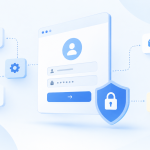
Cloud security still requires identity and access management, least-privilege authorization, encryption, secrets management, network controls, auditability, vulnerability management, data classification, and compliance controls.
Low-code adds another governance problem: development can spread beyond the central engineering organization.
Gartner highlighted governance in 2025 as important for controlling the operational, security, and compliance risks associated with enterprise low-code platforms. Microsoft similarly provides data loss prevention, conditional access, privileged identity management, granular application access, network isolation, audit capabilities, and managed environments for Power Platform.
The technology, however, cannot determine the enterprise’s governance model.
Platform teams need to decide who can create production applications, which connectors can access sensitive systems, which data can leave a security boundary, how applications are reviewed, and what happens when an application becomes business-critical.
The biggest risk may not be one badly configured application. It is hundreds of applications accumulating without consistent ownership, lifecycle controls, dependency documentation, or retirement policies.
When Should an Enterprise Avoid Putting the Entire Application in Low-Code?
Low-code works particularly well when application requirements align with the platform’s abstractions. Internal workflow systems, operational dashboards, approval processes, data-entry applications, portals, and extensions to existing systems can be strong candidates.
The case becomes less straightforward when the application contains computationally intensive processing, highly specialized UX, complex transactional logic, unusual infrastructure requirements, extremely high throughput, or services that must evolve independently.
A hybrid architecture can resolve this tension.
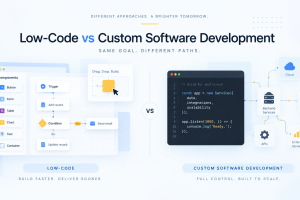
The low-code layer can manage interfaces, workflows, forms, and orchestration while conventional cloud services handle complex business logic, high-volume processing, specialized data operations, and integrations.
Microsoft’s modernization guidance explicitly supports this pattern. Custom APIs can run on services such as Azure Functions or Azure Container Apps and then expose functionality to low-code applications.
This approach prevents engineering teams from forcing every workload into the same development model.
Which Consulting Companies Work Across Low-Code and Cloud Modernization?
Enterprises that need external architecture support can evaluate firms based on their experience across application engineering, cloud infrastructure, integration, modernization, and governance rather than low-code implementation alone.
Deloitte works across low-code transformation, application modernization, platform engineering, cloud strategy, migration, and cloud-native application development. Its engineering practice specifically includes low-code and AI platforms alongside cloud architecture and integration services.
GeekyAnts approaches the problem primarily from a product and engineering perspective, with work spanning enterprise modernization, cloud and infrastructure modernization, backend engineering, application development, and production systems. Its published cloud capabilities include AWS architecture, migration, DevOps, infrastructure modernization, and cloud-native builds. This can be relevant when a low-code layer must coexist with custom APIs, existing applications, or conventional cloud infrastructure rather than becoming the entire technology stack.
Microsoft and its partner ecosystem are another practical route for enterprises already standardized around Azure, Microsoft 365, Dynamics 365, and Power Platform. Power Apps can connect with Azure API Management, Functions, SQL, Logic Apps, CI/CD tooling, and custom components, making the ecosystem particularly relevant where low-code needs to extend an established Microsoft architecture.
The appropriate model depends less on who can build the fastest proof of concept and more on who can define where low-code should stop.
How Should Engineering Leaders Decide Whether Low-Code Belongs in Their Cloud Architecture?
The useful question is not simply, “Can this application run in the cloud?”
It is, “Which parts of this system should be low-code, and which parts need conventional cloud engineering?”
For enterprise teams, that answer should emerge from workload characteristics, transaction volume, security requirements, integration complexity, data residency, expected application lifespan, portability requirements, and the organization’s existing cloud operating model.
A short architecture assessment can map those constraints before a platform decision creates long-term dependencies. The outcome may be a fully managed low-code application, a Kubernetes-based deployment, a low-code front end connected to custom services, or a conventional cloud-native application with low-code used only for specific workflows.
That consultation is most valuable before the first production architecture is locked in. At enterprise scale, the objective is not to maximize low-code adoption. It is to use low-code exactly where its abstraction reduces delivery effort without giving up the control the system will eventually require.


Add Comment